QUESTION IMAGE
Question
question 5 of 10
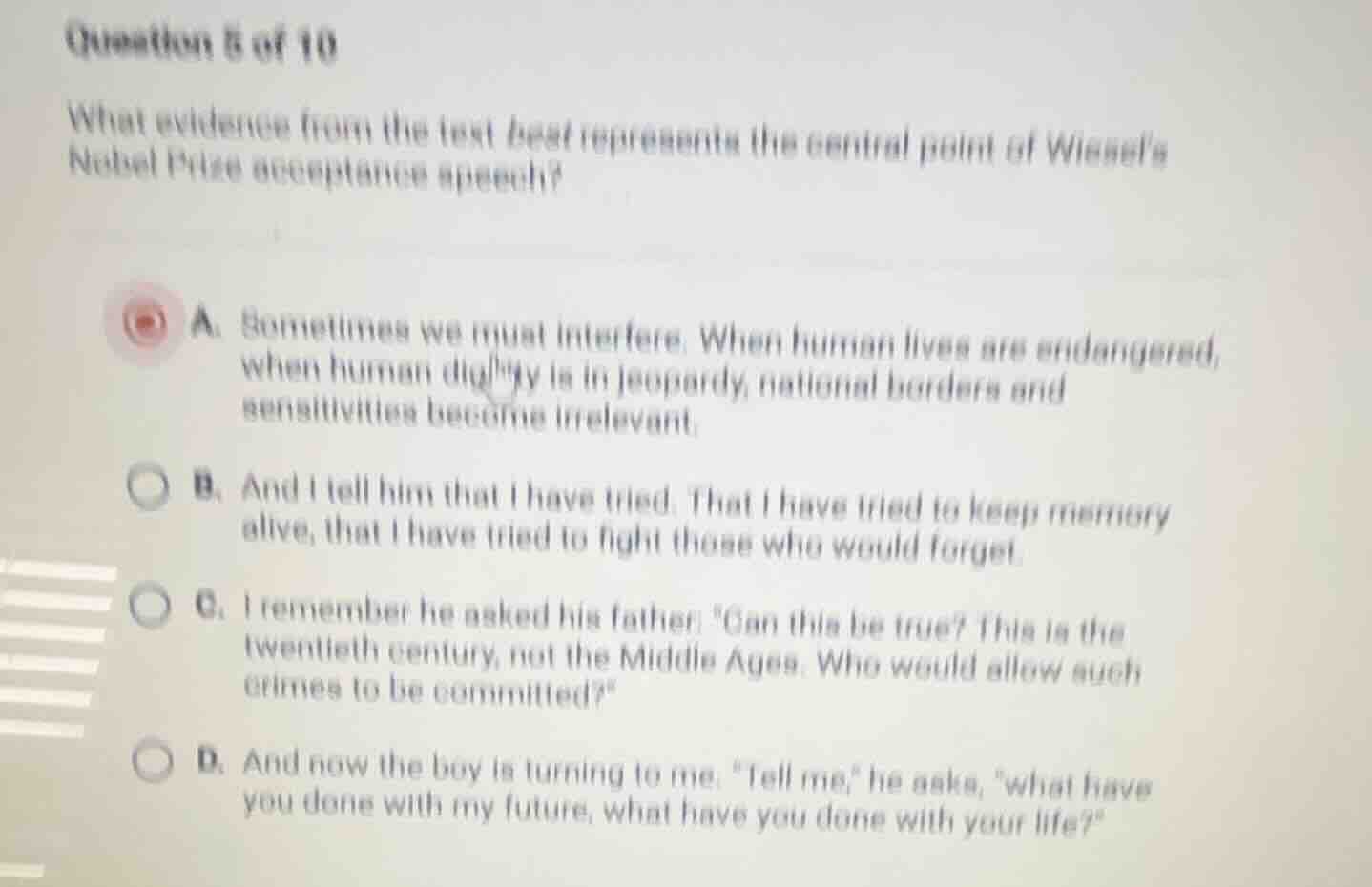
what evidence from the text best represents the central point of wiesels nobel prize acceptance speech?
a. sometimes we must interfere. when human lives are endangered, when human dignity is in jeopardy, national borders and sensitivities become irrelevant.
b. and i tell him that i have tried. that i have tried to keep memory alive, that i have tried to fight those who would forget.
c. i remember he asked his father, \can this be true? this is the twentieth century, not the middle ages. who would allow such crimes to be committed?\
d. and now the boy is turning to me. \tell me,\ he asks, \what have you done with my future, what have you done with your life?\
Elie Wiesel's Nobel Prize acceptance speech emphasizes the moral obligation to interfere when human lives and dignity are at stake, transcending national boundaries. Option A directly addresses this central theme of taking action for human rights, while B focuses on memory, C on questioning atrocities, and D on personal accountability to the next generation. A aligns best with the speech's call for intervention in the face of human suffering.

Snap & solve any problem in the app
Get step-by-step solutions on Sovi AI
Photo-based solutions with guided steps
Explore more problems and detailed explanations
A. Sometimes we must interfere. When human lives are endangered, when human dignity is in jeopardy, national borders and sensitivities become irrelevant.