QUESTION IMAGE
Question
question 2 of 10
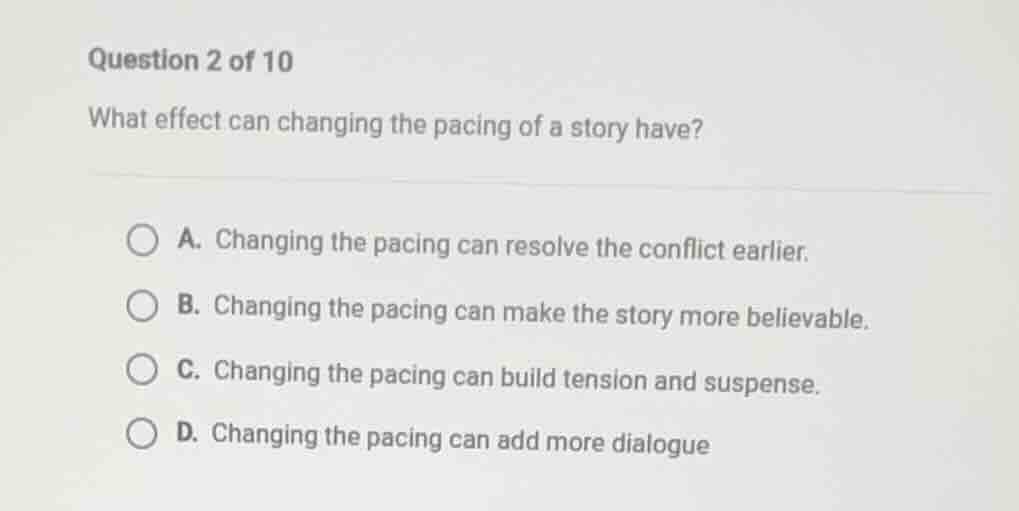
what effect can changing the pacing of a story have?
a. changing the pacing can resolve the conflict earlier.
b. changing the pacing can make the story more believable.
c. changing the pacing can build tension and suspense.
d. changing the pacing can add more dialogue
Analyze the definition of narrative pacing
Pacing refers to how fast or slow a story unfolds. Writers manipulate pacing by adjusting sentence length, word choice, and the level of detail provided in a scene.
Evaluate the effects of pacing on the reader
Slowing down the pace by adding sensory details or internal monologue stretches out a moment, which builds suspense and anticipation. Speeding up the pace with short sentences and rapid action increases excitement. Therefore, changing the pacing directly influences the emotional intensity, tension, and suspense of a narrative.
Assess the given multiple-choice options
- Option A: Pacing controls speed, not the structural placement of conflict resolution.
- Option B: Believability depends on characterization, logic, and world-building, not speed.
- Option C: Adjusting the speed of events directly builds tension and suspense.
- Option D: Dialogue is a tool used to change pacing, not an effect of changing it.

Snap & solve any problem in the app
Get step-by-step solutions on Sovi AI
Photo-based solutions with guided steps
Explore more problems and detailed explanations
- A. Changing the pacing can resolve the conflict earlier.
- B. Changing the pacing can make the story more believable.
- C. Changing the pacing can build tension and suspense. (Correct answer)
- D. Changing the pacing can add more dialogue