QUESTION IMAGE
Question
question 1 of 10
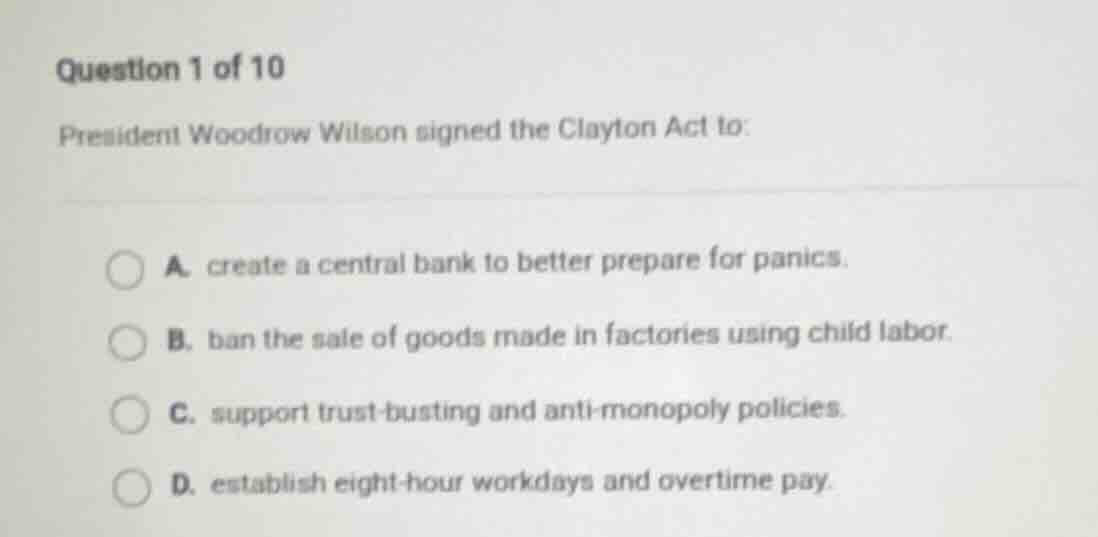
president woodrow wilson signed the clayton act to:
a. create a central bank to better prepare for panics.
b. ban the sale of goods made in factories using child labor.
c. support trust-busting and anti-monopoly policies.
d. establish eight-hour workdays and overtime pay.
Identify the purpose of the Clayton Act
The question asks why President Woodrow Wilson signed the Clayton Antitrust Act of 1914. This key Progressive Era legislation was designed to strengthen the Sherman Antitrust Act of 1890 by clearly defining and prohibiting specific monopolistic business practices, such as price discrimination and interlocking directorates.
Evaluate the given options
- Option A refers to the Federal Reserve Act of 1913, which established the Federal Reserve System to manage the nation's monetary policy and stabilize the banking system.
- Option B refers to child labor legislation, such as the Keating-Owen Act of 1916, rather than antitrust laws.
- Option C directly aligns with the Clayton Act's primary objective, which was to curb the power of monopolies and support trust-busting efforts while also protecting labor unions from being targeted as trusts.
- Option D refers to labor reforms like the Adamson Act of 1916, which established an eight-hour workday for railroad employees.
Formulate the final conclusion
The Clayton Antitrust Act was a cornerstone of Wilson's "New Freedom" platform, specifically aimed at promoting fair competition and preventing unfair business practices. Therefore, the correct option is C.

Snap & solve any problem in the app
Get step-by-step solutions on Sovi AI
Photo-based solutions with guided steps
Explore more problems and detailed explanations
- (A) create a central bank to better prepare for panics.
- (B) ban the sale of goods made in factories using child labor.
- (C) support trust-busting and anti-monopoly policies. (Correct answer)
- (D) establish eight-hour workdays and overtime pay.