QUESTION IMAGE
Question
question 2 of 10
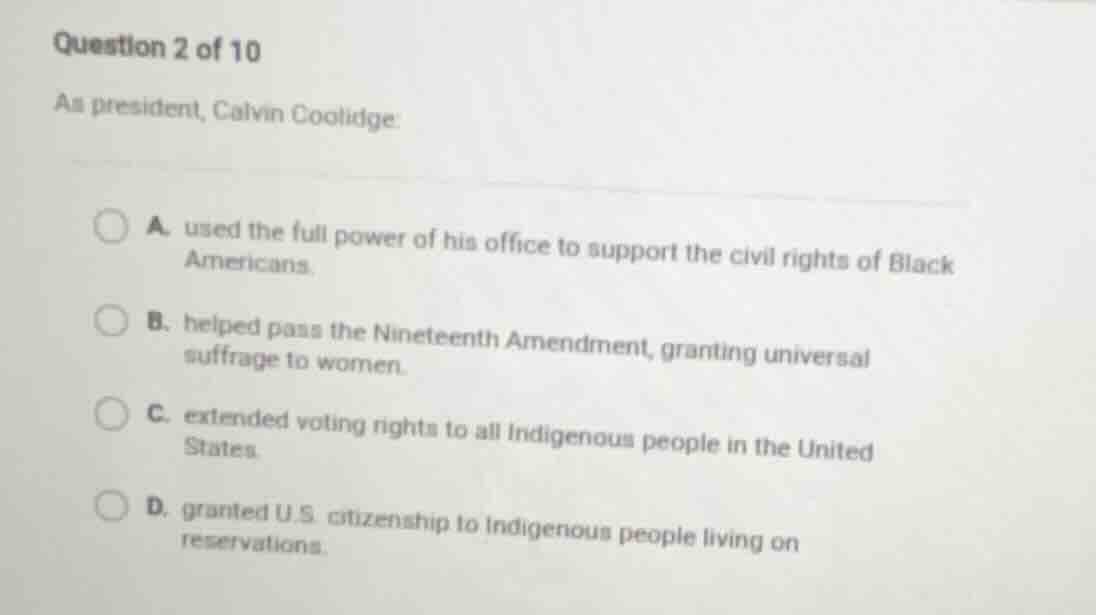
as president, calvin coolidge:
a. used the full power of his office to support the civil rights of black americans.
b. helped pass the nineteenth amendment, granting universal suffrage to women.
c. extended voting rights to all indigenous people in the united states.
d. granted u.s. citizenship to indigenous people living on reservations.
Analyze the historical context of Calvin Coolidge's presidency
Calvin Coolidge served as President of the United States from 1923 to 1929. To evaluate the options, we must examine his administration's major legislative actions regarding civil rights, women's suffrage, and Indigenous peoples.
Evaluate the options regarding civil rights and women's suffrage
- Option A: While Coolidge spoke in favor of civil rights for Black Americans and supported federal anti-lynching legislation, he did not "use the full power of his office" to actively enforce or achieve major civil rights breakthroughs during his term.
- Option B: The Nineteenth Amendment, which granted women the right to vote, was ratified in 1920 during Woodrow Wilson's presidency, before Coolidge took office.
Evaluate the options regarding Indigenous rights
- Option C: While Coolidge signed the Indian Citizenship Act of 1924, this act did not automatically extend voting rights to all Indigenous people. Voting rights were still largely determined by individual state laws, and many states continued to disenfranchise Native Americans for decades.
- Option D: On June 2, 1924, President Calvin Coolidge signed the Indian Citizenship Act (also known as the Snyder Act). This landmark legislation granted full U.S. citizenship to all non-citizen Indigenous people born within the territorial limits of the United States, including those living on reservations, who had previously been excluded. This aligns with the historical reality of his presidency under Indigenous History.

Snap & solve any problem in the app
Get step-by-step solutions on Sovi AI
Photo-based solutions with guided steps
Explore more problems and detailed explanations
- A. used the full power of his office to support the civil rights of Black Americans.
- B. helped pass the Nineteenth Amendment, granting universal suffrage to women.
- C. extended voting rights to all Indigenous people in the United States.
- D. granted U.S. citizenship to Indigenous people living on reservations. (Correct answer)