QUESTION IMAGE
Question
question 5 of 10
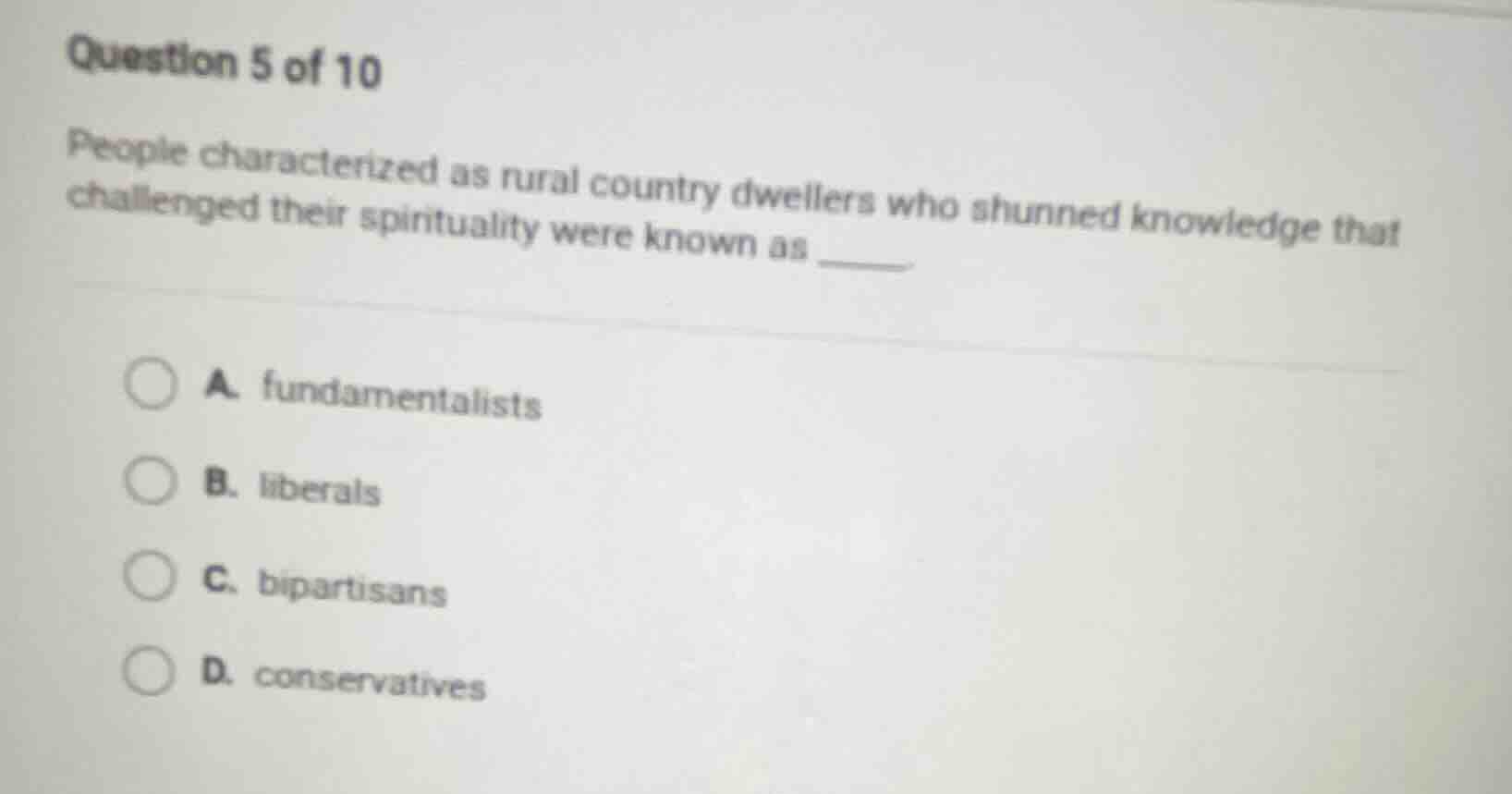
people characterized as rural country dwellers who shunned knowledge that challenged their spirituality were known as _______
a. fundamentalists
b. liberals
c. bipartisans
d. conservatives
Analyze the question prompt
The question asks for the term used to describe "people characterized as rural country dwellers who shunned knowledge that challenged their spirituality." This description refers to a specific cultural and religious group in United States history, particularly prominent during the social and cultural conflicts of the 1920s (such as the Scopes Trial).
Evaluate the answer choices
- A. fundamentalists: Religious fundamentalism, particularly Christian fundamentalism in the early 20th century, was heavily concentrated in rural areas. Fundamentalists insisted on a literal interpretation of the Bible and actively rejected modern scientific theories, such as evolution, that they felt threatened or challenged their traditional spiritual beliefs.
- B. liberals: Liberals generally embraced modern science, secularism, and progressive ideas, integrating them with their worldview rather than shunning them to protect traditional spirituality.
- C. bipartisans: This is a political term referring to cooperation between two opposing political parties, which is irrelevant to the described religious and cultural demographic.
- D. conservatives: While many fundamentalists held conservative views, "conservatives" is a broad political and social term that does not specifically denote the rejection of modern knowledge to protect literal religious spirituality in the way "fundamentalists" does in this historical context.
Determine the correct option
The term that most precisely fits the description of individuals shunning modern scientific knowledge (like Darwinian evolution) to preserve their literal spiritual beliefs during this historical era is fundamentalists.

Snap & solve any problem in the app
Get step-by-step solutions on Sovi AI
Photo-based solutions with guided steps
Explore more problems and detailed explanations
- (A) fundamentalists (Correct answer)
- (B) liberals
- (C) bipartisans
- (D) conservatives