QUESTION IMAGE
Question
question 9 of 10
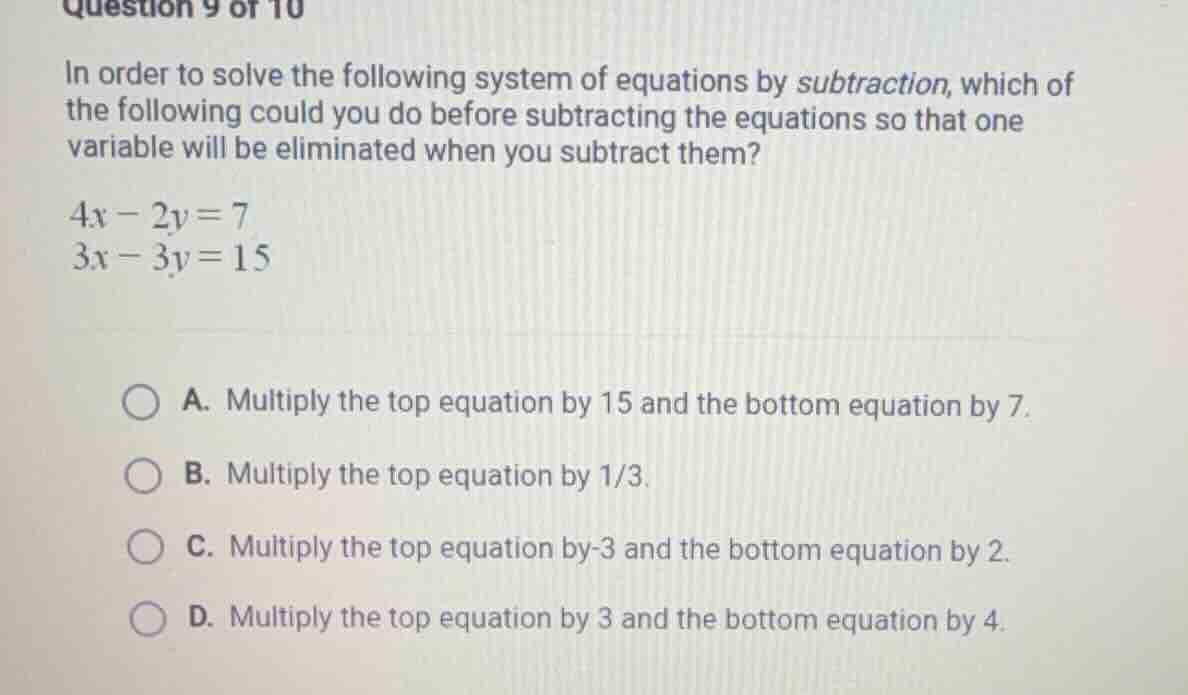
in order to solve the following system of equations by subtraction, which of
the following could you do before subtracting the equations so that one
variable will be eliminated when you subtract them?
$4x - 2y = 7$
$3x - 3y = 15$
a. multiply the top equation by 15 and the bottom equation by 7.
b. multiply the top equation by 1/3.
c. multiply the top equation by -3 and the bottom equation by 2.
d. multiply the top equation by 3 and the bottom equation by 4.
To eliminate a variable when subtracting the equations, we need the coefficients of one variable to be equal (or negatives) after manipulation. Let's analyze each option:
Step1: Analyze Option A
Multiplying top by 15 and bottom by 7: \(15(4x - 2y)=15\times7\) → \(60x - 30y = 105\); \(7(3x - 3y)=7\times15\) → \(21x - 21y = 105\). Coefficients of \(x\) (60 vs 21) and \(y\) (-30 vs -21) are not equal. Not helpful.
Step2: Analyze Option B
Multiplying top by \(1/3\): \(\frac{1}{3}(4x - 2y)=\frac{7}{3}\) → \(\frac{4}{3}x - \frac{2}{3}y=\frac{7}{3}\). Bottom equation remains \(3x - 3y = 15\). Coefficients of \(x\) (\(\frac{4}{3}\) vs 3) and \(y\) (\(-\frac{2}{3}\) vs -3) not equal. Not helpful.
Step3: Analyze Option C
Multiplying top by -3: \(-3(4x - 2y)=-3\times7\) → \(-12x + 6y = -21\); Multiplying bottom by 2: \(2(3x - 3y)=2\times15\) → \(6x - 6y = 30\). Now, coefficients of \(y\) are 6 and -6 (negatives). When we subtract, \(y\) will be eliminated. Let's check: \((-12x + 6y) - (6x - 6y)= -21 - 30\) → \(-18x + 12y = -51\)? Wait, no—wait, subtraction: \((-12x + 6y) - (6x - 6y)= -12x + 6y -6x +6y = -18x +12y\)? Wait, no, maybe I messed up. Wait, actually, if we have \(-12x + 6y\) and \(6x - 6y\), adding them would eliminate \(y\), but the question is about subtraction. Wait, maybe I made a mistake. Wait, let's check Option D.
Step4: Analyze Option D
Multiplying top by 3: \(3(4x - 2y)=3\times7\) → \(12x - 6y = 21\); Multiplying bottom by 4: \(4(3x - 3y)=4\times15\) → \(12x - 12y = 60\). Now, coefficients of \(x\) are both 12. So when we subtract the two equations: \((12x - 6y) - (12x - 12y)=21 - 60\) → \(0x + 6y = -39\), which eliminates \(x\). Wait, but the question is about subtraction to eliminate a variable. Wait, let's re-examine the options. Wait, maybe I misread Option C. Wait, Option C: top by -3, bottom by 2. Top becomes \(-12x + 6y = -21\), bottom becomes \(6x - 6y = 30\). Now, if we subtract the bottom from the top: \((-12x + 6y) - (6x - 6y)= -21 - 30\) → \(-18x + 12y = -51\). Not helpful. But if we subtract the top from the bottom: \((6x - 6y) - (-12x + 6y)=30 - (-21)\) → \(18x -12y = 51\). Still not eliminating. Wait, maybe I made a mistake. Wait, the goal is to have one variable's coefficients equal (so that subtraction eliminates it). Let's check the coefficients of \(x\) and \(y\) in original equations:
Original equations: \(4x - 2y =7\) (Equation 1), \(3x - 3y =15\) (Equation 2).
For \(x\): coefficients 4 and 3. LCM of 4 and 3 is 12. So multiply Equation 1 by 3 (4×3=12) and Equation 2 by 4 (3×4=12). Then Equation 1: \(12x - 6y =21\), Equation 2: \(12x - 12y =60\). Now, subtract Equation 2 from Equation 1: \((12x -6y) - (12x -12y)=21 -60\) → \(6y = -39\), which eliminates \(x\). That's Option D. Wait, but earlier I thought Option C was about \(y\), but let's check \(y\) coefficients: -2 and -3. LCM of 2 and 3 is 6. So multiply Equation 1 by 3: \(12x -6y =21\), Equation 2 by 2: \(6x -6y =30\). Then subtract: \((12x -6y)-(6x -6y)=21 -30\) → \(6x = -9\), which eliminates \(y\). Wait, but Option D is multiply top by 3 and bottom by 4, which gives \(x\) coefficients 12 and 12. Option C: multiply top by -3 and bottom by 2: top becomes \(-12x +6y = -21\), bottom becomes \(6x -6y =30\). If we add them, we get \(-6x =9\), which eliminates \(y\), but the question is about subtraction. Wait, maybe the question allows for subtraction that could be equivalent to addition (if we subtract a negative). Wait, let's re-express the elimination method. The elimination method (subtraction) works when we have two equations, and…

Snap & solve any problem in the app
Get step-by-step solutions on Sovi AI
Photo-based solutions with guided steps
Explore more problems and detailed explanations
D. Multiply the top equation by 3 and the bottom equation by 4.