QUESTION IMAGE
Question
question 8 of 10
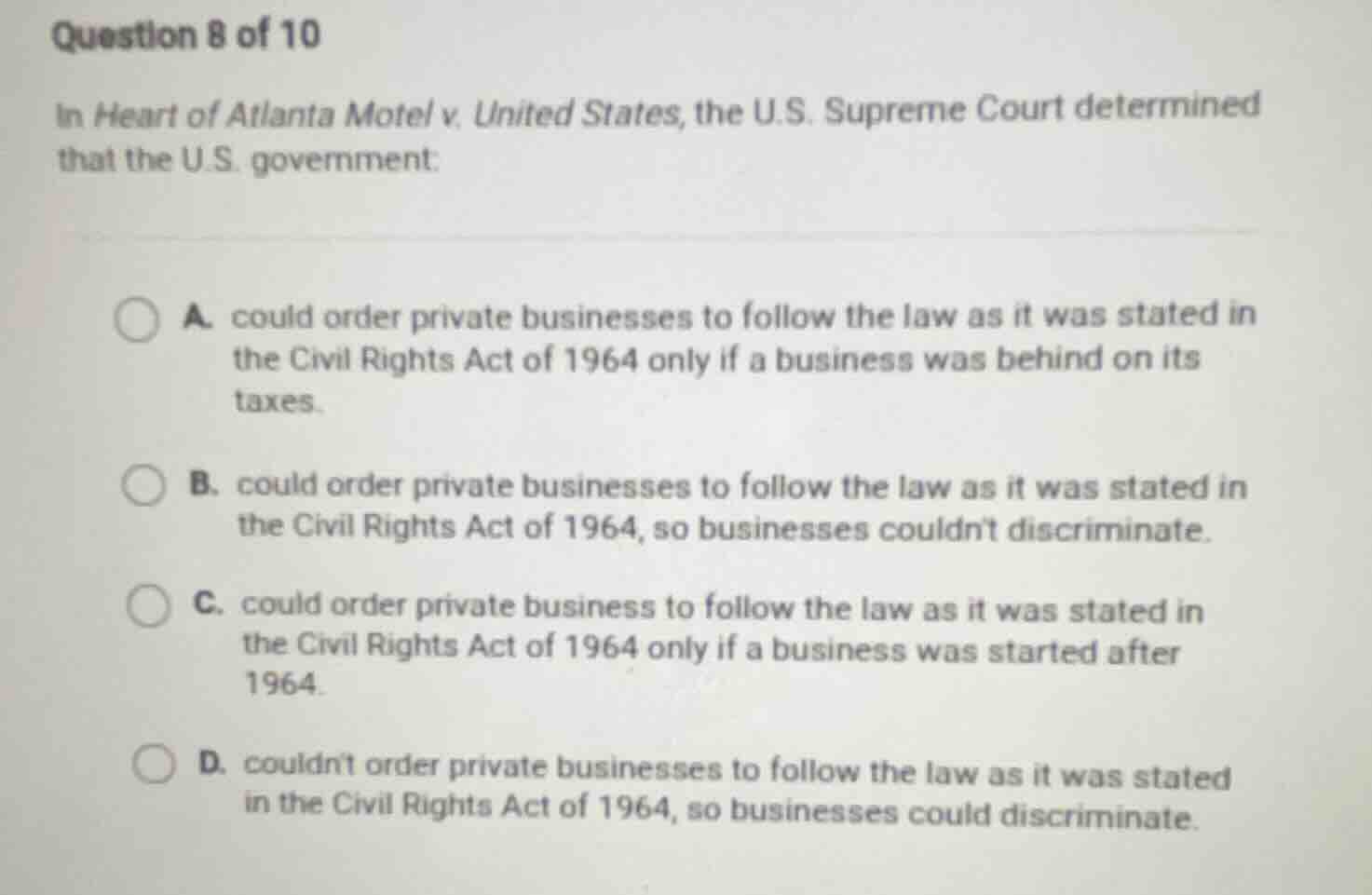
in heart of atlanta motel v. united states, the u.s. supreme court determined that the u.s. government:
a. could order private businesses to follow the law as it was stated in the civil rights act of 1964 only if a business was behind on its taxes.
b. could order private businesses to follow the law as it was stated in the civil rights act of 1964, so businesses couldnt discriminate.
c. could order private business to follow the law as it was stated in the civil rights act of 1964 only if a business was started after 1964.
d. couldnt order private businesses to follow the law as it was stated in the civil rights act of 1964, so businesses could discriminate.
Analyze the legal question
The question asks about the U.S. Supreme Court's ruling in the landmark case Heart of Atlanta Motel v. United States (1964) regarding the federal government's authority.
Examine the historical context
In 1964, Congress passed the Civil Rights Act of 1964, which banned racial discrimination in public accommodations. The Heart of Atlanta Motel refused to rent rooms to African Americans and challenged the constitutionality of this law, arguing Congress had exceeded its authority.
Evaluate the Supreme Court's decision
The Supreme Court ruled unanimously that the federal government could use the Constitution's Commerce Clause to force private businesses to abide by the Civil Rights Act of 1964. Because the motel served interstate travelers, its discriminatory practices affected interstate commerce. Therefore, the government could order private businesses to follow the law so they could not discriminate.
Compare the options
- A is incorrect because tax status was not a condition for enforcing civil rights compliance.
- B is correct because the Court upheld the government's power to forbid racial discrimination in public accommodations.
- C is incorrect because the law applied to existing businesses, not just those started after 1964.
- D is incorrect because the Court ruled that the government could order private businesses to follow the law.

Snap & solve any problem in the app
Get step-by-step solutions on Sovi AI
Photo-based solutions with guided steps
Explore more problems and detailed explanations
- (A) could order private businesses to follow the law as it was stated in the Civil Rights Act of 1964 only if a business was behind on its taxes.
- (B) could order private businesses to follow the law as it was stated in the Civil Rights Act of 1964, so businesses couldn't discriminate. (Correct answer)
- (C) could order private business to follow the law as it was stated in the Civil Rights Act of 1964 only if a business was started after 1964.
- (D) couldn't order private businesses to follow the law as it was stated in the Civil Rights Act of 1964, so businesses could discriminate.