QUESTION IMAGE
Question
question 4 of 10
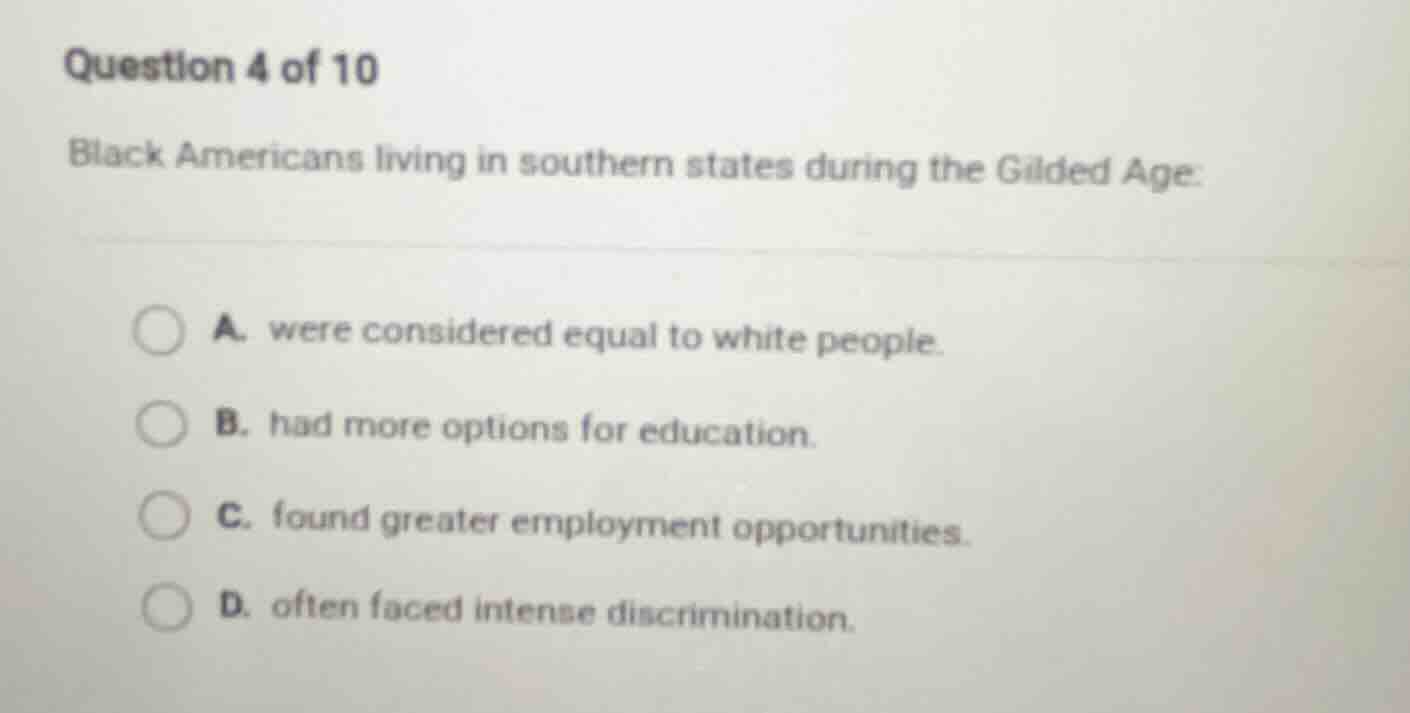
black americans living in southern states during the gilded age:
a. were considered equal to white people.
b. had more options for education.
c. found greater employment opportunities.
d. often faced intense discrimination.
Analyze the historical context
The question asks about the experiences of Black Americans living in southern states during the Gilded Age (late 19th century, roughly 1870s to 1900). Following the end of Reconstruction in 1877, white Southern Democrats regained political control of the South and systematically dismantled the civil and political rights that African Americans had gained.
Evaluate the options
- A. were considered equal to white people. This is historically incorrect. The rise of Racial Segregation and the legal doctrine of "separate but equal" (formalized in Plessy v. Ferguson in 1896) ensured that Black Americans were treated as second-class citizens.
- B. had more options for education. While some historically Black colleges and universities (HBCUs) were established, public funding for Black schools in the South was severely lacking compared to white schools, limiting educational opportunities.
- C. found greater employment opportunities. Most Black Americans in the South were trapped in the exploitative Sharecropping System or low-wage labor, facing severe economic limitations.
- D. often faced intense discrimination. This is historically accurate. During this era, Southern states enacted Jim Crow Laws to enforce segregation, implemented measures for Disenfranchisement (such as poll taxes and literacy tests), and used racial terror and violence to maintain white supremacy.

Snap & solve any problem in the app
Get step-by-step solutions on Sovi AI
Photo-based solutions with guided steps
Explore more problems and detailed explanations
- (A) were considered equal to white people.
- (B) had more options for education.
- (C) found greater employment opportunities.
- (D) often faced intense discrimination. (Correct answer)