QUESTION IMAGE
Question
question 10 of 10
which diagram best shows the effect of industrialization and urbanization on american cities during the progressive era?
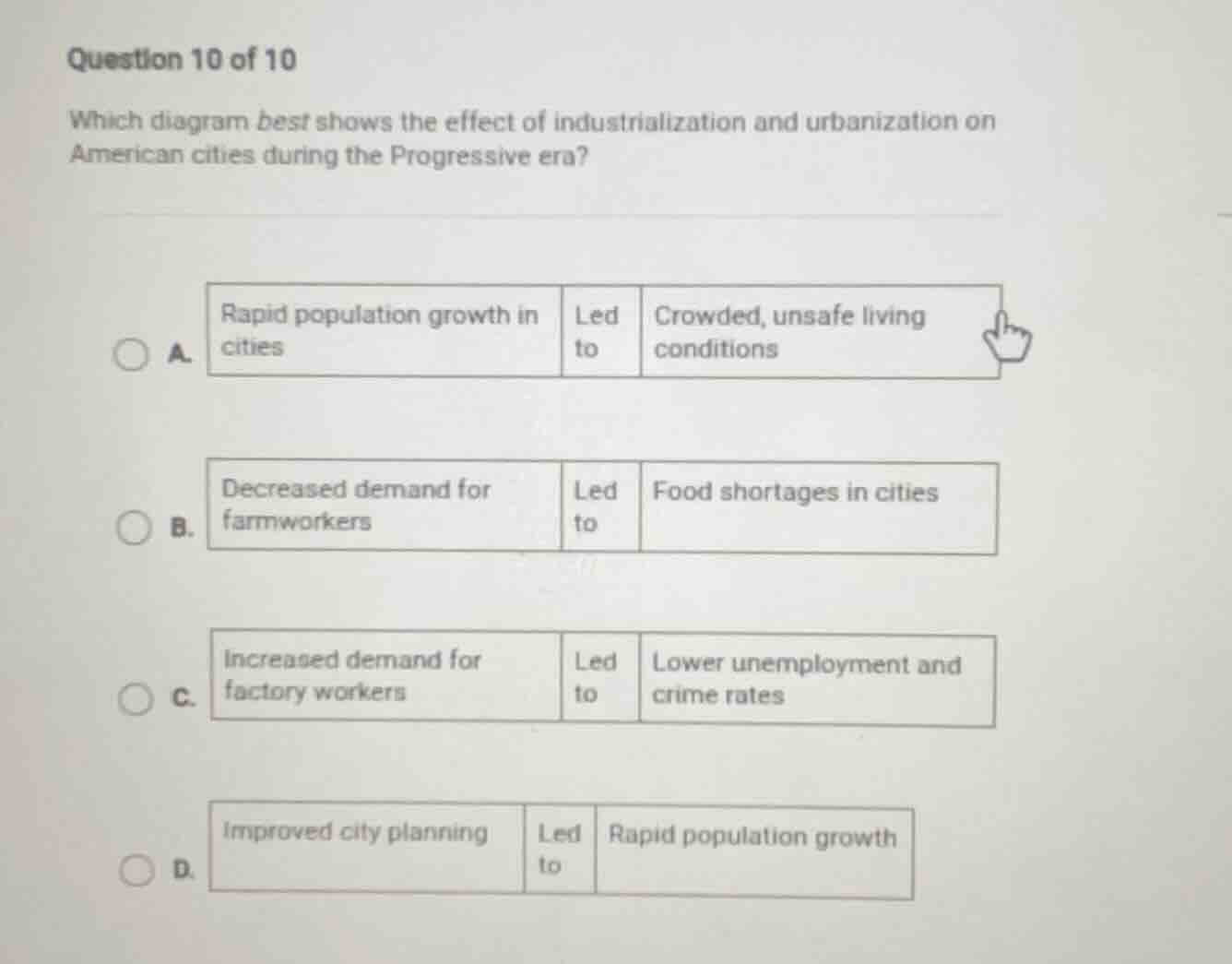
a. rapid population growth in cities led to crowded, unsafe living conditions
b. decreased demand for farmworkers led to food shortages in cities
c. increased demand for factory workers led to lower unemployment and crime rates
d. improved city planning led to rapid population growth
Analyze the historical context of urbanization
During the late 19th and early 20th centuries, the United States experienced rapid industrialization and Urbanization Causes. Millions of immigrants and rural Americans moved to urban centers in search of factory jobs. This massive influx of people caused city populations to swell at an unprecedented rate, far outstripping the capacity of municipal infrastructure and housing.
Evaluate the consequences of rapid urban growth
The sudden, massive population growth in cities led directly to severe housing shortages. To accommodate the influx, landlords built cheap, multi-family apartment buildings known as tenements. These tenements lacked proper ventilation, light, indoor plumbing, and safety features, resulting in crowded, unsanitary, and unsafe living conditions. This reality was famously documented by reformers like Jacob Riis in his work How the Other Half Lives, which eventually spurred the movement for Urban Tenement Reform.
Assess the incorrect options
- Option B suggests that a decreased demand for farmworkers led to food shortages in cities. While agricultural mechanization did reduce the need for farm labor (driving people to cities), it actually increased overall food production, and urban food shortages were not the primary characteristic effect of urbanization.
- Option C suggests that increased demand for factory workers led to lower unemployment and crime rates. While jobs were available, rapid urbanization actually saw high rates of poverty, underemployment, and rising crime rates due to social dislocation and lack of policing.
- Option D suggests that improved city planning led to rapid population growth. In reality, rapid population growth occurred first and caught cities completely unprepared; systematic city planning and zoning laws only developed later as a reaction to these chaotic conditions.
Identify the best matching diagram
Option A correctly identifies the direct cause-and-effect relationship: the rapid population growth in cities (urbanization) led directly to crowded, unsafe living conditions (such as tenement housing), which became a central focus of Progressive Era reformers.

Snap & solve any problem in the app
Get step-by-step solutions on Sovi AI
Photo-based solutions with guided steps
Explore more problems and detailed explanations
- (A) Rapid population growth in cities -> Led to -> Crowded, unsafe living conditions (Correct answer)
- (B) Decreased demand for farmworkers -> Led to -> Food shortages in cities
- (C) Increased demand for factory workers -> Led to -> Lower unemployment and crime rates
- (D) Improved city planning -> Led to -> Rapid population growth