QUESTION IMAGE
Question
question 10 of 10
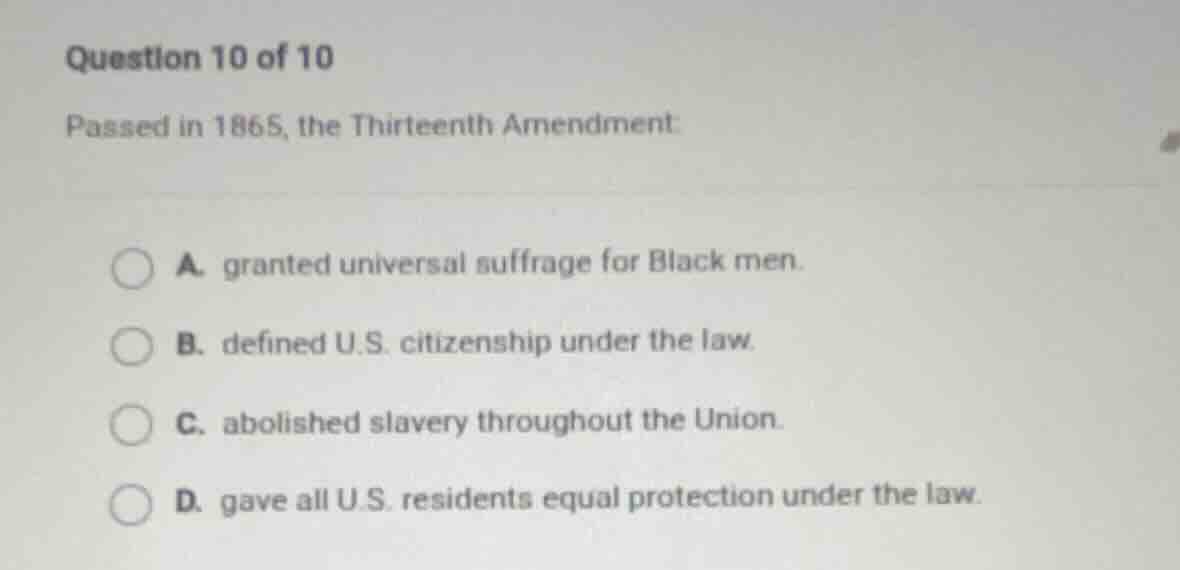
passed in 1865, the thirteenth amendment:
a. granted universal suffrage for black men.
b. defined u.s. citizenship under the law.
c. abolished slavery throughout the union.
d. gave all u.s. residents equal protection under the law.
Identify the core subject of the question
The question asks about the purpose and effect of the Thirteenth Amendment, which was passed in 1865. This is a key part of the Reconstruction Amendments passed after the American Civil War.
Analyze the historical impact of the Thirteenth Amendment
The Thirteenth Amendment officially abolished slavery and involuntary servitude throughout the United States, except as a punishment for a crime whereof the party shall have been duly convicted.
Evaluate the given options
- Option A ("granted universal suffrage for Black men") refers to the Fifteenth Amendment, ratified in 1870.
- Option B ("defined U.S. citizenship under the law") refers to the Fourteenth Amendment, ratified in 1868.
- Option C ("abolished slavery throughout the Union") correctly describes the Thirteenth Amendment.
- Option D ("gave all U.S. residents equal protection under the law") refers to the Equal Protection Clause of the Fourteenth Amendment.

Snap & solve any problem in the app
Get step-by-step solutions on Sovi AI
Photo-based solutions with guided steps
Explore more problems and detailed explanations
- (A) granted universal suffrage for Black men.
- (B) defined U.S. citizenship under the law.
- (C) abolished slavery throughout the Union. (Correct answer)
- (D) gave all U.S. residents equal protection under the law.