QUESTION IMAGE
Question
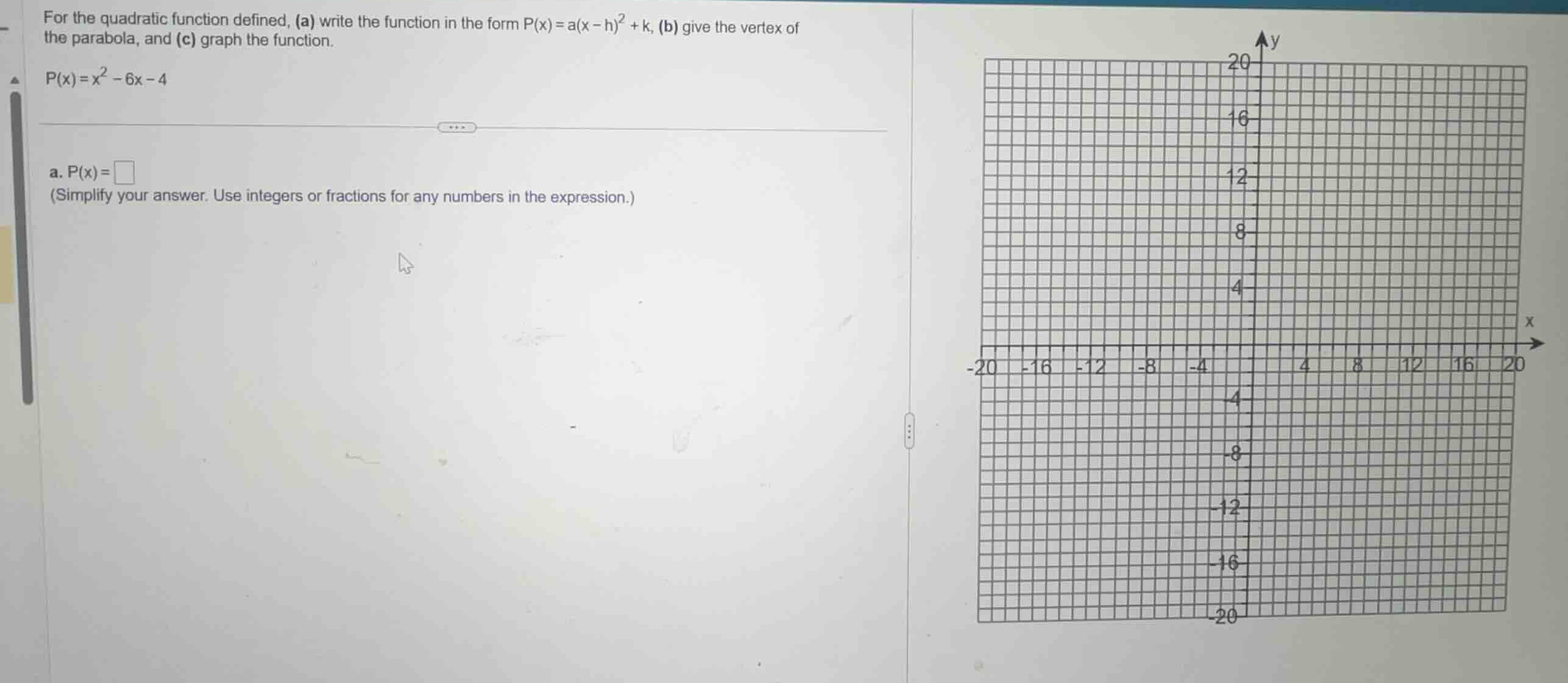
for the quadratic function defined, (a) write the function in the form \\(p(x) = a(x - h)^2 + k\\), (b) give the vertex of the parabola, and (c) graph the function.
\\(p(x) = x^2 - 6x - 4\\)
a. \\(p(x) = \square\\)
(simplify your answer. use integers or fractions for any numbers in the expression.)
Complete the square
To convert \(P(x) = x^2 - 6x - 4\) into vertex form \(P(x) = a(x-h)^2 + k\), we complete the square on the \(x\)-terms.
Take half of the \(x\)-coefficient, \(-6\), which is \(-3\), and square it to get \(9\).
Add and subtract \(9\) inside the expression:
Factor the perfect square trinomial:
Identify the vertex
The vertex form of a parabola is \(P(x) = a(x-h)^2 + k\), where \((h, k)\) is the vertex.
Comparing \(P(x) = (x-3)^2 - 13\) to the standard vertex form:
Thus, the vertex of the parabola is \((3, -13)\).
Determine graphing points
To graph the function, we find additional points on the parabola.
Let's evaluate \(P(x)\) at \(x = 0\) and \(x = 6\) (symmetric about \(x = 3\)):
So, the parabola passes through \((3, -13)\), \((0, -4)\), and \((6, -4)\).

Snap & solve any problem in the app
Get step-by-step solutions on Sovi AI
Photo-based solutions with guided steps
Explore more problems and detailed explanations
Question 1
a. \(P(x) =\) <blank>\((x-3)^2-13\)</blank>
Question 2
b. The vertex is <blank>\((3, -13)\)</blank>.
Question 3
c. The graph of the function is a parabola with its vertex at \((3, -13)\) opening upwards, passing through the y-intercept at \((0, -4)\).