QUESTION IMAGE
Question
production function
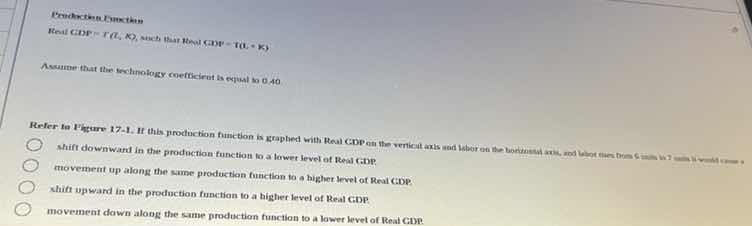
real gdp = t(l, k), such that real gdp = t(l + k)
assume that the technology coefficient is equal to 0.40.
refer to figure 17-1. if this production function is graphed with real gdp on the vertical axis and labor on the horizontal axis, and labor rises from 6 units to 7 units it would cause a
shift downward in the production function to a lower level of real gdp.
movement up along the same production function to a higher level of real gdp.
shift upward in the production function to a higher level of real gdp.
movement down along the same production function to a lower level of real gdp.
Analyze the production function variables
The production function is given as:
where \(T\) is the technology coefficient, \(L\) is labor, and \(K\) is capital.
The graph plots Real GDP on the vertical axis and labor (\(L\)) on the horizontal axis, holding technology (\(T\)) and capital (\(K\)) constant.
Determine the effect of changing labor
When labor (\(L\)) increases from 6 units to 7 units, we are changing the variable plotted on the horizontal axis.
An increase in the independent variable plotted on the horizontal axis causes a movement along the curve, not a shift of the curve.
Since \(T > 0\) and \(K > 0\), an increase in \(L\) increases Real GDP.
Identify the graphical movement
An increase in labor (\(L\)) leads to a higher level of Real GDP.
Because this change is due to a variable on the horizontal axis, it results in a movement up along the same production function curve to a higher level of Real GDP.

Snap & solve any problem in the app
Get step-by-step solutions on Sovi AI
Photo-based solutions with guided steps
Explore more problems and detailed explanations
- shift downward in the production function to a lower level of Real GDP.
- movement up along the same production function to a higher level of Real GDP. (Correct answer)
- shift upward in the production function to a higher level of Real GDP.
- movement down along the same production function to a lower level of Real GDP.