Sovi.AI - AI Math Tutor

Scan to solve math questions

QUESTION IMAGE

probably the most alarming characteristic of the new constitution to th…

Question

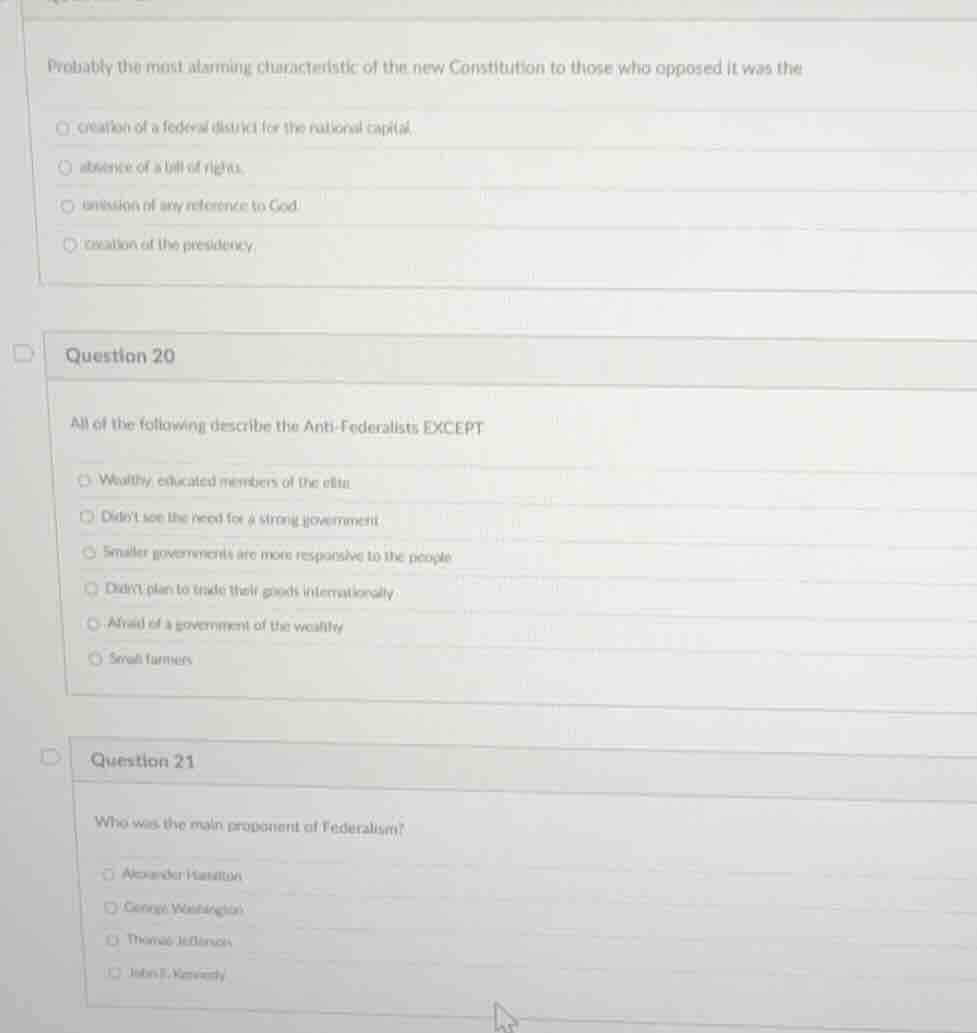
probably the most alarming characteristic of the new constitution to those who opposed it was the

  • creation of a federal district for the national capital
  • absence of a bill of rights
  • omission of any reference to god
  • creation of the presidency

question 20

all of the following describe the anti-federalists except

  • wealthy, educated members of the elite
  • didnt see the need for a strong government
  • smaller governments are more responsive to the people
  • didnt plan to trade their goods internationally
  • afraid of a government of the wealthy
  • small farmers

question 21

who was the main proponent of federalism?

  • alexander hamilton
  • george washington
  • thomas jefferson
  • john f. kennedy

Explanation:

Response

<pre_analysis>
{
"quality": "clear",
"question_count": 3,
"skills_matched": [
"direct_cot",
"multiple_choice_formatter",
"explain_then_answer",
"quick"
],
"needs_drawing": false,
"concepts_used": [
"Federalists and Anti-Federalists",
"Anti-Federalist Leaders",
"Federalism"
],
"new_concepts": [],
"current_concepts": [
"Federalists and Anti-Federalists",
"Anti-Federalist Leaders",
"Federalism"
]
}
</pre_analysis>

<reasoning>

Analyze the first question regarding the Constitution's opposition

The first question asks for the most alarming characteristic of the new Constitution to those who opposed it (the Anti-Federalists). The primary objection raised by the Anti-Federalists during the ratification debates was the lack of explicit protections for individual liberties, which was the absence of a bill of rights.

Analyze Question 20 regarding Anti-Federalist characteristics

This question asks which option does NOT describe the Anti-Federalists. Anti-Federalists were generally small farmers, shopkeepers, and laborers who feared a strong central government and believed smaller local governments were more responsive to the people. They were concerned about a government run by the wealthy elite. Therefore, "Wealthy, educated members of the elite" describes the Federalists, not the Anti-Federalists.

Analyze Question 21 regarding the main proponent of Federalism

This question asks for the main proponent of Federalism. Alexander Hamilton was the leading champion of a strong federal government, co-author of the Federalist Papers, and the chief architect of the Federalist nationalist program.
</reasoning>

<answer>

Question 1

<mcq-option>(A) creation of a federal district for the national capital</mcq-option>
<mcq-correct>(B) absence of a bill of rights.</mcq-correct>
<mcq-option>(C) omission of any reference to God</mcq-option>
<mcq-option>(D) creation of the presidency.</mcq-option>

Question 20

<mcq-correct>(A) Wealthy, educated members of the elite</mcq-correct>
<mcq-option>(B) Didn't see the need for a strong government</mcq-option>
<mcq-option>(C) Smaller governments are more responsive to the people</mcq-option>
<mcq-option>(D) Didn't plan to trade their goods internationally</mcq-option>
<mcq-option>(E) Afraid of a government of the wealthy</mcq-option>
<mcq-option>(F) Small farmers</mcq-option>

Question 21

<mcq-correct>(A) Alexander Hamilton</mcq-correct>
<mcq-option>(B) George Washington</mcq-option>
<mcq-option>(C) Thomas Jefferson</mcq-option>
<mcq-option>(D) John F. Kennedy</mcq-option>
</answer>

<post_analysis>
{
"subject": "Social Science",
"question_type": "Multiple Choice",
"knowledge_point": [
"Social Science",
"U.S. History",
"Federalists and Anti-Federalists"
]
}
</post_analysis>

Answer:

<pre_analysis>
{
"quality": "clear",
"question_count": 3,
"skills_matched": [
"direct_cot",
"multiple_choice_formatter",
"explain_then_answer",
"quick"
],
"needs_drawing": false,
"concepts_used": [
"Federalists and Anti-Federalists",
"Anti-Federalist Leaders",
"Federalism"
],
"new_concepts": [],
"current_concepts": [
"Federalists and Anti-Federalists",
"Anti-Federalist Leaders",
"Federalism"
]
}
</pre_analysis>

<reasoning>

Analyze the first question regarding the Constitution's opposition

The first question asks for the most alarming characteristic of the new Constitution to those who opposed it (the Anti-Federalists). The primary objection raised by the Anti-Federalists during the ratification debates was the lack of explicit protections for individual liberties, which was the absence of a bill of rights.

Analyze Question 20 regarding Anti-Federalist characteristics

This question asks which option does NOT describe the Anti-Federalists. Anti-Federalists were generally small farmers, shopkeepers, and laborers who feared a strong central government and believed smaller local governments were more responsive to the people. They were concerned about a government run by the wealthy elite. Therefore, "Wealthy, educated members of the elite" describes the Federalists, not the Anti-Federalists.

Analyze Question 21 regarding the main proponent of Federalism

This question asks for the main proponent of Federalism. Alexander Hamilton was the leading champion of a strong federal government, co-author of the Federalist Papers, and the chief architect of the Federalist nationalist program.
</reasoning>

<answer>

Question 1

<mcq-option>(A) creation of a federal district for the national capital</mcq-option>
<mcq-correct>(B) absence of a bill of rights.</mcq-correct>
<mcq-option>(C) omission of any reference to God</mcq-option>
<mcq-option>(D) creation of the presidency.</mcq-option>

Question 20

<mcq-correct>(A) Wealthy, educated members of the elite</mcq-correct>
<mcq-option>(B) Didn't see the need for a strong government</mcq-option>
<mcq-option>(C) Smaller governments are more responsive to the people</mcq-option>
<mcq-option>(D) Didn't plan to trade their goods internationally</mcq-option>
<mcq-option>(E) Afraid of a government of the wealthy</mcq-option>
<mcq-option>(F) Small farmers</mcq-option>

Question 21

<mcq-correct>(A) Alexander Hamilton</mcq-correct>
<mcq-option>(B) George Washington</mcq-option>
<mcq-option>(C) Thomas Jefferson</mcq-option>
<mcq-option>(D) John F. Kennedy</mcq-option>
</answer>

<post_analysis>
{
"subject": "Social Science",
"question_type": "Multiple Choice",
"knowledge_point": [
"Social Science",
"U.S. History",
"Federalists and Anti-Federalists"
]
}
</post_analysis>