QUESTION IMAGE
Question
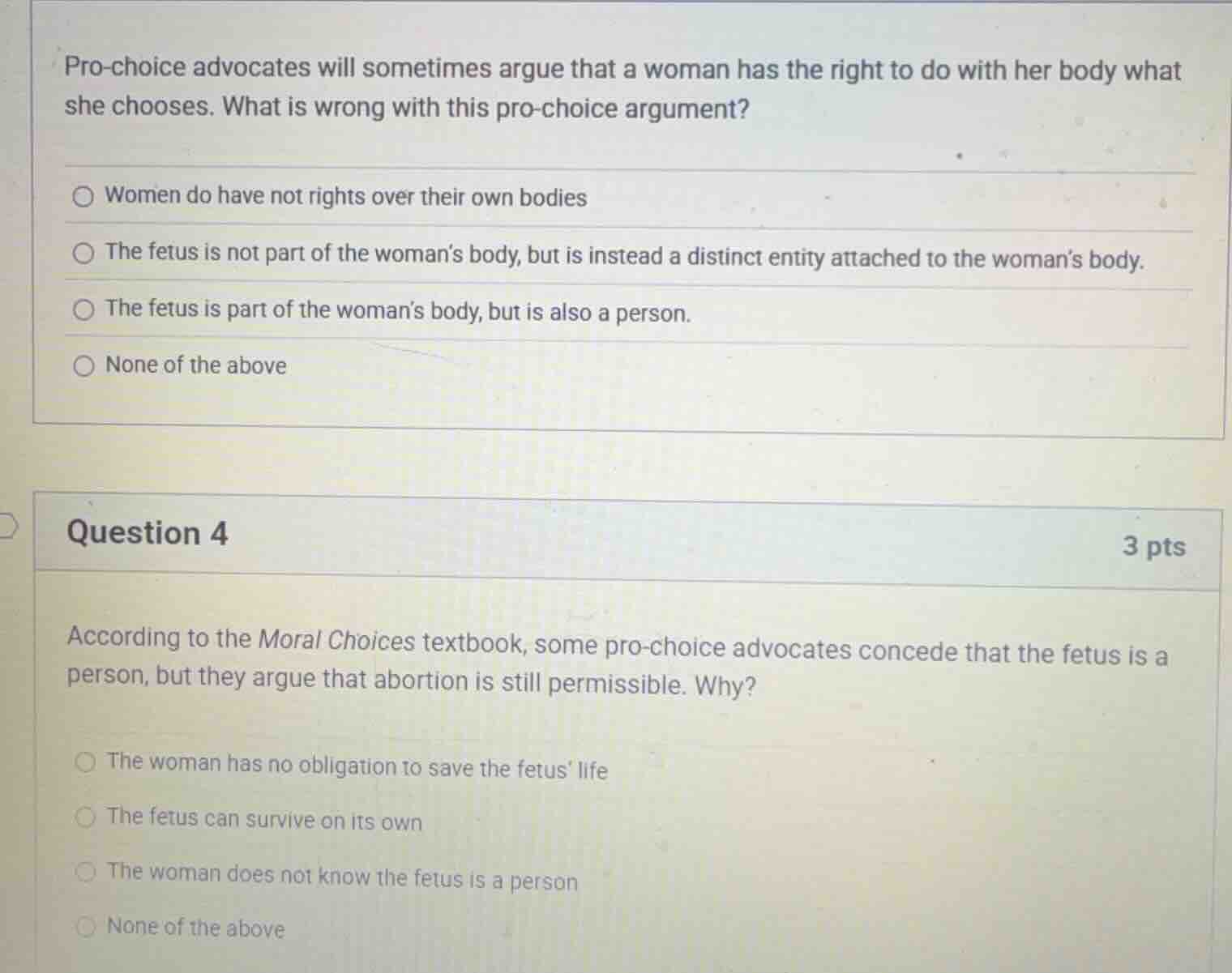
pro-choice advocates will sometimes argue that a woman has the right to do with her body what she chooses. what is wrong with this pro-choice argument?
- women do have not rights over their own bodies
- the fetus is not part of the womans body, but is instead a distinct entity attached to the womans body.
- the fetus is part of the womans body, but is also a person.
- none of the above
question 4
according to the moral choices textbook, some pro-choice advocates concede that the fetus is a person, but they argue that abortion is still permissible. why?
- the woman has no obligation to save the fetus life
- the fetus can survive on its own
- the woman does not know the fetus is a person
- none of the above
🆕 New Concept Discovered: Analyzing Philosophical Arguments
Evaluating the logical premises of ethical and moral claims.
Step 1: Analyze the First Question
The first question asks: "Pro-choice advocates will sometimes argue that a woman has the right to do with her body what she chooses. What is wrong with this pro-choice argument?"
In philosophical and bioethical debates surrounding abortion, a central counterargument to the "sovereignty over one's body" claim is that a fetus is biologically and genetically a distinct organism, not merely an organ or part of the woman's body.
- Option 1 ("Women do have not rights over their own bodies") is incorrect because mainstream ethical frameworks agree women possess bodily autonomy.
- Option 2 ("The fetus is not part of the woman's body, but is instead a distinct entity attached to the woman's body") directly addresses the biological and philosophical flaw in the premise that abortion only affects the woman's own body.
- Option 3 ("The fetus is part of the woman's body, but is also a person") is biologically inaccurate because the fetus is genetically distinct, not a literal body part like an appendix.
Thus, the second option is the correct critique of this specific premise.
Step 2: Analyze the Second Question
The second question asks: "According to the Moral Choices textbook, some pro-choice advocates concede that the fetus is a person, but they argue that abortion is still permissible. Why?"
This refers to a famous philosophical argument in bioethics (most notably formulated by Judith Jarvis Thomson in "A Defense of Abortion"). Even if we grant that the fetus is a person with a right to life, some advocates argue that this right does not automatically give the fetus the right to use another person's body to survive without their ongoing consent.
- Option 1 ("The woman has no obligation to save the fetus' life") aligns with this philosophical defense, which argues that bodily autonomy means a person is not morally obligated to undergo significant physical burden to sustain another life.
- Option 2 ("The fetus can survive on its own") is factually incorrect, especially in early pregnancy.
- Option 3 ("The woman does not know the fetus is a person") contradicts the premise of the question, which states that advocates concede (agree) the fetus is a person.
Thus, the first option is the correct answer.

Snap & solve any problem in the app
Get step-by-step solutions on Sovi AI
Photo-based solutions with guided steps
Explore more problems and detailed explanations
First Question:
- The fetus is not part of the woman's body, but is instead a distinct entity attached to the woman's body.
Question 4:
- The woman has no obligation to save the fetus' life