QUESTION IMAGE
Question
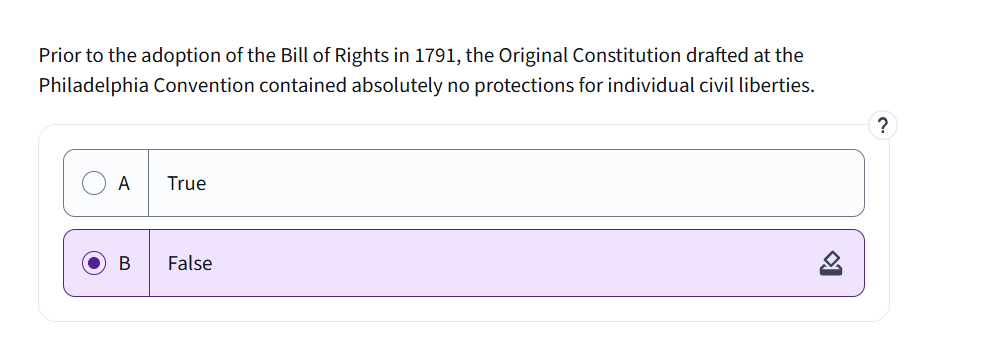
prior to the adoption of the bill of rights in 1791, the original constitution drafted at the philadelphia convention contained absolutely no protections for individual civil liberties.
a true
b false
🆕 New Concept Discovered: Constitutional Protections of Liberties
Specific rights written directly into the main body of the Constitution.
Step 1: Analyze the statement's claim
The statement asserts that the original U.S. Constitution drafted in 1787 contained "absolutely no protections for individual civil liberties" prior to the addition of the Bill of Rights in 1791.
To determine if this is true or false, we must look for any specific protections of individual rights that were written directly into the main body (Articles I through VII) of the original Constitution.
Step 2: Identify liberties protected in the original text
While the original Constitution did not have a comprehensive bill of rights, the Framers did include several specific protections for individual liberties directly in Article I and Article III:
- Habeas Corpus (Article I, Section 9): Protects individuals against illegal and indefinite imprisonment by allowing them to challenge their detention in court.
- No Bills of Attainder (Article I, Section 9 & 10): Prohibits Congress and the states from passing laws that declare a specific person or group guilty of a crime and punishing them without a trial.
- No Ex Post Facto Laws (Article I, Section 9 & 10): Prohibits making an action illegal retroactively (punishing someone for doing something that was legal when they did it).
- Trial by Jury (Article III, Section 2): Guarantees the right to a jury trial for all federal crimes.
Step 3: Evaluate the truth value
Because the original Constitution did contain these specific, fundamental protections for individual civil liberties, the claim that it contained "absolutely no protections" is historically incorrect.

Snap & solve any problem in the app
Get step-by-step solutions on Sovi AI
Photo-based solutions with guided steps
Explore more problems and detailed explanations
B. False