QUESTION IMAGE
Question
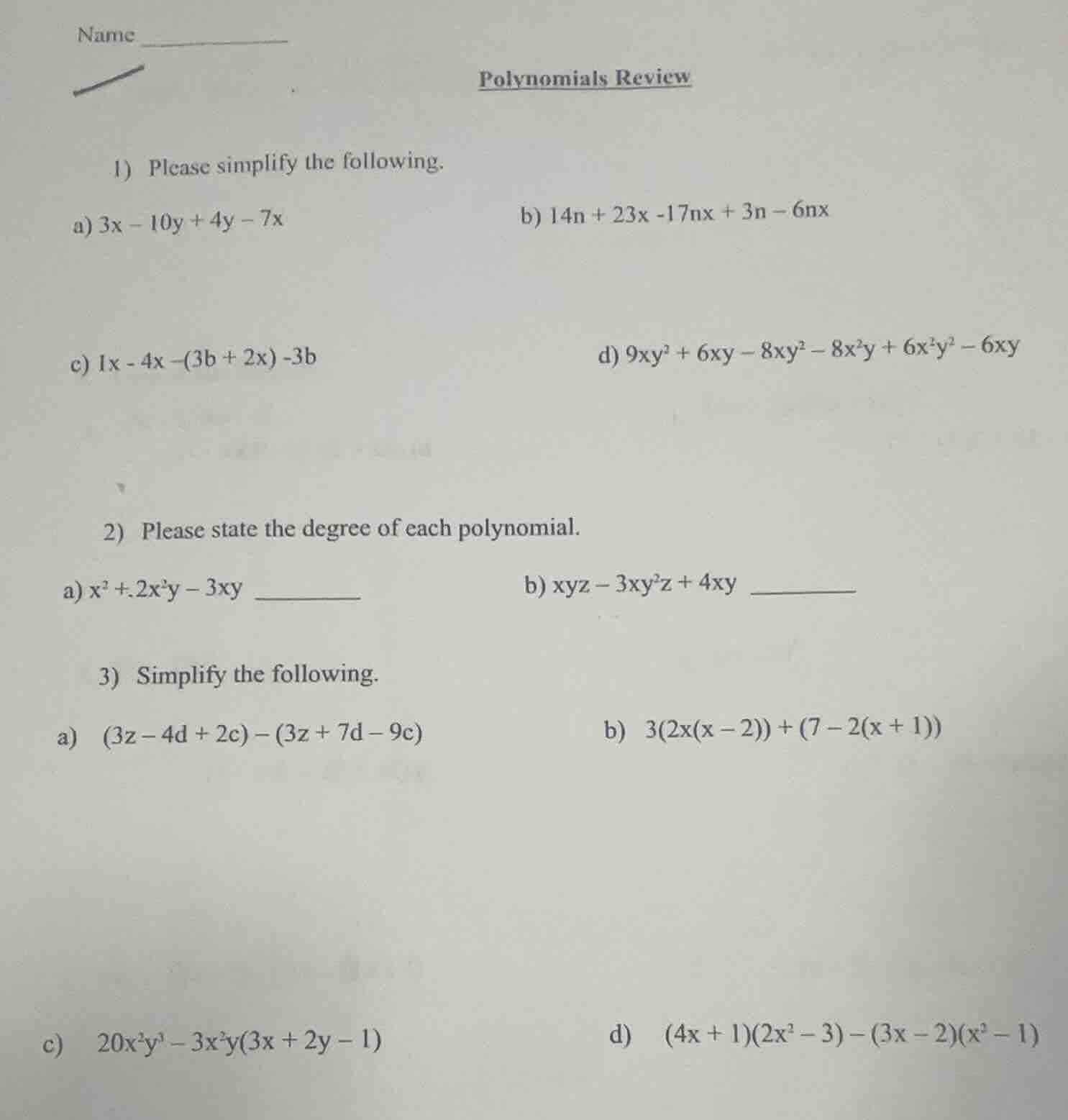
polynomials review
- please simplify the following.
a) (3x - 10y + 4y - 7x)
b) (14n + 23x - 17nx + 3n - 6nx)
c) (1x - 4x - (3b + 2x) - 3b)
d) (9xy^2 + 6xy - 8xy^2 - 8x^2y + 6x^2y^2 - 6xy)
- please state the degree of each polynomial.
a) (x^2 + 2x^2y - 3xy) _______
b) (xyz - 3xy^2z + 4xy) _______
- simplify the following.
a) ((3z - 4d + 2c) - (3z + 7d - 9c))
b) (3(2x(x - 2)) + (7 - 2(x + 1)))
c) (20x^2y^3 - 3x^2y(3x + 2y - 1))
d) ((4x + 1)(2x^2 - 3) - (3x - 2)(x^2 - 1))
⚡ Using: simplifying expressions · 🆕 New: degree of a polynomial
The highest total exponent sum in any single term.
---
Step 1: Simplify Question 1
Group and combine like terms (terms with the exact same variables and exponents).
a) \( 3x - 10y + 4y - 7x \)
Combine \( x \)-terms and \( y \)-terms:
b) \( 14n + 23x - 17nx + 3n - 6nx \)
Combine \( n \)-terms, \( x \)-terms, and \( nx \)-terms:
c) \( 1x - 4x - (3b + 2x) - 3b \)
Distribute the negative sign through the parentheses:
Combine \( x \)-terms and \( b \)-terms:
d) \( 9xy^2 + 6xy - 8xy^2 - 8x^2y + 6x^2y^2 - 6xy \)
Combine like terms:
- \( xy^2 \) terms: \( 9xy^2 - 8xy^2 = 1xy^2 \)
- \( xy \) terms: \( 6xy - 6xy = 0 \)
- \( x^2y \) terms: \( -8x^2y \)
- \( x^2y^2 \) terms: \( 6x^2y^2 \)
---
Step 2: Determine the Degree in Question 2
The degree of a polynomial is the highest sum of the exponents of the variables in any single term.
a) \( x^2 + 2x^2y - 3xy \)
- Term 1: \( x^2 \) (degree = 2)
- Term 2: \( 2x^2y^1 \) (degree = \( 2 + 1 = 3 \))
- Term 3: \( -3x^1y^1 \) (degree = \( 1 + 1 = 2 \))
The highest degree is 3.
b) \( xyz - 3xy^2z + 4xy \)
- Term 1: \( x^1y^1z^1 \) (degree = \( 1 + 1 + 1 = 3 \))
- Term 2: \( -3x^1y^2z^1 \) (degree = \( 1 + 2 + 1 = 4 \))
- Term 3: \( 4x^1y^1 \) (degree = \( 1 + 1 = 2 \))
The highest degree is 4.
---
Step 3: Simplify Question 3
a) \( (3z - 4d + 2c) - (3z + 7d - 9c) \)
Distribute the negative sign:
Combine like terms:
b) \( 3(2x(x - 2)) + (7 - 2(x + 1)) \)
Simplify inside the brackets first:
Combine like terms:
c) \( 20x^2y^3 - 3x^2y(3x + 2y - 1) \)
Distribute \( -3x^2y \) to each term inside the parentheses:
d) \( (4x + 1)(2x^2 - 3) - (3x - 2)(x^2 - 1) \)
Expand the first part:
Expand the second part:
Subtract the second expanded expression from the first:
Combine like terms:
---

Snap & solve any problem in the app
Get step-by-step solutions on Sovi AI
Photo-based solutions with guided steps
Explore more problems and detailed explanations
1) Simplify:
- a) \( -4x - 6y \)
- b) \( 17n + 23x - 23nx \)
- c) \( -5x - 6b \)
- d) \( 6x^2y^2 - 8x^2y + xy^2 \)
2) Degree of each polynomial:
- a) \( 3 \)
- b) \( 4 \)
3) Simplify:
- a) \( -11d + 11c \)
- b) \( 6x^2 - 14x + 5 \)
- c) \( 20x^2y^3 - 9x^3y - 6x^2y^2 + 3x^2y \)
- d) \( 5x^3 + 4x^2 - 9x - 5 \)