QUESTION IMAGE
Question
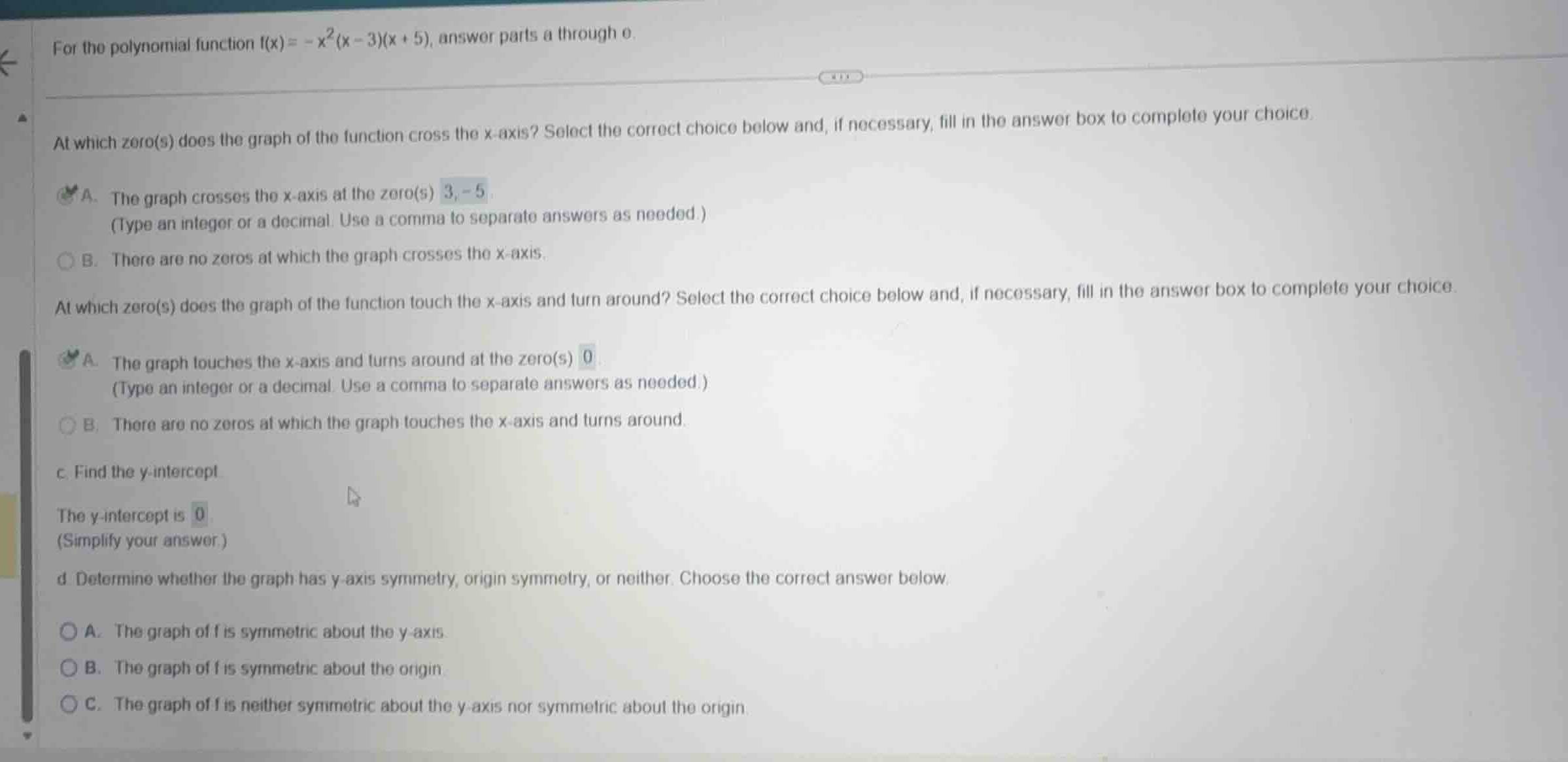
for the polynomial function \\(f(x) = -x^2(x - 3)(x + 5)\\), answer parts a through e.
at which zero(s) does the graph of the function cross the x-axis? select the correct choice below and, if necessary, fill in the answer box to complete your choice.
a. the graph crosses the x-axis at the zero(s) 3, -5.
(type an integer or a decimal. use a comma to separate answers as needed.)
b. there are no zeros at which the graph crosses the x-axis.
at which zero(s) does the graph of the function touch the x-axis and turn around? select the correct choice below and, if necessary, fill in the answer box to complete your choice.
a. the graph touches the x-axis and turns around at the zero(s) 0.
(type an integer or a decimal. use a comma to separate answers as needed.)
b. there are no zeros at which the graph touches the x-axis and turns around.
c. find the y-intercept.
the y-intercept is 0.
(simplify your answer.)
d. determine whether the graph has y-axis symmetry, origin symmetry, or neither. choose the correct answer below.
a. the graph of f is symmetric about the y-axis.
b. the graph of f is symmetric about the origin.
c. the graph of f is neither symmetric about the y-axis nor symmetric about the origin.
Find zeros and multiplicities
Using the Multiplicity of Zeros knowledge point
Determine x-axis crossing behavior
Using the Graph Behavior at Zeros knowledge point
Find the y-intercept
Evaluate the function at \(x = 0\):
Thus, the \(y\)-intercept is \(0\).
Determine function symmetry
We test for symmetry by evaluating \(f(-x)\):
Since \(f(-x)
eq f(x)\) and \(f(-x)
eq -f(x)\), the graph is neither symmetric about the \(y\)-axis nor symmetric about the origin.

Snap & solve any problem in the app
Get step-by-step solutions on Sovi AI
Photo-based solutions with guided steps
Explore more problems and detailed explanations
Question a
- A. The graph crosses the x-axis at the zero(s) 3, -5 (Correct answer)
- B. There are no zeros at which the graph crosses the x-axis.
Question b
- A. The graph touches the x-axis and turns around at the zero(s) 0 (Correct answer)
- B. There are no zeros at which the graph touches the x-axis and turns around.
Question c
The y-intercept is <blank>0</blank>.
Question d
- A. The graph of f is symmetric about the y-axis.
- B. The graph of f is symmetric about the origin.
- C. The graph of f is neither symmetric about the y-axis nor symmetric about the origin. (Correct answer)