Sovi.AI - AI Math Tutor

Scan to solve math questions

QUESTION IMAGE

phi may be released without the patients authorization in all of the fo…

Question

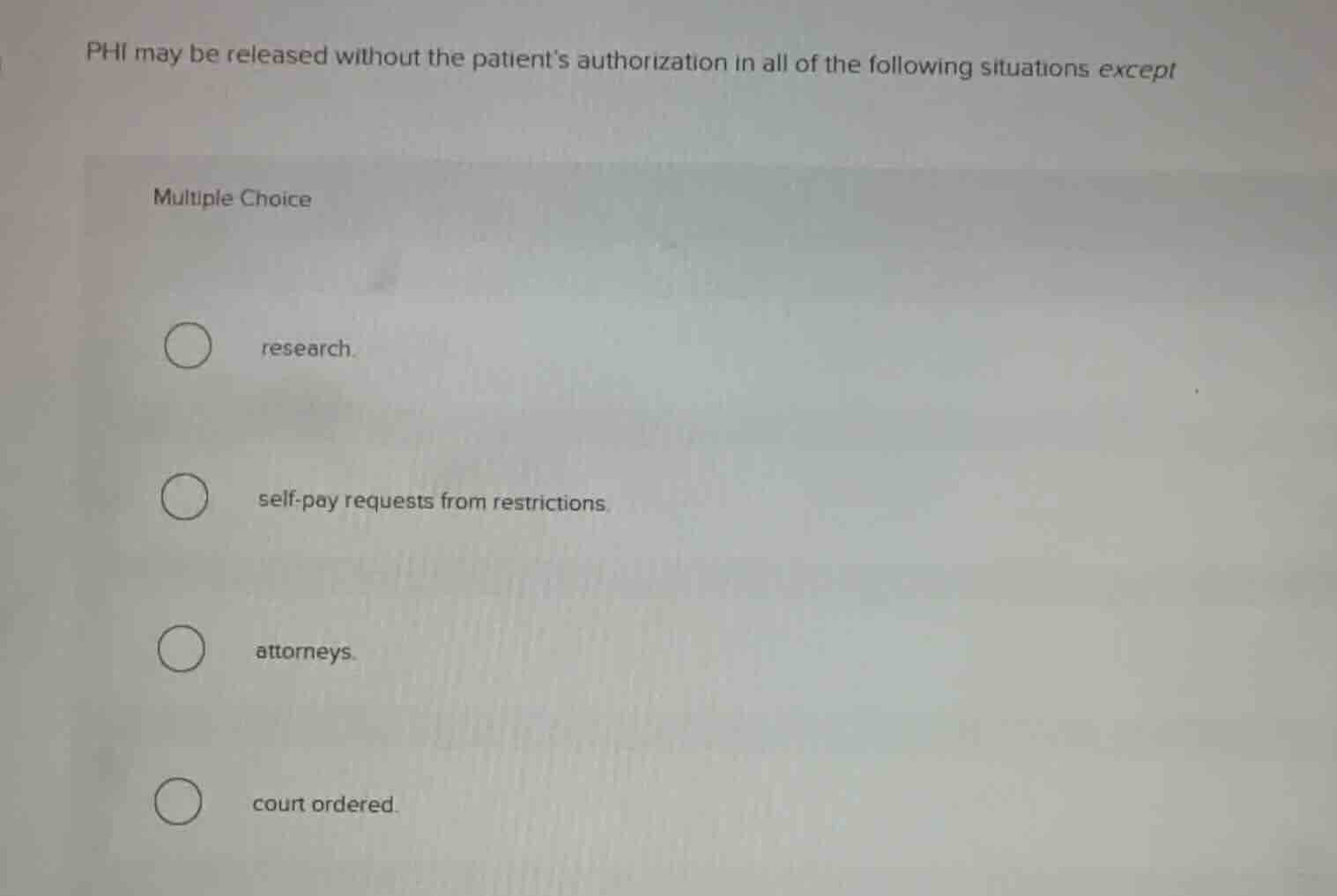
phi may be released without the patients authorization in all of the following situations except

multiple choice

research.

self-pay requests from restrictions.

attorneys.

court ordered.

Explanation:

Response

<pre_analysis>
{
"quality": "clear",
"question_count": 1,
"skills_matched": [
"direct_cot",
"multiple_choice_formatter",
"explain_then_answer",
"tutor",
"mastery_adaptive_brevity"
],
"needs_drawing": false,
"concepts_used": [
"Medical Information Release Authority",
"Patient Privacy Regulations"
],
"new_concepts": [],
"current_concepts": [
"Medical Information Release Authority",
"Patient Privacy Regulations",
"HIPAA Structure"
]
}
</pre_analysis>

<reasoning>

Analyze the core question

The question asks for the exception where Protected Health Information (PHI) cannot be released without the patient's explicit authorization. Under the Health Insurance Portability and Accountability Act (HIPAA), there are specific circumstances where a covered entity is permitted or required to disclose PHI without written authorization, and other circumstances where authorization is strictly mandatory.

Evaluate the exceptions and rules

Using the Medical Information Release Authority and Patient Privacy Regulations knowledge points:

  • research: Under certain conditions (such as an Institutional Review Board or Privacy Board waiver), PHI can be used or disclosed for research without authorization.
  • self-pay requests from restrictions: If a patient pays out-of-pocket in full (self-pay) and requests that the provider not disclose PHI to their health plan, the provider must honor this restriction. This is a patient right, but it does not represent a general category of third-party release without authorization.
  • court ordered: A covered entity may disclose PHI in response to an order of a court or administrative tribunal without patient authorization.
  • attorneys: Generally, a covered entity cannot release PHI to an attorney (such as in civil litigation) without a signed patient authorization, unless it is accompanied by a qualified protective order, subpoena with satisfactory assurances, or a direct court order. Therefore, releasing PHI to attorneys without authorization is generally prohibited, making this the correct exception.

Select the correct option

Comparing the choices, releasing information directly to attorneys generally requires explicit patient authorization, unlike court orders or specific research exceptions.
</reasoning>

<answer>
<mcq-option>research.</mcq-option>
<mcq-option>self-pay requests from restrictions.</mcq-option>
<mcq-correct>attorneys.</mcq-correct>
<mcq-option>court ordered.</mcq-option>
</answer>

<post_analysis>
{
"subject": "Others",
"question_type": "Multiple Choice",
"knowledge_point": [
"Others",
"Healthcare Administration",
"Medical Information Release Authority"
]
}
</post_analysis>

Answer:

<pre_analysis>
{
"quality": "clear",
"question_count": 1,
"skills_matched": [
"direct_cot",
"multiple_choice_formatter",
"explain_then_answer",
"tutor",
"mastery_adaptive_brevity"
],
"needs_drawing": false,
"concepts_used": [
"Medical Information Release Authority",
"Patient Privacy Regulations"
],
"new_concepts": [],
"current_concepts": [
"Medical Information Release Authority",
"Patient Privacy Regulations",
"HIPAA Structure"
]
}
</pre_analysis>

<reasoning>

Analyze the core question

The question asks for the exception where Protected Health Information (PHI) cannot be released without the patient's explicit authorization. Under the Health Insurance Portability and Accountability Act (HIPAA), there are specific circumstances where a covered entity is permitted or required to disclose PHI without written authorization, and other circumstances where authorization is strictly mandatory.

Evaluate the exceptions and rules

Using the Medical Information Release Authority and Patient Privacy Regulations knowledge points:

  • research: Under certain conditions (such as an Institutional Review Board or Privacy Board waiver), PHI can be used or disclosed for research without authorization.
  • self-pay requests from restrictions: If a patient pays out-of-pocket in full (self-pay) and requests that the provider not disclose PHI to their health plan, the provider must honor this restriction. This is a patient right, but it does not represent a general category of third-party release without authorization.
  • court ordered: A covered entity may disclose PHI in response to an order of a court or administrative tribunal without patient authorization.
  • attorneys: Generally, a covered entity cannot release PHI to an attorney (such as in civil litigation) without a signed patient authorization, unless it is accompanied by a qualified protective order, subpoena with satisfactory assurances, or a direct court order. Therefore, releasing PHI to attorneys without authorization is generally prohibited, making this the correct exception.

Select the correct option

Comparing the choices, releasing information directly to attorneys generally requires explicit patient authorization, unlike court orders or specific research exceptions.
</reasoning>

<answer>
<mcq-option>research.</mcq-option>
<mcq-option>self-pay requests from restrictions.</mcq-option>
<mcq-correct>attorneys.</mcq-correct>
<mcq-option>court ordered.</mcq-option>
</answer>

<post_analysis>
{
"subject": "Others",
"question_type": "Multiple Choice",
"knowledge_point": [
"Others",
"Healthcare Administration",
"Medical Information Release Authority"
]
}
</post_analysis>