QUESTION IMAGE
Question
part a
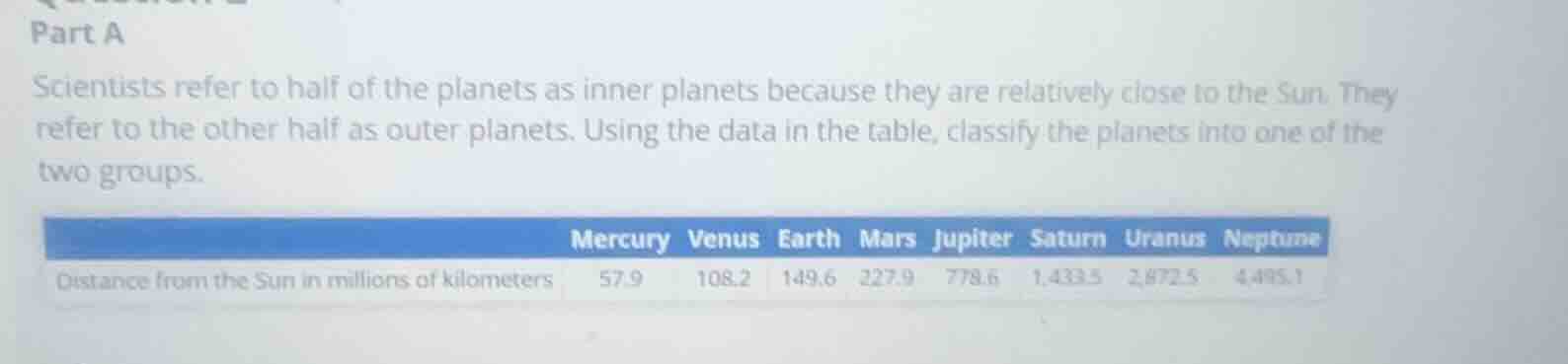
scientists refer to half of the planets as inner planets because they are relatively close to the sun. they refer to the other half as outer planets. using the data in the table, classify the planets into one of the two groups.
<pre_analysis>
{
"quality": "clear",
"question_count": 1,
"skills_matched": [
"direct_cot",
"explain_then_answer",
"tutor"
],
"needs_drawing": false,
"concepts_used": [
"Solar System Structure"
],
"new_concepts": [
"Inner and Outer Planets"
],
"current_concepts": [
"Solar System Structure",
"Inner and Outer Planets"
]
}
</pre_analysis>
<reasoning>
Identify the classification criteria
The problem states that half of the eight planets are classified as inner planets because they are relatively close to the Sun, and the other half are classified as outer planets. This means we need to divide the eight planets into two groups of four based on their distance from the Sun.
Analyze the distance data
Using the Solar System Structure concept, we examine the distances from the Sun (in millions of kilometers) provided in the table:
- Mercury: \(57.9\)
- Venus: \(108.2\)
- Earth: \(149.6\)
- Mars: \(227.9\)
- Jupiter: \(778.6\)
- Saturn: \(1,433.5\)
- Uranus: \(2,872.5\)
- Neptune: \(4,495.1\)
Group the planets
The four planets closest to the Sun are Mercury, Venus, Earth, and Mars. The four planets furthest from the Sun are Jupiter, Saturn, Uranus, and Neptune.
</reasoning>
<answer>
- Inner Planets: Mercury, Venus, Earth, Mars
- Outer Planets: Jupiter, Saturn, Uranus, Neptune
</answer>
<post_analysis>
{
"subject": "Natural Science",
"question_type": "Free Response",
"knowledge_point": [
"Natural Science",
"Others",
"Solar System Structure"
]
}
</post_analysis>
Snap & solve any problem in the app
Get step-by-step solutions on Sovi AI
Photo-based solutions with guided steps
Explore more problems and detailed explanations
<pre_analysis>
{
"quality": "clear",
"question_count": 1,
"skills_matched": [
"direct_cot",
"explain_then_answer",
"tutor"
],
"needs_drawing": false,
"concepts_used": [
"Solar System Structure"
],
"new_concepts": [
"Inner and Outer Planets"
],
"current_concepts": [
"Solar System Structure",
"Inner and Outer Planets"
]
}
</pre_analysis>
<reasoning>
Identify the classification criteria
The problem states that half of the eight planets are classified as inner planets because they are relatively close to the Sun, and the other half are classified as outer planets. This means we need to divide the eight planets into two groups of four based on their distance from the Sun.
Analyze the distance data
Using the Solar System Structure concept, we examine the distances from the Sun (in millions of kilometers) provided in the table:
- Mercury: \(57.9\)
- Venus: \(108.2\)
- Earth: \(149.6\)
- Mars: \(227.9\)
- Jupiter: \(778.6\)
- Saturn: \(1,433.5\)
- Uranus: \(2,872.5\)
- Neptune: \(4,495.1\)
Group the planets
The four planets closest to the Sun are Mercury, Venus, Earth, and Mars. The four planets furthest from the Sun are Jupiter, Saturn, Uranus, and Neptune.
</reasoning>
<answer>
- Inner Planets: Mercury, Venus, Earth, Mars
- Outer Planets: Jupiter, Saturn, Uranus, Neptune
</answer>
<post_analysis>
{
"subject": "Natural Science",
"question_type": "Free Response",
"knowledge_point": [
"Natural Science",
"Others",
"Solar System Structure"
]
}
</post_analysis>