QUESTION IMAGE
Question
part a
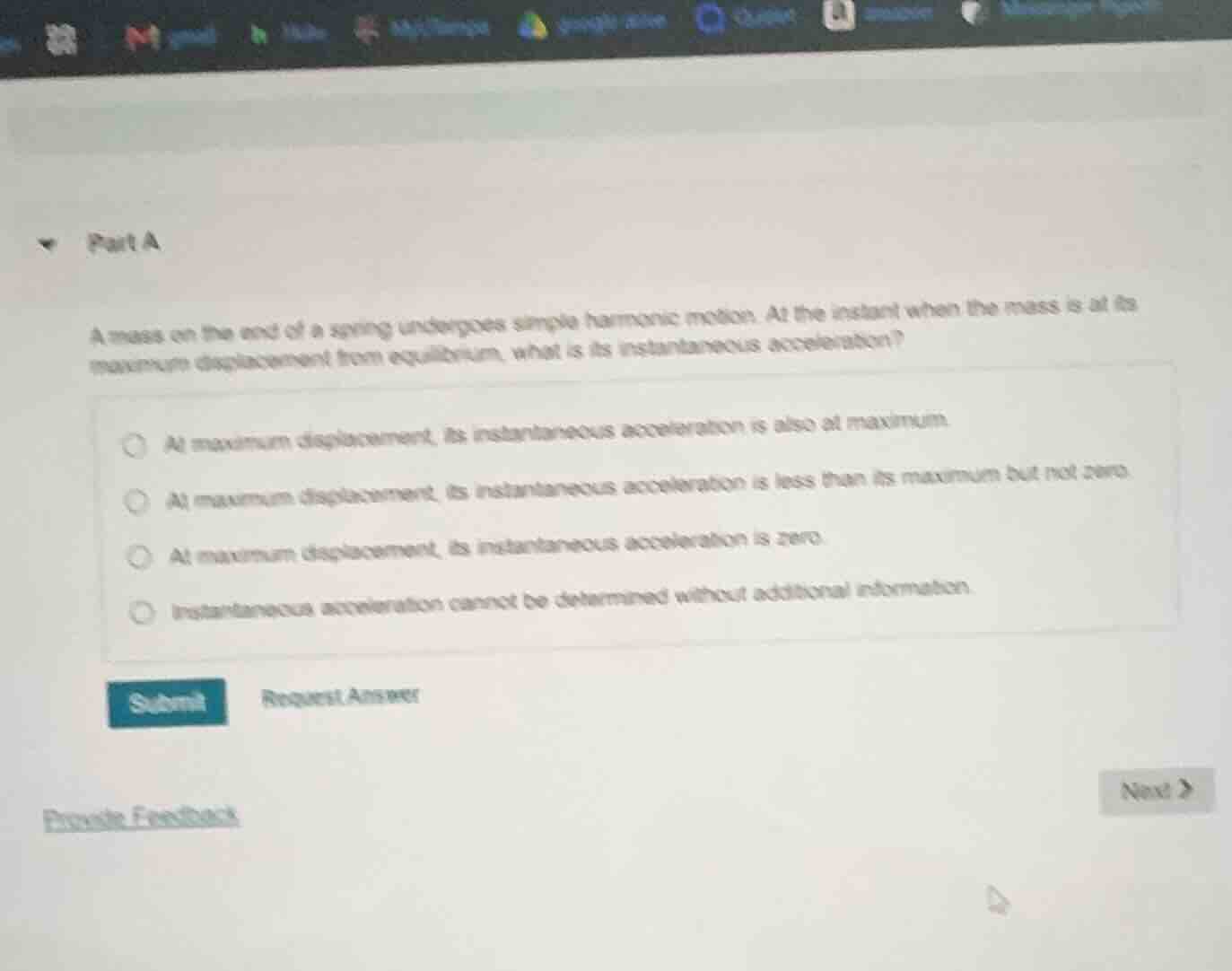
a mass on the end of a spring undergoes simple harmonic motion. at the instant when the mass is at its maximum displacement from equilibrium, what is its instantaneous acceleration?
- at maximum displacement, its instantaneous acceleration is also at maximum.
- at maximum displacement, its instantaneous acceleration is less than its maximum but not zero.
- at maximum displacement, its instantaneous acceleration is zero.
- instantaneous acceleration cannot be determined without additional information.
Analyze the restoring force in simple harmonic motion
Using the Simple Harmonic Motion Acceleration knowledge point
$$
F = -kx
$$
$$
a = \frac{F}{m} = -\frac{k}{m}x
$$
Determine acceleration at maximum displacement
Using the Simple Harmonic Motion Acceleration knowledge point
$$
|x| = A \implies |a| = \frac{k}{m}A = a_{\text{max}}
$$
At maximum displacement, the magnitude of the instantaneous acceleration is also at its maximum.

Snap & solve any problem in the app
Get step-by-step solutions on Sovi AI
Photo-based solutions with guided steps
Explore more problems and detailed explanations
- At maximum displacement, its instantaneous acceleration is also at maximum. (Correct answer)
- At maximum displacement, its instantaneous acceleration is less than its maximum but not zero.
- At maximum displacement, its instantaneous acceleration is zero.
- Instantaneous acceleration cannot be determined without additional information.