QUESTION IMAGE
Question
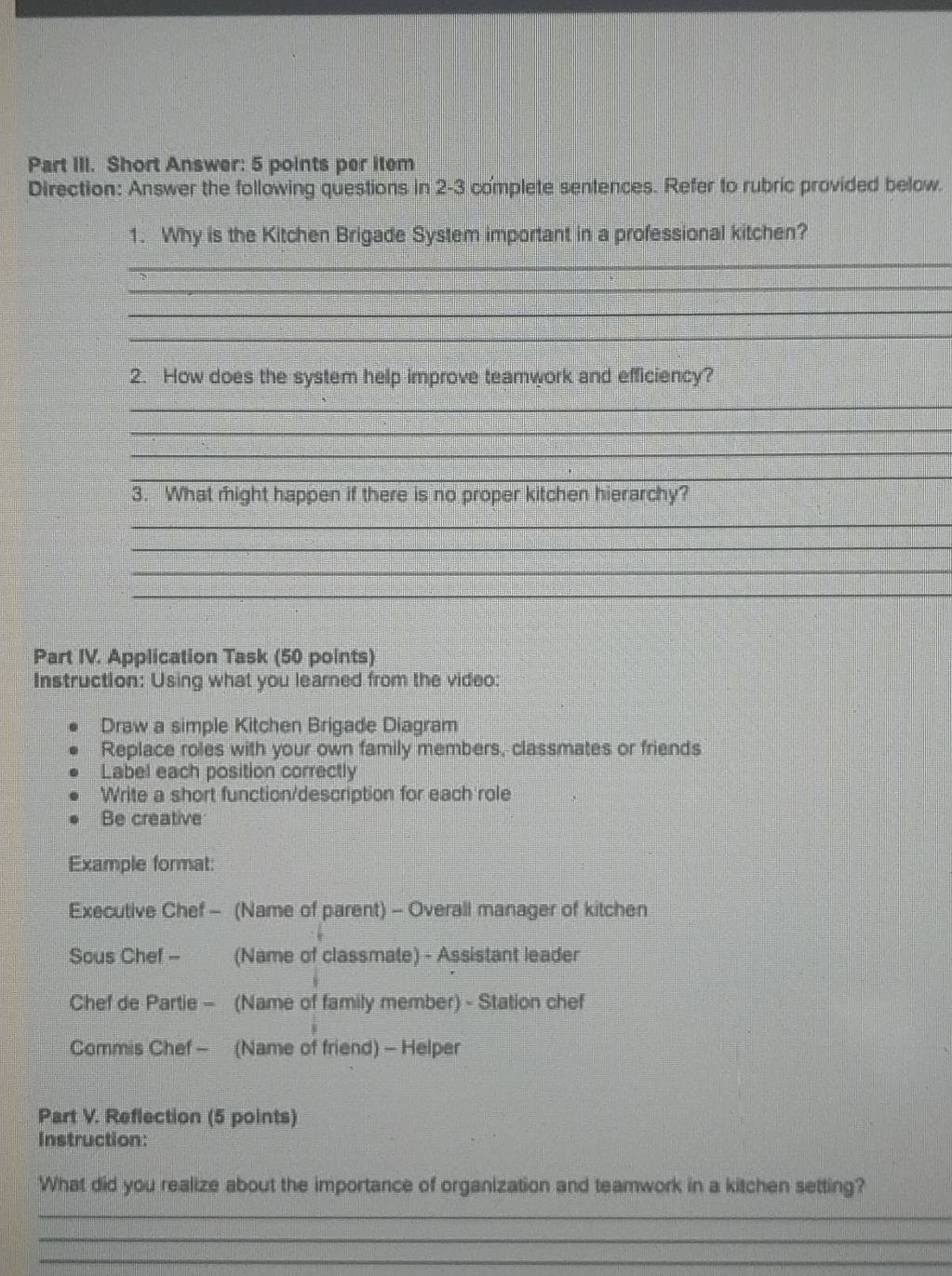
part iii. short answer: 5 points per item
direction: answer the following questions in 2-3 complete sentences. refer to rubric provided below.
- why is the kitchen brigade system important in a professional kitchen?
- how does the system help improve teamwork and efficiency?
- what might happen if there is no proper kitchen hierarchy?
part iv. application task (50 points)
instruction: using what you learned from the video:
- draw a simple kitchen brigade diagram
- replace roles with your own family members, classmates or friends
- label each position correctly
- write a short function/description for each role
- be creative
example format:
executive chef - (name of parent) - overall manager of kitchen
sous chef - (name of classmate) - assistant leader
chef de partie - (name of family member) - station chef
commis chef - (name of friend) - helper
part v. reflection (5 points)
instruction:
what did you realize about the importance of organization and teamwork in a kitchen setting?
🆕 New Concept Discovered: Kitchen Brigade System (Brigade de Cuisine)
Structured hierarchy for culinary efficiency and organization
---
Step 1: Answer Part III, Question 1
Why is the Kitchen Brigade System important in a professional kitchen?
The Kitchen Brigade System, originally created by Georges Auguste Escoffier, is essential because it establishes a clear, structured hierarchy that streamlines kitchen operations. By assigning specific duties to specialized stations, it eliminates confusion and ensures that high-quality food is prepared consistently and quickly. This structured division of labor is what allows high-volume professional kitchens to run smoothly under pressure.
---
Step 2: Answer Part III, Question 2
How does the system help improve teamwork and efficiency?
This system improves efficiency by ensuring every staff member knows exactly what tasks they are responsible for, preventing overlapping duties and wasted movement. Teamwork is enhanced because the clear chain of command allows for seamless communication and coordination between different stations, such as the saucier and the poissonier. When each specialized station completes its role on time, the entire kitchen functions as a cohesive, well-oiled machine.
---
Step 3: Answer Part III, Question 3
What might happen if there is no proper kitchen hierarchy?
Without a proper kitchen hierarchy, the kitchen would likely descend into chaos, resulting in disorganization, miscommunication, and delayed food orders. Staff members would duplicate efforts or neglect crucial tasks because no one knows who is in charge of what. Ultimately, this lack of structure leads to high stress levels among the staff, inconsistent food quality, and unsatisfied customers.
---
Step 4: Complete Part IV (Application Task)
Create a personalized Kitchen Brigade Diagram using family, classmates, or friends.
Below is a creative diagram and description format that fulfills all the requirements:
       [ Executive Chef ]
     (Name of Parent: e.g., Maria)
                 │
                 ▼
         [ Sous Chef ]
    (Name of Classmate: e.g., John)
                 │
                 ▼
       [ Chef de Partie ]
   (Name of Sibling: e.g., Sarah)
                 │
                 ▼
        [ Commis Chef ]
(Name of Friend: e.g., Alex)- Executive Chef – Maria (Mother) – Overall manager of the kitchen: She plans the menu, directs the kitchen staff, manages the budget, and ensures that every dish meets high-quality standards before leaving the kitchen.
- Sous Chef – John (Classmate) – Assistant leader: He acts as the second-in-command, directly supervising the kitchen staff, assisting the Executive Chef with daily operations, and stepping in to lead when the head chef is absent.
- Chef de Partie – Sarah (Sister) – Station chef: She is in charge of a specific section of the kitchen (such as the grill or pastry station), managing the preparation and cooking of all items produced at her station.
- Commis Chef – Alex (Friend) – Helper: He works under the Chef de Partie to learn the station's operations, taking care of basic food preparation, cleaning, and assisting with plating.
---
Step 5: Answer Part V (Reflection)
What did you realize about the importance of organization and teamwork in a kitchen setting?
I realized that organization and teamwork are the backbone of any successful kitchen; without them, even the most talented chefs cannot deliver a great dining experience. A kitchen relies on a chain reaction where on…

Snap & solve any problem in the app
Get step-by-step solutions on Sovi AI
Photo-based solutions with guided steps
Explore more problems and detailed explanations
Part III. Short Answer
- Importance: The Kitchen Brigade System is essential because it establishes a clear, structured hierarchy that streamlines kitchen operations. By assigning specific duties to specialized stations, it eliminates confusion and ensures that high-quality food is prepared consistently and quickly.
- Teamwork & Efficiency: This system improves efficiency by ensuring every staff member knows exactly what tasks they are responsible for, preventing overlapping duties. Teamwork is enhanced because the clear chain of command allows for seamless communication and coordination between different stations.
- Lack of Hierarchy: Without a proper kitchen hierarchy, the kitchen would likely descend into chaos, resulting in disorganization, miscommunication, and delayed food orders. Staff members would duplicate efforts or neglect crucial tasks, leading to high stress levels and inconsistent food quality.
Part IV. Application Task
- Executive Chef – Maria (Mother) – Overall manager of the kitchen: Plans the menu, directs the kitchen staff, and ensures every dish meets high-quality standards.
- Sous Chef – John (Classmate) – Assistant leader: Acts as second-in-command, supervising daily operations and assisting the Executive Chef.
- Chef de Partie – Sarah (Sister) – Station chef: Manages a specific section of the kitchen (e.g., grill or pastry) and oversees its food preparation.
- Commis Chef – Alex (Friend) – Helper: Works under the station chef, handling basic prep work, cleaning, and assisting with plating.
Part V. Reflection
I realized that organization and teamwork are the backbone of any successful kitchen; without them, even the most talented chefs cannot deliver a great dining experience. A kitchen relies on a chain reaction where one person's delay affects everyone else, making mutual trust and clear communication absolutely vital. Proper organization reduces stress and transforms a high-pressure environment into a collaborative space.