QUESTION IMAGE
Question
part d
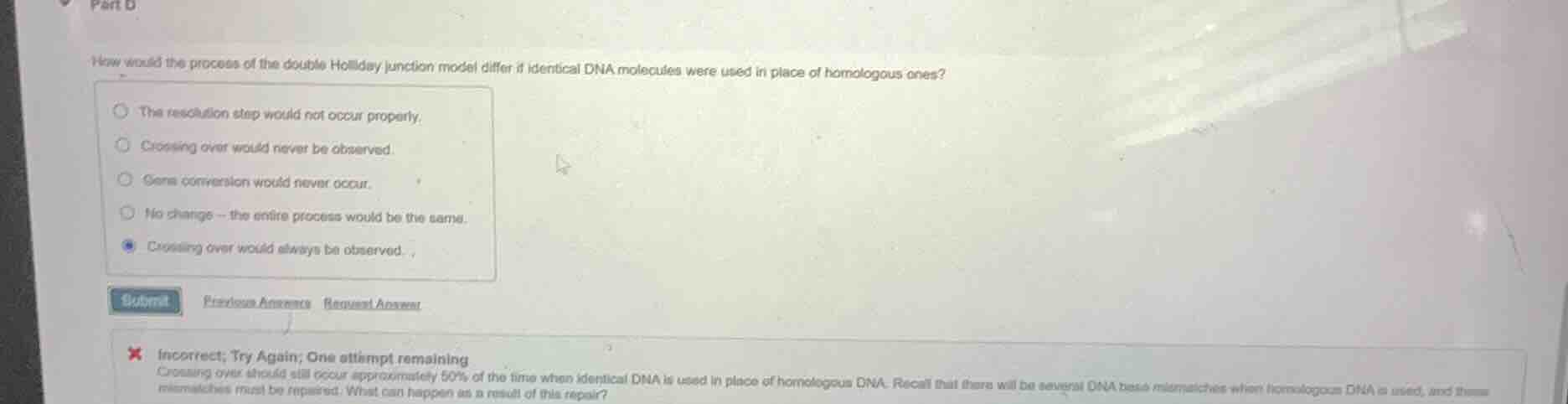
how would the process of the double holliday junction model differ if identical dna molecules were used in place of homologous ones?
- the resolution step would not occur properly.
- crossing over would never be observed.
- gene conversion would never occur.
- no change - the entire process would be the same.
- crossing over would always be observed.
Analyze the question and feedback
The question asks how the process of the Double Holliday Junction Model would differ if identical DNA molecules were used instead of homologous ones.
The feedback at the bottom states:
"Crossing over should still occur approximately 50% of the time when identical DNA is used in place of homologous DNA. Recall that there will be several DNA base mismatches when homologous DNA is used, and these mismatches must be repaired. What can happen as a result of this repair?"
Evaluate the biological mechanism
Using the Double Holliday Junction Model knowledge point:
- Homologous chromosomes have minor sequence differences (alleles), leading to base mismatches (heteroduplex DNA) during strand invasion and branch migration.
- These mismatches are recognized and repaired by mismatch repair machinery, which can lead to Gene Conversion (where one allele is converted to the other).
- If identical DNA molecules are used, there are no sequence differences. Therefore, no heteroduplex mismatches are formed, and mismatch repair cannot occur.
- Consequently, Gene Conversion (which relies on mismatch repair of heteroduplex DNA) would never occur.
Assess the options
- The resolution step would not occur properly: Incorrect. Resolution enzymes (resolvases) recognize the physical structure of the junction, not sequence differences.
- Crossing over would never be observed: Incorrect. The feedback confirms crossing over still occurs about 50% of the time.
- Gene conversion would never occur: Correct. Without sequence differences, there are no mismatches to repair, preventing gene conversion.
- No change - the entire process would be the same: Incorrect. Gene conversion is a key outcome that would be lost.
- Crossing over would always be observed: Incorrect (and marked wrong in the image).
Formulate the explanation
Using the Gene Conversion knowledge point:
- Explain that homologous chromosomes contain sequence polymorphisms that form heteroduplex DNA with mismatches during recombination.
- Explain that mismatch repair of these heteroduplex regions is the molecular basis of gene conversion.
- Conclude that with identical DNA, no mismatches exist, so gene conversion cannot occur.

Snap & solve any problem in the app
Get step-by-step solutions on Sovi AI
Photo-based solutions with guided steps
Explore more problems and detailed explanations
- The resolution step would not occur properly.
- Crossing over would never be observed.
- Gene conversion would never occur. (Correct answer)
- No change - the entire process would be the same.
- Crossing over would always be observed.