QUESTION IMAGE
Question
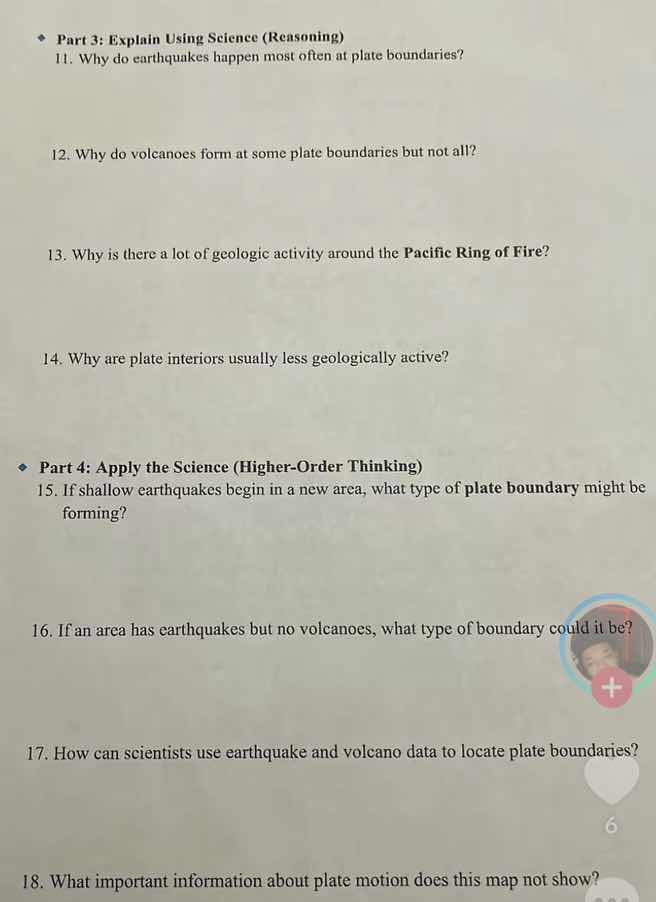
part 3: explain using science (reasoning)
- why do earthquakes happen most often at plate boundaries?
- why do volcanoes form at some plate boundaries but not all?
- why is there a lot of geologic activity around the pacific ring of fire?
- why are plate interiors usually less geologically active?
part 4: apply the science (higher-order thinking)
- if shallow earthquakes begin in a new area, what type of plate boundary might be forming?
- if an area has earthquakes but no volcanoes, what type of boundary could it be?
- how can scientists use earthquake and volcano data to locate plate boundaries?
- what important information about plate motion does this map not show?
Analyze Part 3: Explain Using Science (Reasoning)
- Question 11: Earthquakes occur due to the release of accumulated stress as tectonic plates grind past, collide, or pull apart from each other at their boundaries.
- Question 12: Volcanoes require magma generation, which occurs at subduction zones (convergent boundaries) or rifting zones (divergent boundaries) where pressure drops or water lowers the melting point, but not at transform boundaries where plates slide horizontally without melting.
- Question 13: The Pacific Ring of Fire is surrounded by active subduction zones and transform faults, leading to high concentrations of tectonic interactions, earthquakes, and volcanic eruptions.
- Question 14: Plate interiors are far from active boundaries where stress accumulates and magma rises, making them geologically stable and quiet.
Analyze Part 4: Apply the Science (Higher-Order Thinking)
- Question 15: Shallow earthquakes without deep ones typically indicate a divergent boundary (rifting) or a transform boundary beginning to form.
- Question 16: A boundary with earthquakes but no volcanoes is characteristic of a transform boundary (where plates slide past each other without subduction or melting) or a continent-continent convergent boundary (which forms mountains but lacks subduction-related volcanism).
- Question 17: Plotting the epicenters of earthquakes and locations of volcanoes reveals distinct, linear patterns that trace the outlines of tectonic plates.
- Question 18: The map (referenced in the text) does not show the rate/speed of plate motion, the direction of plate movement (vectors), or the depth of the earthquakes.

Snap & solve any problem in the app
Get step-by-step solutions on Sovi AI
Photo-based solutions with guided steps
Explore more problems and detailed explanations
Question 11
Earthquakes happen most often at plate boundaries because these are the areas where tectonic plates actively interact, build up stress due to friction, and suddenly release energy when they slip.
Question 12
Volcanoes only form where magma can reach the surface, which occurs at divergent boundaries (rifting) and subduction zones (convergent boundaries), but not at transform boundaries where plates slide horizontally without creating magma.
Question 13
The Pacific Ring of Fire is a continuous series of subduction zones and plate boundaries where oceanic plates are sliding under continental plates, causing massive amounts of friction, melting, and tectonic activity.
Question 14
Plate interiors are located far from the edges where plates collide, separate, or slide past one another, meaning there is very little stress accumulation or magma generation to cause geologic activity.
Question 15
A divergent boundary (rifting) or a transform boundary.
Question 16
A transform boundary (or a continent-continent convergent boundary).
Question 17
By plotting the locations of earthquakes and volcanoes on a map, scientists can see that they form distinct linear belts which outline the edges of the tectonic plates.
Question 18
The map does not show the direction of plate movement (vectors), the speed/rate of plate motion, or the depth of the earthquakes.