QUESTION IMAGE
Question
parameters reference vs primitive
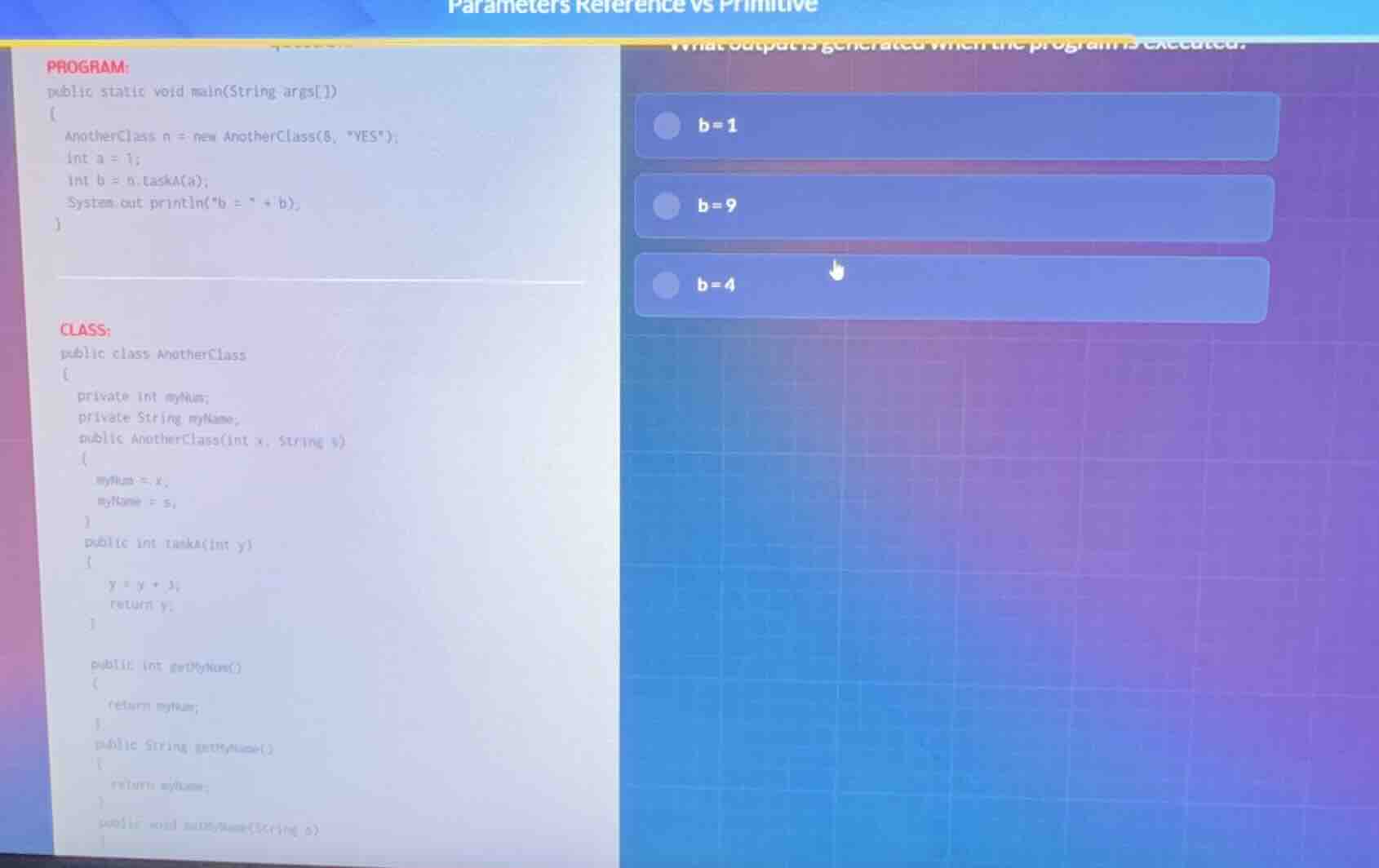
what output is generated when the program is executed?
program:
public static void main(string args)
{
anotherclass n = new anotherclass(8, \yes\);
int a = 1;
int b = n.taska(a);
system.out.println(\b = \ + b);
}
class:
public class anotherclass
{
private int mynum;
private string myname;
public anotherclass(int x, string s)
{
mynum = x;
myname = s;
}
public int taska(int y)
{
y = y + 3;
return y;
}
public int getmynum()
{
return mynum;
}
public string getmyname()
{
return myname;
}
}
options:
- b = 1
- b = 9
- b = 4
🆕 New Concept Discovered: Java Parameter Passing (Value vs. Reference)
How Java passes variables to methods
Step 1: Analyze the main program execution
We start inside the main method:
- An object
nof typeAnotherClassis instantiated:
AnotherClass n = new AnotherClass(8, "YES");This sets the instance variable myNum to 8 and myName to "YES".
- A primitive integer variable
ais declared and initialized to1:
int a = 1;- The method
taskAis called on objectnwithapassed as an argument:
int b = n.taskA(a);Step 2: Trace the method execution
Let's look at the definition of taskA in AnotherClass:
public int taskA(int y)
{
    y = y + 3;
    return y;
}- When
n.taskA(a)is called, the value ofa(which is1) is copied into the local parametery. - Inside the method,
yis updated:
- The method returns the value of
y, which is4.
Step 3: Determine the final output
- The returned value
4is assigned to the variablebin themainmethod:
int b = n.taskA(a); // b becomes 4- The program prints the value of
b:
System.out.println("b = " + b);This outputs: b = 4.

Snap & solve any problem in the app
Get step-by-step solutions on Sovi AI
Photo-based solutions with guided steps
Explore more problems and detailed explanations
b = 4