QUESTION IMAGE
Question
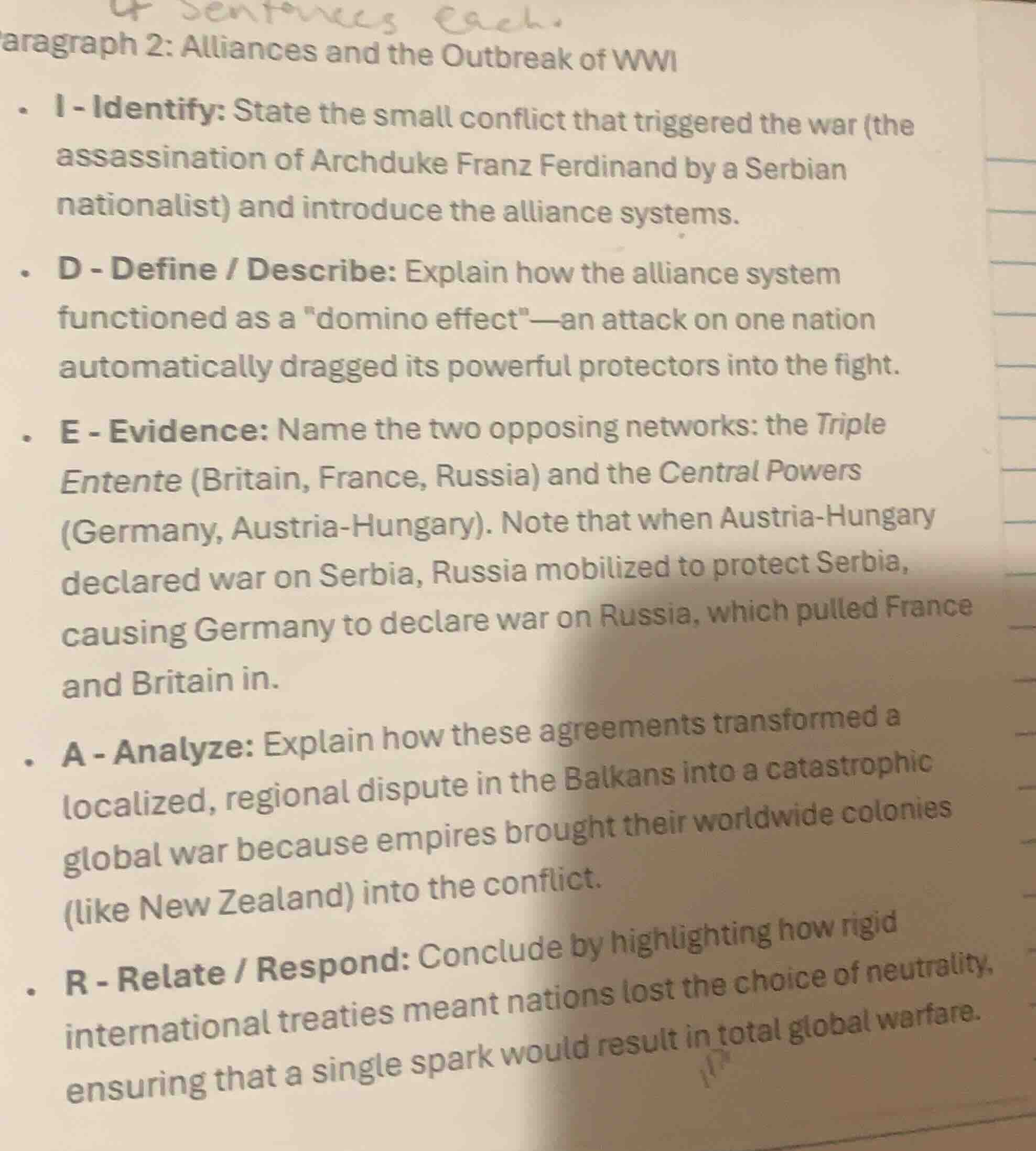
paragraph 2: alliances and the outbreak of wwi
- i - identify: state the small conflict that triggered the war (the assassination of archduke franz ferdinand by a serbian nationalist) and introduce the alliance systems.
- d - define / describe: explain how the alliance system functioned as a \domino effect\—an attack on one nation automatically dragged its powerful protectors into the fight.
- e - evidence: name the two opposing networks: the triple entente (britain, france, russia) and the central powers (germany, austria-hungary). note that when austria-hungary declared war on serbia, russia mobilized to protect serbia, causing germany to declare war on russia, which pulled france and britain in.
- a - analyze: explain how these agreements transformed a localized, regional dispute in the balkans into a catastrophic global war because empires brought their worldwide colonies (like new zealand) into the conflict.
- r - relate / respond: conclude by highlighting how rigid international treaties meant nations lost the choice of neutrality, ensuring that a single spark would result in total global warfare.
Draft the paragraph using the IDEAR structure
The assassination of Archduke Franz Ferdinand by a Serbian nationalist triggered a localized conflict that quickly activated Europe's complex alliance systems. This system functioned as a "domino effect," where an attack on one nation automatically dragged its powerful protectors into a wider war. Specifically, the two opposing networks were the Triple Entente (Britain, France, and Russia) and the Central Powers (Germany and Austria-Hungary); when Austria-Hungary declared war on Serbia, Russia mobilized to protect Serbia, prompting Germany to declare war on Russia, which subsequently pulled France and Britain into the conflict. These agreements transformed a regional dispute in the Balkans into a catastrophic global war because empires brought their worldwide colonies, such as New Zealand, into the fight. Ultimately, rigid international treaties meant nations lost the choice of neutrality, ensuring that a single spark would result in total global warfare.

Snap & solve any problem in the app
Get step-by-step solutions on Sovi AI
Photo-based solutions with guided steps
Explore more problems and detailed explanations
The assassination of Archduke Franz Ferdinand by a Serbian nationalist triggered a localized conflict that quickly activated Europe's complex alliance systems. This system functioned as a "domino effect," where an attack on one nation automatically dragged its powerful protectors into a wider war. Specifically, the two opposing networks were the Triple Entente (Britain, France, and Russia) and the Central Powers (Germany and Austria-Hungary); when Austria-Hungary declared war on Serbia, Russia mobilized to protect Serbia, prompting Germany to declare war on Russia, which subsequently pulled France and Britain into the conflict. These agreements transformed a regional dispute in the Balkans into a catastrophic global war because empires brought their worldwide colonies, such as New Zealand, into the fight. Ultimately, rigid international treaties meant nations lost the choice of neutrality, ensuring that a single spark would result in total global warfare.