QUESTION IMAGE
Question
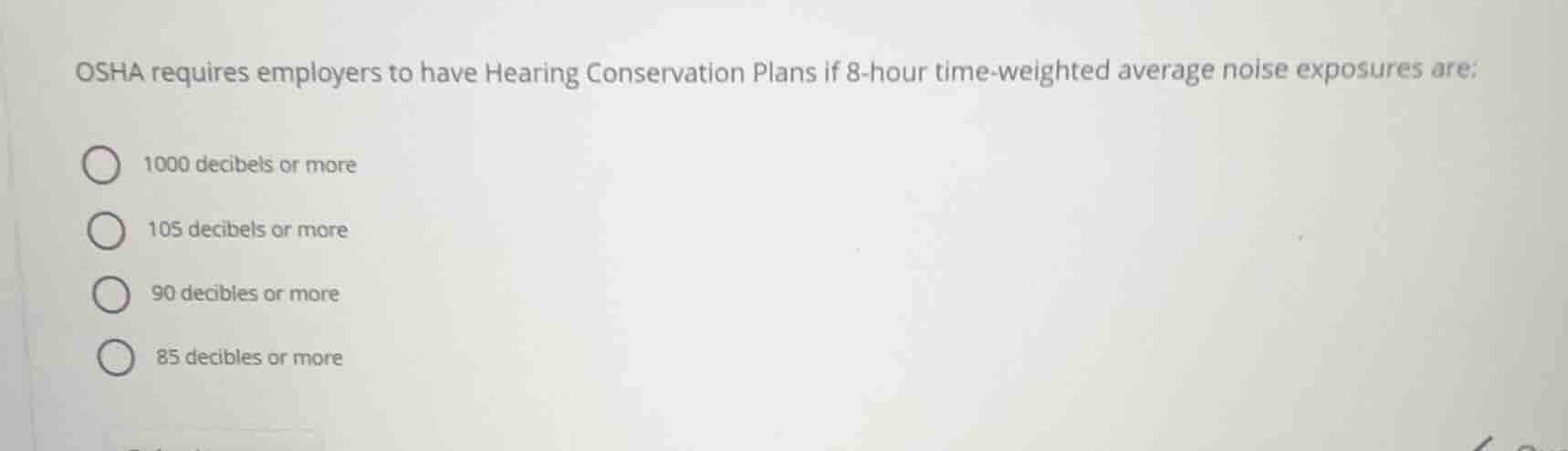
osha requires employers to have hearing conservation plans if 8-hour time-weighted average noise exposures are:
1000 decibels or more
105 decibels or more
90 decibels or more
85 decibels or more
Identify the regulatory context
The question asks for the threshold at which OSHA requires employers to implement a Hearing Conservation Program based on an 8-hour time-weighted average (TWA) noise exposure. This falls under OSHA Standards for occupational health.
Recall the specific noise standard
Under OSHA Standards (specifically 29 CFR 1910.95), employers must administer a continuing, effective hearing conservation program whenever employee noise exposures equal or exceed an 8-hour time-weighted average sound level of 85 decibels (dB) measured on the A scale (dBA).
Compare with the given options
Let's evaluate the options provided in the question:
- 1000 decibels or more: Extremely high, physically impossible for human survival.
- 105 decibels or more: Higher than the action level.
- 90 decibels or more: This is the Permissible Exposure Limit (PEL) for an 8-hour TWA, but the conservation plan action level is lower.
- 85 decibels or more: This is the official OSHA Action Level requiring a Hearing Conservation Plan.
Formulate the final conclusion
The correct threshold for implementing a Hearing Conservation Plan is 85 decibels or more. This is a key component of Occupational Safety to prevent work-related hearing loss.

Snap & solve any problem in the app
Get step-by-step solutions on Sovi AI
Photo-based solutions with guided steps
Explore more problems and detailed explanations
- (A) 1000 decibels or more
- (B) 105 decibels or more
- (C) 90 decibels or more
- (D) 85 decibels or more (Correct answer)