QUESTION IMAGE
Question
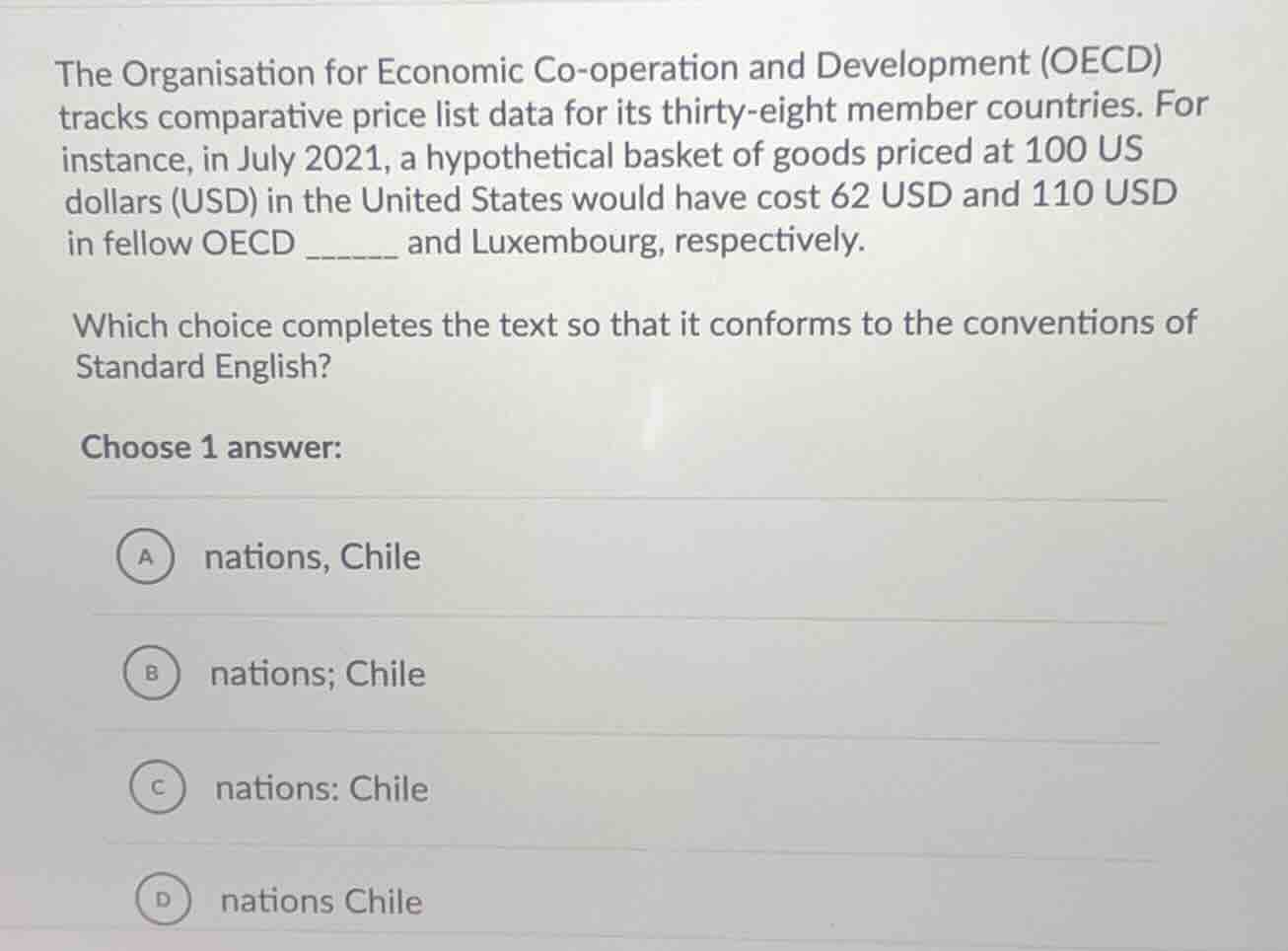
the organisation for economic co-operation and development (oecd) tracks comparative price list data for its thirty-eight member countries. for instance, in july 2021, a hypothetical basket of goods priced at 100 us dollars (usd) in the united states would have cost 62 usd and 110 usd in fellow oecd ______ and luxembourg, respectively.
which choice completes the text so that it conforms to the conventions of standard english?
choose 1 answer:
a nations, chile
b nations; chile
c nations: chile
d nations chile
Analyze the sentence structure
The sentence reads: "...a hypothetical basket of goods priced at 100 US dollars (USD) in the United States would have cost 62 USD and 110 USD in fellow OECD ______ and Luxembourg, respectively."
We need to determine how to connect "fellow OECD nations" and "Chile" to the rest of the sentence.
Evaluate the grammatical relationship
The phrase "fellow OECD nations" is a noun phrase acting as the object of the preposition "in".
The specific countries being referred to are "Chile" and "Luxembourg", which correspond to the two prices listed ("62 USD and 110 USD") respectively.
"Chile" and "Luxembourg" are joined by the coordinating conjunction "and".
Therefore, "Chile" is the first of the two parallel elements in the compound object of the preposition "in": "in fellow OECD nations [which are] Chile and Luxembourg".
Test the punctuation options
Let's test each option to see if it maintains grammatical flow:
- Option A (nations, Chile): "...in fellow OECD nations, Chile and Luxembourg, respectively." This inserts a comma after "nations", which incorrectly sets off "Chile and Luxembourg" as a non-essential appositive. However, "Chile and Luxembourg" are essential to complete the meaning of which "fellow OECD nations" are being discussed.
- Option B (nations; Chile): A semicolon is used to link two independent clauses or to separate items in a complex list that already contains commas. Neither condition is met here.
- Option C (nations: Chile): A colon must follow an independent clause. "For instance, in July 2021, a hypothetical basket of goods priced at 100 US dollars (USD) in the United States would have cost 62 USD and 110 USD in fellow OECD nations" is not a complete independent clause because "respectively" requires the specific entities to be named directly within the main clause structure to make sense.
- Option D (nations Chile): "...in fellow OECD nations Chile and Luxembourg, respectively." Here, "Chile and Luxembourg" acts as a restrictive appositive identifying which specific "fellow OECD nations" are being referred to. No punctuation is needed between the noun "nations" and the specific names "Chile and Luxembourg". This creates a smooth, grammatically correct flow.

Snap & solve any problem in the app
Get step-by-step solutions on Sovi AI
Photo-based solutions with guided steps
Explore more problems and detailed explanations
- (A) nations, Chile
- (B) nations; Chile
- (C) nations: Chile
- (D) nations Chile (Correct answer)