QUESTION IMAGE
Question
5
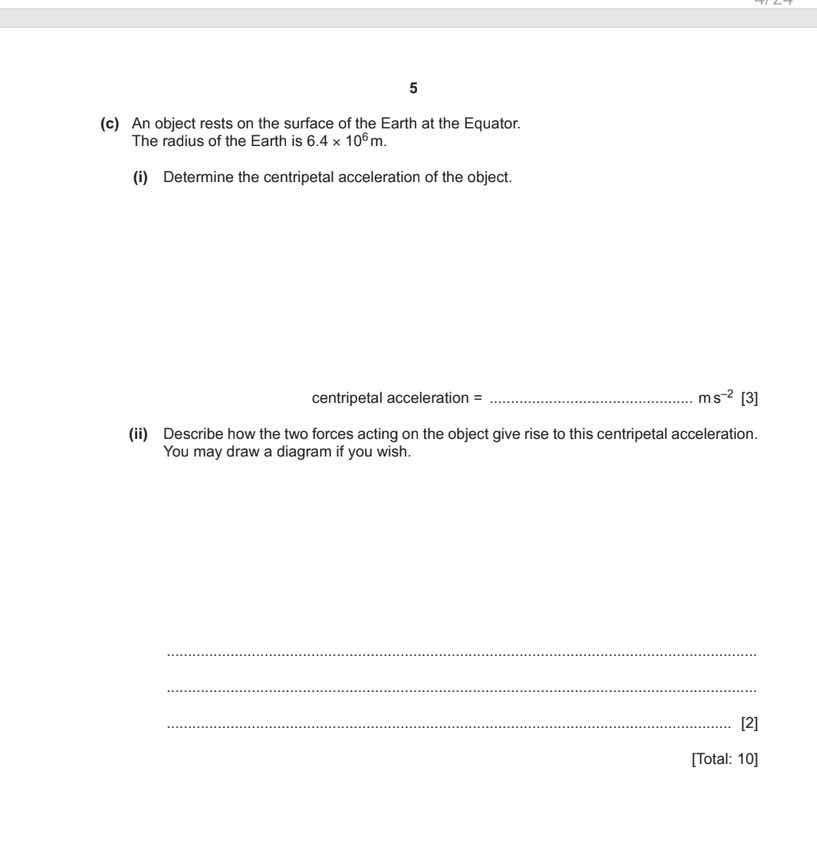
(c) an object rests on the surface of the earth at the equator.
the radius of the earth is \\(6.4 \times 10^6\text{ m}\\).
(i) determine the centripetal acceleration of the object.
centripetal acceleration = ............................................................ \\(\text{ms}^{-2}\\) 3
(ii) describe how the two forces acting on the object give rise to this centripetal acceleration.
you may draw a diagram if you wish.
..................................................................................................................................
..................................................................................................................................
............................................................................................................................ 2
total: 10
Calculate the angular velocity of the Earth
To find the centripetal acceleration of an object resting at the Equator, we first determine the angular velocity \(\omega\) of the Earth's rotation. The Earth rotates once on its axis every 24 hours.
Calculate the centripetal acceleration
Using the Centripetal Force concept, we find the centripetal acceleration \(a_c\) using the radius of the Earth \(R = 6.4 \times 10^6 \text{ m}\).
Identify the forces acting on the object
Two forces act on the object resting at the Equator:
- The gravitational force (weight) acting inwards towards the center of the Earth.
- The normal contact force acting outwards, perpendicular to the Earth's surface.
Explain the resultant centripetal force
The gravitational force is larger than the normal contact force. The resultant of these two opposing forces provides the necessary centripetal force directed towards the center of the Earth, which produces the centripetal acceleration:

Snap & solve any problem in the app
Get step-by-step solutions on Sovi AI
Photo-based solutions with guided steps
Explore more problems and detailed explanations
Question (c)(i)
centripetal acceleration = <blank>\(0.034\)</blank> \(\text{m s}^{-2}\)
Question (c)(ii)
The two forces acting on the object are the gravitational force directed inwards towards the center of the Earth and the normal contact force directed outwards. The gravitational force is slightly larger than the normal force, and their resultant force points towards the center of the Earth, providing the required centripetal force that produces the centripetal acceleration.