QUESTION IMAGE
Question
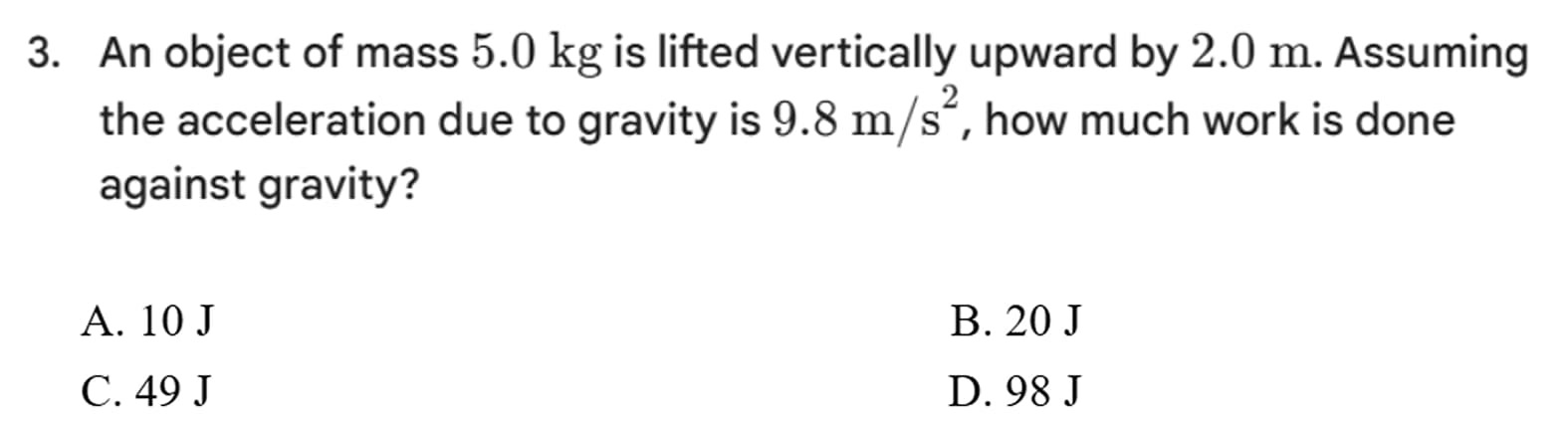
- an object of mass \\(5.0\text{ kg}\\) is lifted vertically upward by \\(2.0\text{ m}\\). assuming the acceleration due to gravity is \\(9.8\text{ m/s}^2\\), how much work is done against gravity?
a. \\(10\text{ j}\\)
b. \\(20\text{ j}\\)
c. \\(49\text{ j}\\)
d. \\(98\text{ j}\\)
Identify the given physical parameters
We extract the values from the problem statement:
- Mass of the object: \(m = 5.0\text{ kg}\)
- Vertical displacement: \(h = 2.0\text{ m}\)
- Acceleration due to gravity: \(g = 9.8\text{ m/s}^2\)
State the formula for work against gravity
The force required to lift the object at a constant velocity is equal in magnitude to its weight:
$$F = m \cdot g$$
The work done by this lifting force over a vertical distance \(h\) is:
$$W = F \cdot h = m \cdot g \cdot h$$
Calculate the numerical value of work
Substitute the given values into the work formula:
$$W = (5.0\text{ kg}) \cdot (9.8\text{ m/s}^2) \cdot (2.0\text{ m})$$
$$W = 49\text{ kg}\cdot\text{m}^2/\text{s}^2 = 49\text{ J}$$
Match the result with the options
The calculated work is \(49\text{ J}\), which corresponds to option C.

Snap & solve any problem in the app
Get step-by-step solutions on Sovi AI
Photo-based solutions with guided steps
Explore more problems and detailed explanations
- (A) 10 J
- (B) 20 J
- (C) 49 J (Correct answer)
- (D) 98 J