QUESTION IMAGE
Question
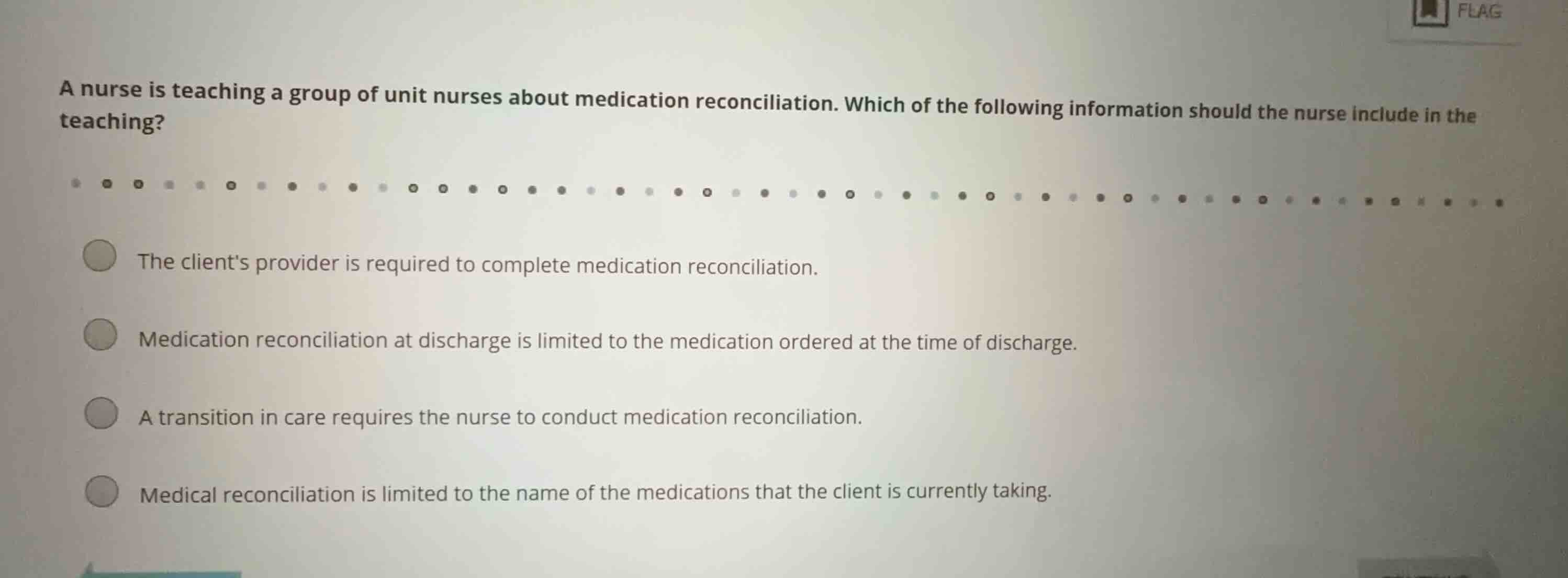
a nurse is teaching a group of unit nurses about medication reconciliation. which of the following information should the nurse include in the teaching?
the clients provider is required to complete medication reconciliation.
medication reconciliation at discharge is limited to the medication ordered at the time of discharge.
a transition in care requires the nurse to conduct medication reconciliation.
medical reconciliation is limited to the name of the medications that the client is currently taking.
Define medication reconciliation
Medication reconciliation is a formal process of creating the most accurate list possible of all medications a patient is taking (including drug name, dosage, frequency, and route) and comparing that list against the physician's admission, transfer, and/or discharge orders. The primary goal is to prevent medication errors such as omissions, duplications, dosing errors, or drug interactions.
Identify when medication reconciliation is required
According to national patient safety goals (such as those established by The Joint Commission), medication reconciliation must occur at every transition of care. Transitions of care include:
- Admission to a healthcare facility.
- Transfer from one unit/level of care to another (e.g., from the Intensive Care Unit to a general medical-surgical floor).
- Discharge from the facility to home or another facility.
Evaluate the given options
- Option 1: "The client's provider is required to complete medication reconciliation."
While providers (physicians, nurse practitioners, physician assistants) write the orders, the actual process of gathering, comparing, and reconciling the medication list is a collaborative interdisciplinary task that is frequently performed and completed by nurses or pharmacists. It is not solely the provider's requirement.
- Option 2: "Medication reconciliation at discharge is limited to the medication ordered at the time of discharge."
This is incorrect. Discharge reconciliation must compare the pre-admission medications with those prescribed at discharge to ensure no necessary home medications are inadvertently omitted or duplicated.
- Option 3: "A transition in care requires the nurse to conduct medication reconciliation."
This is correct. Any transition in care (admission, transfer, discharge) is a critical point where medication discrepancies are highly likely to occur, requiring a formal reconciliation process.
- Option 4: "Medical reconciliation is limited to the name of the medications that the client is currently taking."
This is incorrect. The process is comprehensive and must include the drug name, dosage, frequency, route, and the purpose/indication of each medication.

Snap & solve any problem in the app
Get step-by-step solutions on Sovi AI
Photo-based solutions with guided steps
Explore more problems and detailed explanations
- (A) The client's provider is required to complete medication reconciliation.
- (B) Medication reconciliation at discharge is limited to the medication ordered at the time of discharge.
- (C) A transition in care requires the nurse to conduct medication reconciliation. (Correct answer)
- (D) Medical reconciliation is limited to the name of the medications that the client is currently taking.