QUESTION IMAGE
Question
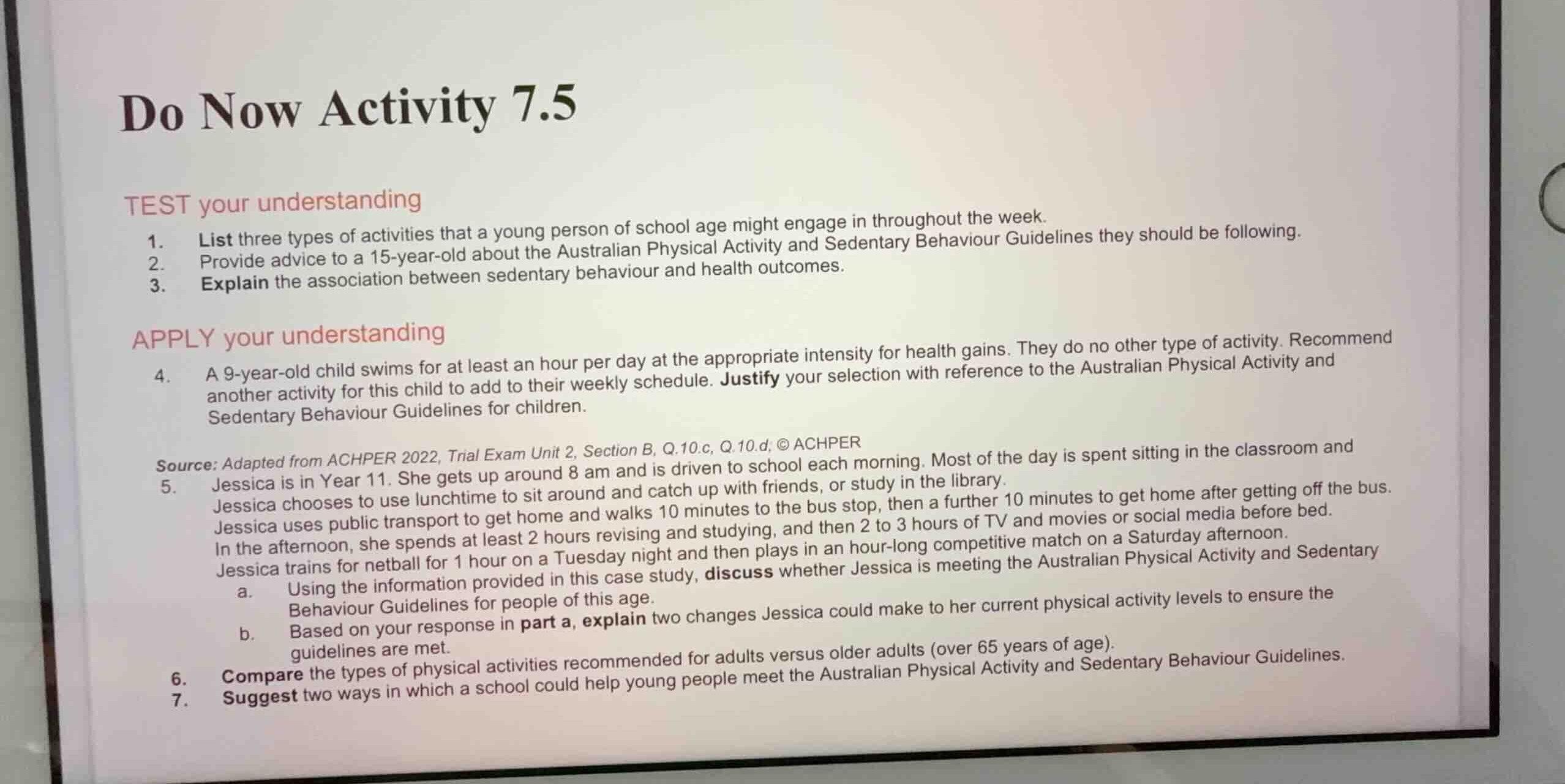
do now activity 7.5
test your understanding
- list three types of activities that a young person of school age might engage in throughout the week.
- provide advice to a 15-year-old about the australian physical activity and sedentary behaviour guidelines they should be following.
- explain the association between sedentary behaviour and health outcomes.
apply your understanding
- a 9-year-old child swims for at least an hour per day at the appropriate intensity for health gains. they do no other type of activity. recommend another activity for this child to add to their weekly schedule. justify your selection with reference to the australian physical activity and sedentary behaviour guidelines for children.
source: adapted from achper 2022, trial exam unit 2, section b, q.10.c, q.10.d; © achper
- jessica is in year 11. she gets up around 8 am and is driven to school each morning. most of the day is spent sitting in the classroom and jessica chooses to use lunchtime to sit around and catch up with friends, or study in the library.
jessica uses public transport to get home and walks 10 minutes to the bus stop, then a further 10 minutes to get home after getting off the bus.
in the afternoon, she spends at least 2 hours revising and studying, and then 2 to 3 hours of tv and movies or social media before bed.
jessica trains for netball for 1 hour on a tuesday night and then plays in an hour-long competitive match on a saturday afternoon.
a. using the information provided in this case study, discuss whether jessica is meeting the australian physical activity and sedentary behaviour guidelines for people of this age.
b. based on your response in part a, explain two changes jessica could make to her current physical activity levels to ensure the guidelines are met.
- compare the types of physical activities recommended for adults versus older adults (over 65 years of age).
- suggest two ways in which a school could help young people meet the australian physical activity and sedentary behaviour guidelines.
Identify the core requirements of each question
- List three activity types for school-aged youth.
- Provide physical activity advice for a 15-year-old based on Australian Guidelines.
- Explain the link between sedentary behaviour and health outcomes.
- Recommend and justify an additional activity for a swimming 9-year-old.
5a. Evaluate Jessica's compliance with the guidelines.
5b. Propose two changes for Jessica to meet the guidelines.
- Compare activity recommendations for adults vs. older adults.
- Suggest two school-based strategies to support meeting guidelines.
Formulate concise answers based on Australian Physical Activity Guidelines
- Youth (5-17 years) need \(\ge 60\) minutes of moderate-to-vigorous physical activity (MVPA) daily, incorporating muscle/bone strengthening 3 days/week, and limiting sedentary screen time to \(\le 2\) hours/day.
- Children (5-12 years) have similar daily MVPA and strengthening requirements.
- Adults (18-64) need 150-300 minutes of moderate or 75-150 minutes of vigorous activity weekly, plus muscle strengthening 2 days/week.
- Older adults (65+) need at least 30 minutes of daily physical activity, focusing on fitness, strength, balance, and flexibility.
Compile direct responses for all questions
- Q1: Aerobic, muscle-strengthening, bone-strengthening.
- Q2: Accumulate \(\ge 60\) minutes of moderate-to-vigorous physical activity daily and limit recreational screen time to \(\le 2\) hours daily.
- Q3: High sedentary time increases risks of cardiovascular disease, type 2 diabetes, and poor cardiometabolic health.
- Q4: Resistance training or gymnastics. Justification: Swimming is non-weight-bearing; bone-strengthening activities are required 3 days/week.
- Q5a: Not meeting guidelines. She only gets 2 hours of physical activity per week (netball) and exceeds 2 hours of daily sedentary screen time.
- Q5b: Walk to/from school instead of being driven; replace 1 hour of evening TV with moderate exercise.
- Q6: Adults focus on intensity ranges (150-300 mins MVPA) and strength; older adults prioritize daily movement, balance, and flexibility regardless of intensity.
- Q7: Implement active recess programs and offer extracurricular sports clubs.

Snap & solve any problem in the app
Get step-by-step solutions on Sovi AI
Photo-based solutions with guided steps
Explore more problems and detailed explanations
Question 1
- Aerobic activities (e.g., running)
- Muscle-strengthening activities (e.g., push-ups)
- Bone-strengthening activities (e.g., jumping rope)
Question 2
Accumulate at least 60 minutes of moderate-to-vigorous physical activity daily, incorporate muscle and bone strengthening activities at least 3 days per week, and limit recreational screen time to no more than 2 hours per day.
Question 3
High levels of sedentary behaviour are strongly associated with adverse health outcomes, including increased risks of cardiovascular disease, type 2 diabetes, obesity, and poorer cardiometabolic health.
Question 4
- Recommendation: Gymnastics or running.
- Justification: Swimming is a non-weight-bearing activity. The guidelines state children need bone-strengthening activities (which require impact forces) at least 3 days per week.
Question 5
- a. Jessica is not meeting the guidelines. She only accumulates 2 hours of physical activity per week (netball training and play) instead of the recommended 60 minutes daily, and her daily recreational screen time (2 to 3 hours of TV/social media) exceeds the 2-hour limit.
- b.
- Walk or cycle to and from school instead of being driven.
- Replace 1 hour of sedentary TV/social media time after school with a moderate-to-vigorous physical activity, such as a brisk walk or jog.
Question 6
Adults (18–64 years) are recommended to accumulate 150 to 300 minutes of moderate activity (or 75 to 150 minutes of vigorous activity) weekly plus muscle-strengthening on 2 days. Older adults (65+ years) are advised to be active daily for at least 30 minutes, with a specific emphasis on multi-component training that incorporates balance, flexibility, and strength to prevent falls.
Question 7
- Introduce active recess and lunchtime equipment loans or structured intramural sports.
- Implement active travel initiatives, such as secure bicycle storage and walking school bus programs.