QUESTION IMAGE
Question
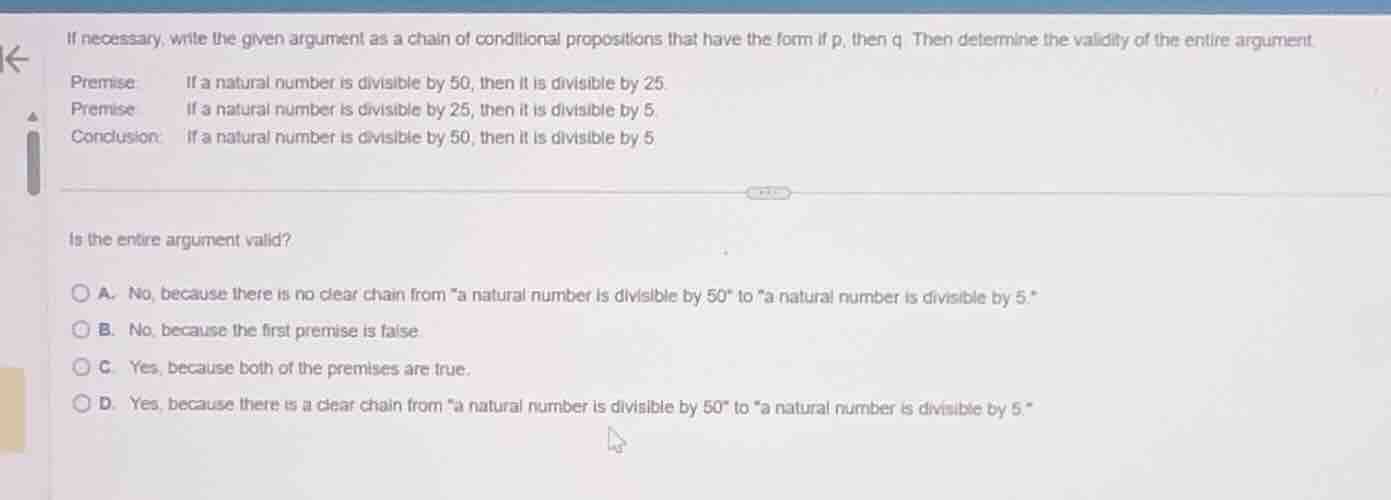
if necessary, write the given argument as a chain of conditional propositions that have the form if p, then q. then determine the validity of the entire argument.
premise: if a natural number is divisible by 50, then it is divisible by 25.
premise: if a natural number is divisible by 25, then it is divisible by 5.
conclusion: if a natural number is divisible by 50, then it is divisible by 5.
is the entire argument valid?
a. no, because there is no clear chain from \a natural number is divisible by 50\ to \a natural number is divisible by 5.\
b. no, because the first premise is false.
c. yes, because both of the premises are true.
d. yes, because there is a clear chain from \a natural number is divisible by 50\ to \a natural number is divisible by 5.\
Define propositional variables
Using the Conditional Statements knowledge point
Let:
- \(p\): A natural number is divisible by 50.
- \(q\): A natural number is divisible by 25.
- \(r\): A natural number is divisible by 5.
Represent premises and conclusion
Using the Conditional Statements knowledge point
- Premise 1: \(p
ightarrow q\)
- Premise 2: \(q
ightarrow r\)
- Conclusion: \(p
ightarrow r\)
Analyze argument validity
Using the Conditional Statements knowledge point
The argument has the form:
This is a valid argument form known as Hypothetical Syllogism, which establishes a clear chain from \(p\) to \(r\).
Match with options
Using the Conditional Statements knowledge point
- Option D states: "Yes, because there is a clear chain from 'a natural number is divisible by 50' to 'a natural number is divisible by 5.'"
- This matches our logical analysis.

Snap & solve any problem in the app
Get step-by-step solutions on Sovi AI
Photo-based solutions with guided steps
Explore more problems and detailed explanations
- (A) No, because there is no clear chain from "a natural number is divisible by 50" to "a natural number is divisible by 5."
- (B) No, because the first premise is false
- (C) Yes, because both of the premises are true.
- (D) Yes, because there is a clear chain from "a natural number is divisible by 50" to "a natural number is divisible by 5." (Correct answer)