QUESTION IMAGE
Question
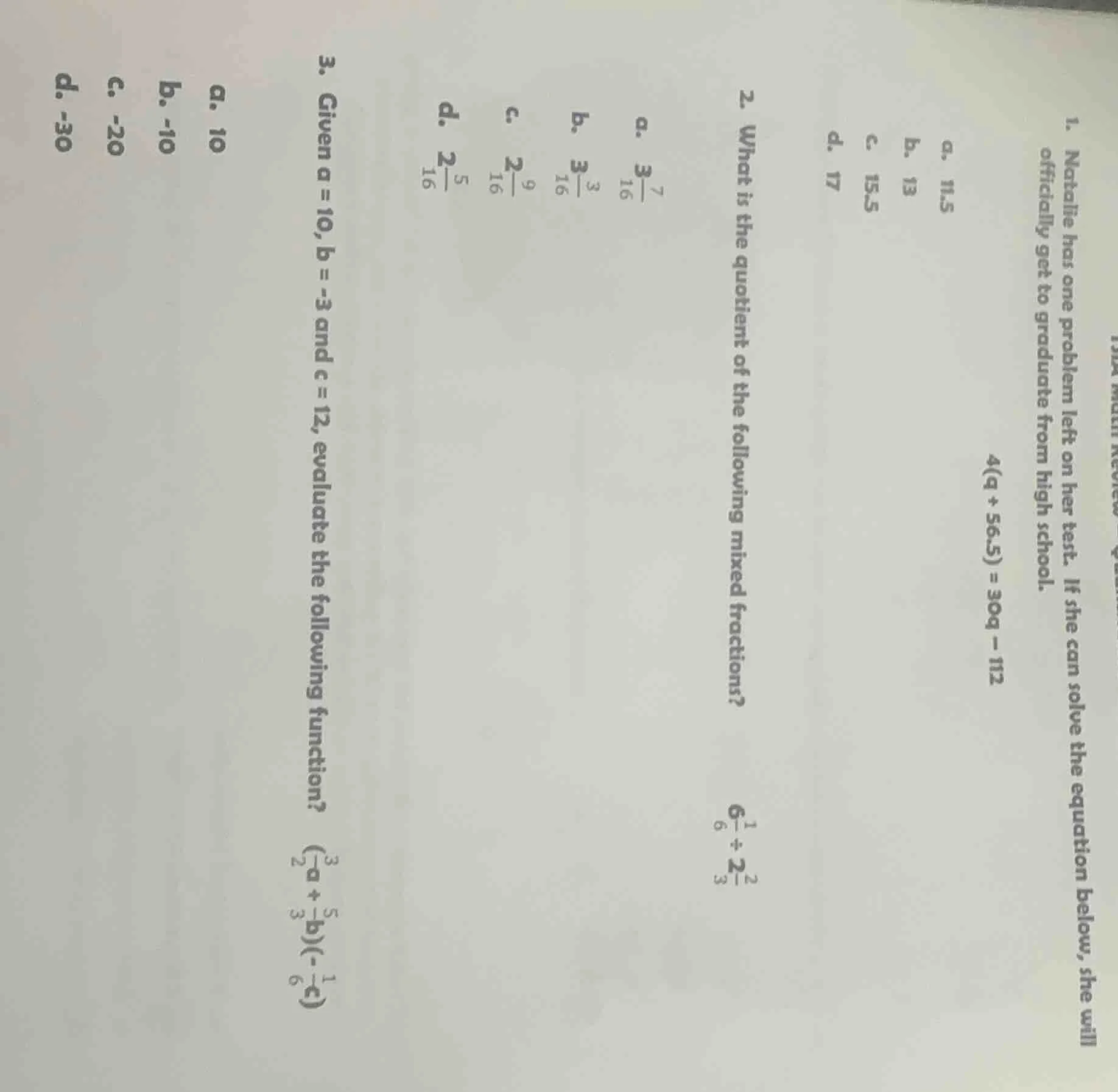
- natalie has one problem left on her test. if she can solve the equation below, she will officially get to graduate from high school.
4(a + 56.5) = 309 − 112
a. 11.5
b. 13
c. 15.5
d. 17
- what is the quotient of the following mixed fractions?
6\frac{1}{6} \div 2\frac{2}{3}
a. 3\frac{7}{16}
b. 3\frac{3}{16}
c. 2\frac{9}{16}
d. 2\frac{5}{16}
- given a = 10, b = -3 and c = 12, evaluate the following function?
\left(\frac{3}{2}a + \frac{5}{3}b\
ight)\left(-\frac{1}{6}c\
ight)
a. 10
b. -10
c. -20
d. -30
Question 1:
Step1: Solve the equation \(4(a + 56.5)=309 - 112\)
First, calculate the right - hand side: \(309-112 = 197\). So the equation becomes \(4(a + 56.5)=197\).
Step2: Divide both sides by 4
\(a + 56.5=\frac{197}{4}=49.25\)
Step3: Subtract 56.5 from both sides
\(a=49.25 - 56.5=- 7.25\)? Wait, there must be a miscalculation. Wait, maybe I misread the equation. Wait, the original equation is \(4(a + 56.5)=309-112\)? Wait, no, maybe the equation is \(4(a + 56.5)=30a-112\)? Let's re - examine the problem statement: "Natalie has one problem left on her test. If she can solve the equation below, she will officially get to graduate from high school. \(4(a + 56.5)=30a-112\)".
Let's solve \(4(a + 56.5)=30a-112\)
Step1: Expand the left - hand side
Using the distributive property \(4\times a+4\times56.5 = 30a-112\), so \(4a + 226=30a-112\)
Step2: Move the terms with \(a\) to one side and constants to the other side
Subtract \(4a\) from both sides: \(226 = 30a-4a-112\), which simplifies to \(226=26a - 112\)
Then add 112 to both sides: \(226 + 112=26a\), so \(338 = 26a\)
Step3: Solve for \(a\)
Divide both sides by 26: \(a=\frac{338}{26}=13\)
Question 2:
The problem is to find the quotient of the mixed fractions \(6\frac{1}{6}\div2\frac{2}{3}\)
Step1: Convert mixed fractions to improper fractions
\(6\frac{1}{6}=\frac{6\times6 + 1}{6}=\frac{36 + 1}{6}=\frac{37}{6}\)
\(2\frac{2}{3}=\frac{2\times3+2}{3}=\frac{6 + 2}{3}=\frac{8}{3}\)
Step2: Divide the two improper fractions
Dividing by a fraction is the same as multiplying by its reciprocal. So \(\frac{37}{6}\div\frac{8}{3}=\frac{37}{6}\times\frac{3}{8}\)
Step3: Simplify the multiplication
\(\frac{37\times3}{6\times8}=\frac{111}{48}\)
Simplify the fraction: \(\frac{111\div3}{48\div3}=\frac{37}{16}=2\frac{5}{16}\)? Wait, this is not one of the options. Wait, maybe the mixed fraction is \(6\frac{1}{6}\div2\frac{2}{3}\) is wrong. Wait, maybe the first mixed fraction is \(5\frac{1}{6}\)? No, the options are \(a.3\frac{7}{16},b.3\frac{3}{16},c.2\frac{9}{16},d.2\frac{5}{16}\). Wait, let's re - do the calculation. Maybe the first mixed fraction is \(6\frac{1}{6}\) and the second is \(2\frac{2}{3}\)
\(6\frac{1}{6}=\frac{37}{6}\), \(2\frac{2}{3}=\frac{8}{3}\)
\(\frac{37}{6}\div\frac{8}{3}=\frac{37}{6}\times\frac{3}{8}=\frac{37}{16}=2\frac{5}{16}\)? No, \(\frac{37}{16}=2\frac{5}{16}\), which is option d. But maybe I made a mistake in the mixed fraction. Wait, if the first mixed fraction is \(5\frac{1}{6}=\frac{31}{6}\), then \(\frac{31}{6}\div\frac{8}{3}=\frac{31}{6}\times\frac{3}{8}=\frac{31}{16}=1\frac{15}{16}\), not in the options. Wait, maybe the division is \(6\frac{1}{6}\div2\frac{2}{3}\) is actually \(6\frac{1}{6}\div2\frac{2}{3}\)
Wait, \(6\frac{1}{6}=\frac{37}{6}\), \(2\frac{2}{3}=\frac{8}{3}\)
\(\frac{37}{6}\div\frac{8}{3}=\frac{37}{6}\times\frac{3}{8}=\frac{37}{16}=2\frac{5}{16}\), which is option d. But the options have \(a.3\frac{7}{16},b.3\frac{3}{16},c.2\frac{9}{16},d.2\frac{5}{16}\). So the answer is d.
Question 3:
Given \(a = 10\), \(b=-3\) and \(c = 12\), evaluate \((\frac{3}{2}a+\frac{5}{3}b)(-\frac{1}{6}c)\)
Step1: Substitute the values of \(a\), \(b\) and \(c\) into the first parenthesis
For \(\frac{3}{2}a+\frac{5}{3}b\), substitute \(a = 10\) and \(b=-3\):
\(\frac{3}{2}\times10+\frac{5}{3}\times(-3)\)
\(\frac{3\times10}{2}+\frac{5\times(-3)}{3}\)
\(15-5 = 10\)
Step2: Substitute the value of \(c\) into the second parenthesis
\(-\frac{1}{6}c=-\frac{1}{6}\times12=-2\)
Step3: Multiply the two results
\(10\times(-2)=-20\)

Snap & solve any problem in the app
Get step-by-step solutions on Sovi AI
Photo-based solutions with guided steps
Explore more problems and detailed explanations
s:
- The solution of the equation gives \(a = 13\), so the answer is b. 13
- The quotient of the mixed fractions is \(2\frac{5}{16}\), so the answer is d. \(2\frac{5}{16}\)
- The value of the function is \(-20\), so the answer is c. - 20