QUESTION IMAGE
Question
name
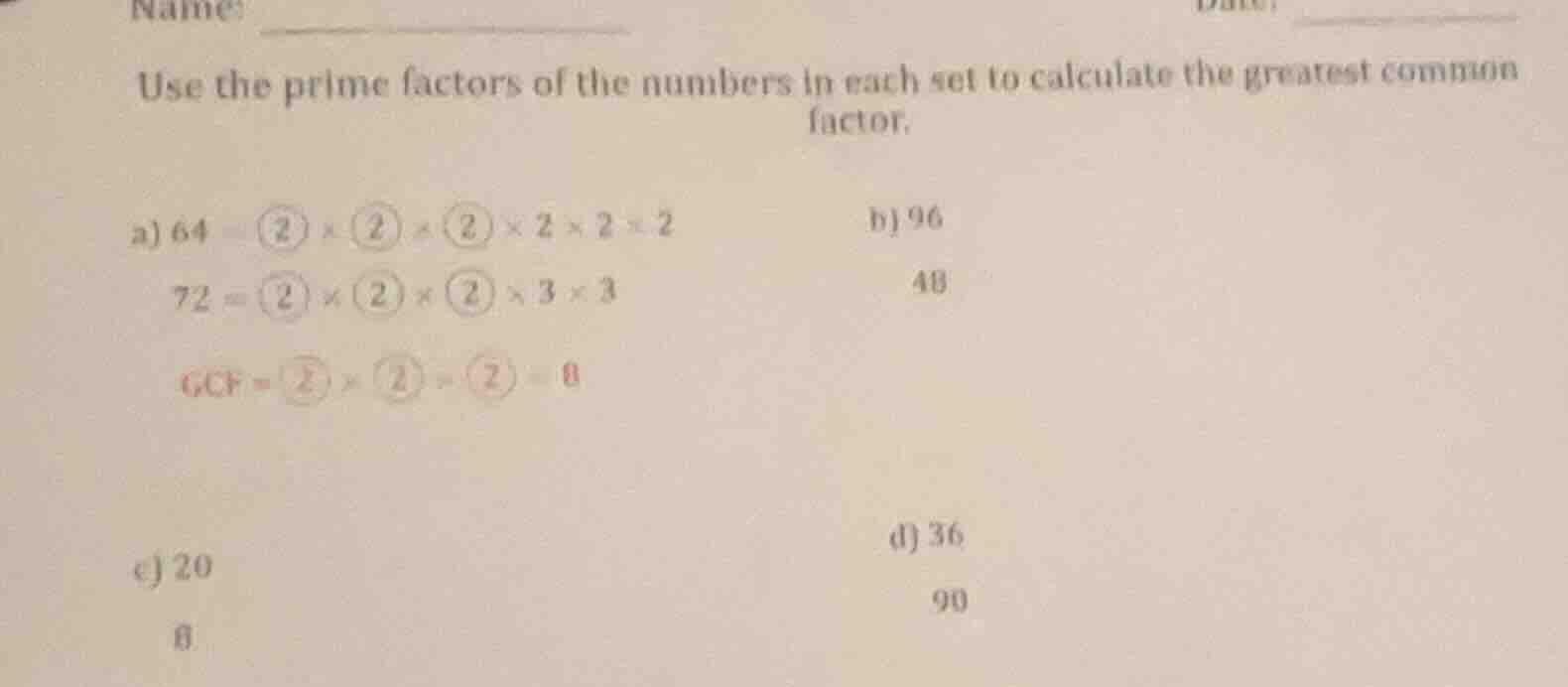
use the prime factors of the numbers in each set to calculate the greatest common factor.
a) 64 = 2 × 2 × 2 × 2 × 2 × 2
72 = 2 × 2 × 2 × 3 × 3
gcf = 2 × 2 × 2 = 8
b) 96
48
c) 20
d) 36
90
Part b)
Step1: Prime factorize 96 and 48
Prime factorization of \( 96 = 2 \times 2 \times 2 \times 2 \times 2 \times 3 \)
Prime factorization of \( 48 = 2 \times 2 \times 2 \times 2 \times 3 \)
Step2: Identify common prime factors
The common prime factors of 96 and 48 are \( 2, 2, 2, 2, 3 \)? Wait, no, let's list the exponents:
For 2: in 96, exponent is 5; in 48, exponent is 4. So we take the smaller exponent, which is 4.
For 3: in 96, exponent is 1; in 48, exponent is 1. So we take exponent 1.
Wait, actually, the correct way is to find the prime factors present in both and take the minimum number of each.
Prime factors of 96: \( 2^5 \times 3^1 \)
Prime factors of 48: \( 2^4 \times 3^1 \)
The GCF is the product of the lowest powers of all common prime factors. So for 2, the lowest power is \( 2^4 \); for 3, the lowest power is \( 3^1 \). Wait, no, wait: 48 is a factor of 96, so the GCF of 96 and 48 should be 48? Wait, no, let's do it step by step.
Wait, 96 divided by 48 is 2, so 48 is a factor of 96. So GCF(96,48) is 48? Wait, no, 48 is a factor of 96, so the greatest common factor is 48? Wait, no, let's check the prime factors.
Wait, 96 = 2×2×2×2×2×3
48 = 2×2×2×2×3
The common factors are the prime factors that are in both. So the common prime factors are 2×2×2×2×3? Wait, no, 48 has four 2s and one 3, 96 has five 2s and one 3. So the common factors are the ones with the minimum exponents. So for 2: min(5,4)=4, for 3: min(1,1)=1. So GCF = 2^4 × 3^1 = 16 × 3 = 48. Wait, but 48 is a factor of 96, so that makes sense.
Wait, maybe I made a mistake earlier. Let's do it again.
Prime factorization:
96: 2 × 2 × 2 × 2 × 2 × 3 (so \( 2^5 \times 3^1 \))
48: 2 × 2 × 2 × 2 × 3 (so \( 2^4 \times 3^1 \))
To find GCF, we take the product of the prime factors with the lowest exponents. So for each prime number present in both factorizations:
- For prime 2: lowest exponent is 4 (since 48 has \( 2^4 \) and 96 has \( 2^5 \))
- For prime 3: lowest exponent is 1 (both have \( 3^1 \))
So GCF = \( 2^4 \times 3^1 = 16 \times 3 = 48 \).
Part c) (assuming c is 20 and 8? Wait, the image shows c) 20 and 8? Wait, the user's image has c) 20 and 8? Let's check.
for c):
Step1: Prime factorize 20 and 8
20 = 2 × 2 × 5
8 = 2 × 2 × 2
Step2: Identify common prime factors
Common prime factors are 2 × 2 (since both have two 2s; 20 has two 2s, 8 has three 2s, so we take the minimum number of 2s, which is 2).
Step3: Calculate GCF
GCF = 2 × 2 = 4
Part d)
Step1: Prime factorize 36 and 90
36 = 2 × 2 × 3 × 3
90 = 2 × 3 × 3 × 5
Step2: Identify common prime factors
Common prime factors are 2, 3, 3 (since 36 has one 2, two 3s; 90 has one 2, two 3s; so we take the minimum number of each common prime factor: one 2, two 3s).
Step3: Calculate GCF
GCF = 2 × 3 × 3 = 18
Let's summarize each part:
Part b)

Snap & solve any problem in the app
Get step-by-step solutions on Sovi AI
Photo-based solutions with guided steps
Explore more problems and detailed explanations
Step1: Prime factorize 36 and 90
\( 36 = 2 \times 2 \times 3 \times 3 \)
\( 90 = 2 \times 3 \times 3 \times 5 \)
Step2: Find common prime factors with minimum exponents
For prime 2: minimum exponent is 1 (from 90)
For prime 3: minimum exponent is 2 (from both)
Step3: Calculate GCF
\( \text{GCF} = 2^1 \times 3^2 = 2 \times 9 = 18 \)
Final Answers:
b) \(\boldsymbol{48}\)
c) \(\boldsymbol{4}\) (assuming numbers are 20 and 8)
d) \(\boldsymbol{18}\)