QUESTION IMAGE
Question
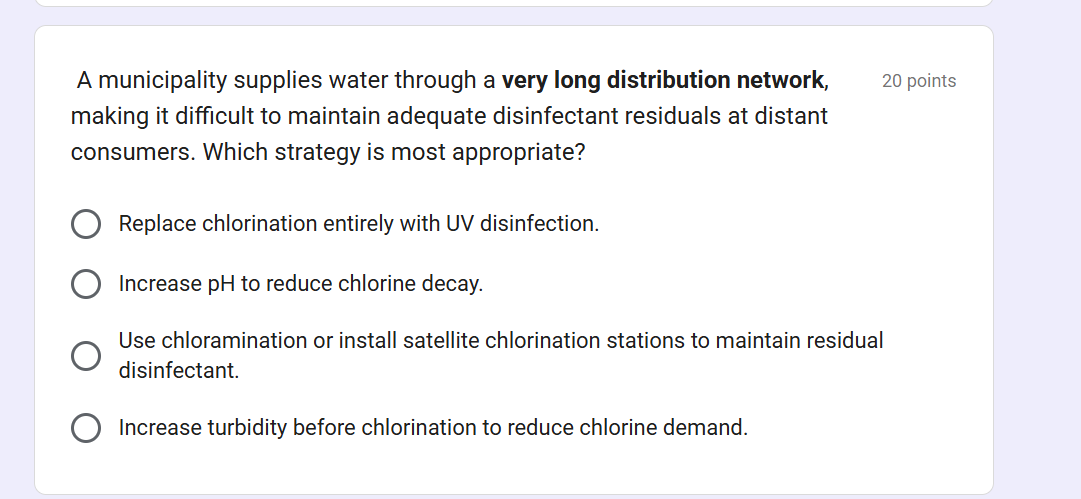
a municipality supplies water through a very long distribution network, making it difficult to maintain adequate disinfectant residuals at distant consumers. which strategy is most appropriate?
- replace chlorination entirely with uv disinfection.
- increase ph to reduce chlorine decay.
- use chloramination or install satellite chlorination stations to maintain residual disinfectant.
- increase turbidity before chlorination to reduce chlorine demand.
🆕 New Concept Discovered: Disinfectant Residual Management
Maintaining active protection throughout long water networks.
Step 1: Understand the core challenge
In a very long water distribution network, water takes a long time to travel from the treatment plant to distant consumers (high water age). During this transit, free chlorine reacts with organic matter, pipe walls, and bulk water, causing the disinfectant concentration to decay. If it drops too low, pathogens can regrow in the pipes.
Step 2: Evaluate the options
- Replace chlorination entirely with UV disinfection: UV light provides excellent primary disinfection at the treatment plant but leaves absolutely no residual protection in the pipes. Once the water leaves the UV reactor, it is vulnerable to contamination.
- Increase pH to reduce chlorine decay: While pH affects the ratio of hypochlorous acid (\(\text{HOCl}\)) to hypochlorite ion (\(\text{OCl}^-\)), raising pH actually decreases the disinfecting efficacy of free chlorine and is not a standard or effective way to maintain residuals in long networks.
- Use chloramination or install satellite chlorination stations:
- Chloramines (combined chlorine) are much more stable and decay far slower than free chlorine, making them ideal for long distribution systems.
- Satellite (booster) chlorination stations physically add small amounts of chlorine at strategic points along the network to restore depleted residual levels.
This option directly and effectively solves the problem.
- Increase turbidity before chlorination: Turbidity (cloudiness caused by suspended particles) actually shields pathogens and increases chlorine demand, which would make maintaining a residual even harder.

Snap & solve any problem in the app
Get step-by-step solutions on Sovi AI
Photo-based solutions with guided steps
Explore more problems and detailed explanations
Use chloramination or install satellite chlorination stations to maintain residual disinfectant.