QUESTION IMAGE
Question
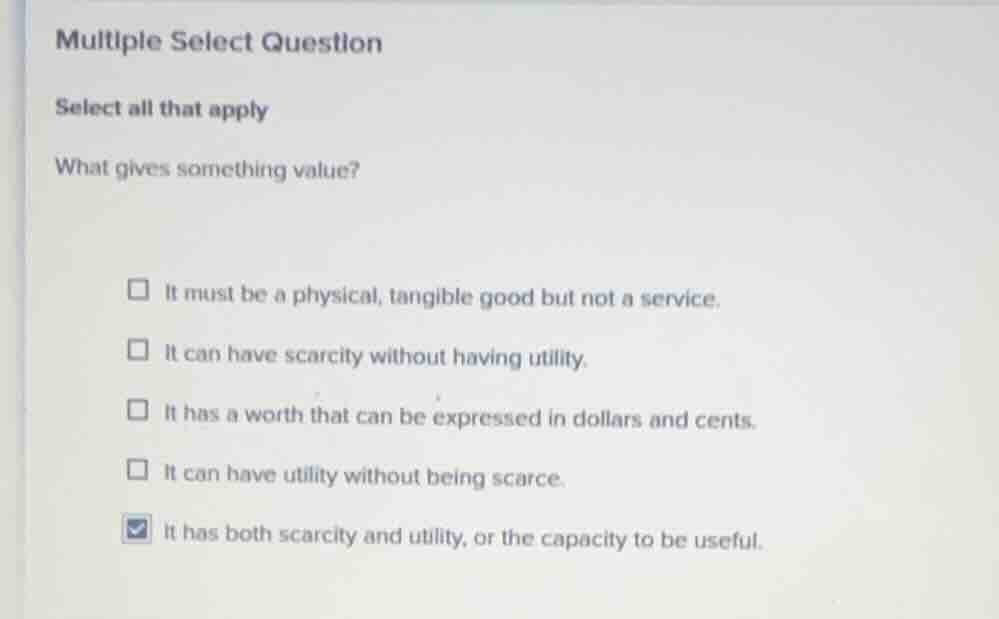
multiple select question
select all that apply
what gives something value?
it must be a physical, tangible good but not a service.
it can have scarcity without having utility.
it has a worth that can be expressed in dollars and cents.
it can have utility without being scarce.
it has both scarcity and utility, or the capacity to be useful.
Brief Explanations
- Analyze "It must be a physical, tangible good but not a service": Services (e.g., education, healthcare) can have value, so this is incorrect.
- Analyze "It can have scarcity without having utility": For something to have value, it needs to be useful (utility) along with scarcity. If there's no utility, it won't have value, so this is incorrect.
- Analyze "It has a worth that can be expressed in dollars and cents": Value can be non - monetary (e.g., emotional value of a family heirloom), but also many valuable things are priced in currency, and this is a valid way to express worth for many economic goods/services, so this applies.
- Analyze "It can have utility without being scarce": For example, air (in most cases) has utility (we need it to breathe) but is not scarce, yet it has value in the sense of its usefulness (though its economic value in a traditional scarce - utility sense is different, but the statement is about having utility without scarcity and if we consider value in terms of usefulness, it holds. However, in economic terms, for exchange value, scarcity is needed, but the question is about what gives something value in a broader sense. But also, the correct economic principle for value (exchange value) is scarcity + utility. But let's re - evaluate: If something has utility but is not scarce, does it have value? In terms of economic value (price), no, but in terms of use value, yes. But the options:
- "It has a worth that can be expressed in dollars and cents": Many valuable items (goods, services) have their worth expressed in currency, so this is correct.
- "It has both scarcity and utility, or the capacity to be useful": This is the core economic principle of value (for exchange value, scarcity + utility; for use value, utility, but the option says "or the capacity to be useful", so it covers both. This is correct.
- Wait, earlier analysis of "It can have utility without being scarce": Let's think again. Air has utility, is not scarce, and has value (we can't live without it). So in a broad sense, it has value (use value) with utility and without scarcity. So does this option apply? But the standard economic theory for exchange value (the value we trade) is scarcity + utility. But the question is "what gives something value" in general. So:
- "It has a worth that can be expressed in dollars and cents": Correct, as many valuable things are priced in currency.
- "It has both scarcity and utility, or the capacity to be useful": Correct, as scarcity + utility (exchange value) or just utility (use value) gives value.
- "It can have utility without being scarce": Correct, as seen in the air example (utility without scarcity and has value in terms of usefulness). Wait, but maybe the intended correct answers are the ones that are in line with economic value concepts. Let's re - check:
- The option "It has a worth that can be expressed in dollars and cents" is correct because many economic goods and services have their value quantified in monetary terms.
- The option "It has both scarcity and utility, or the capacity to be useful" is correct as per economic theory (scarcity + utility for exchange value, utility for use value).
- The option "It can have utility without being scarce" is correct as things with utility (like air) that are not scarce still have value (use value). But maybe the original question's intended answers are:
Wait, let's go back to the options:
- "It must be a physical, tangible good but not a service": Incorrect.
- "It can have scarcity without having utility"…

Snap & solve any problem in the app
Get step-by-step solutions on Sovi AI
Photo-based solutions with guided steps
Explore more problems and detailed explanations
- It has a worth that can be expressed in dollars and cents.
- It can have utility without being scarce.
- It has both scarcity and utility, or the capacity to be useful.