QUESTION IMAGE
Question
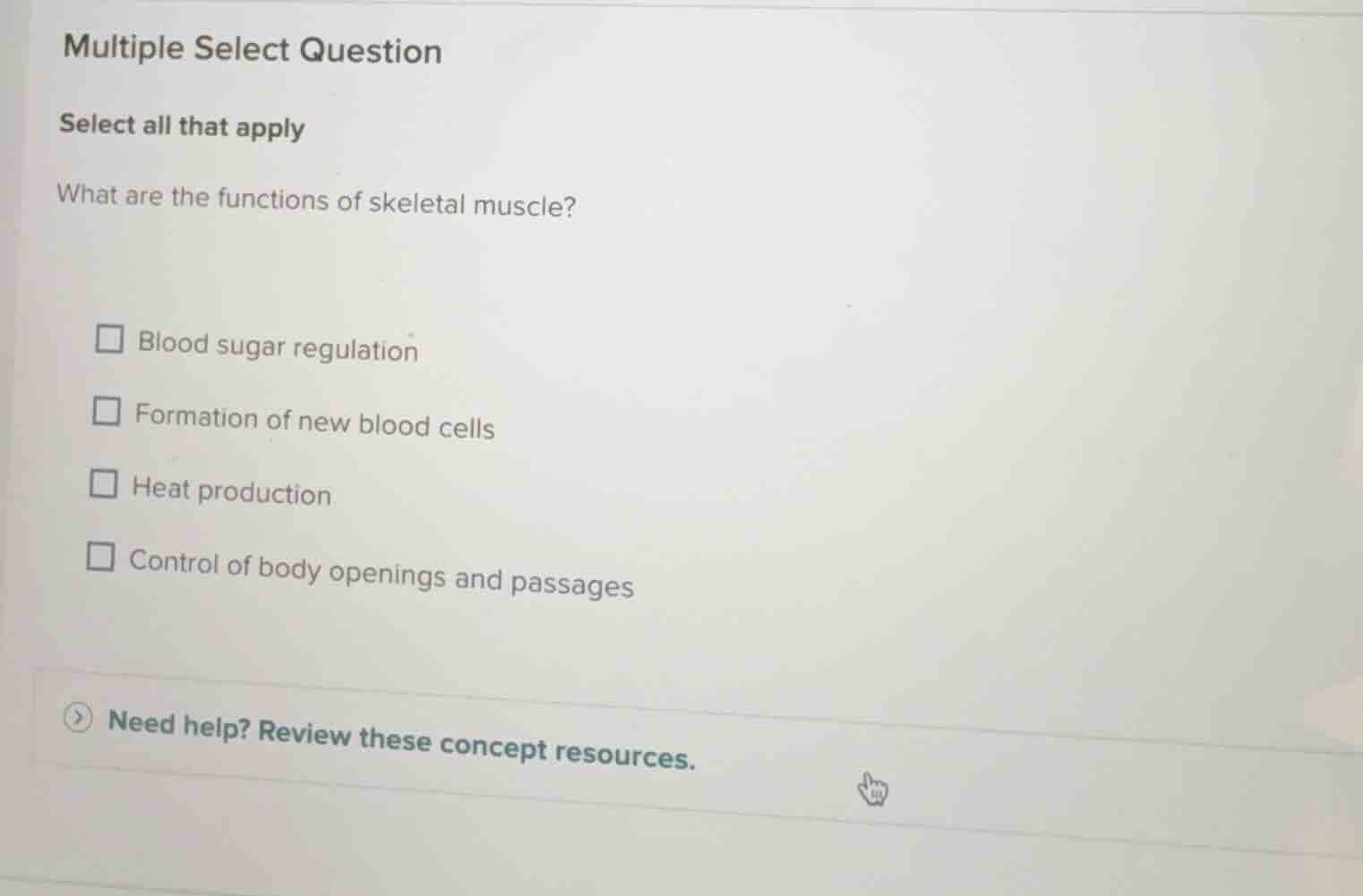
multiple select question
select all that apply
what are the functions of skeletal muscle?
blood sugar regulation
formation of new blood cells
heat production
control of body openings and passages
Analyze the physiological role of skeletal muscle in blood sugar regulation
Skeletal muscles store a significant amount of glucose as glycogen and absorb large quantities of glucose from the blood under the influence of insulin. This makes them crucial for glycemic control (blood sugar regulation).
Evaluate the formation of new blood cells
The formation of new blood cells (hematopoiesis) is a primary function of the red bone marrow found within bones, which is a function of the skeletal system, not skeletal muscle tissue.
Analyze the role of skeletal muscle in heat production
Skeletal muscle contraction is highly metabolic and releases heat as a byproduct. This process, known as Thermogenesis or Muscle Heat Production, is vital for maintaining normal body temperature.
Evaluate the control of body openings and passages
Skeletal muscles form sphincters that voluntarily regulate the opening and closing of passages, such as those in the digestive and urinary tracts (e.g., the external anal sphincter and external urethral sphincter).
Summarize the correct functions
Based on physiological roles, the functions of skeletal muscle include blood sugar regulation, heat production, and the control of body openings and passages.

Snap & solve any problem in the app
Get step-by-step solutions on Sovi AI
Photo-based solutions with guided steps
Explore more problems and detailed explanations
- Blood sugar regulation (Correct answer)
- Formation of new blood cells
- Heat production (Correct answer)
- Control of body openings and passages (Correct answer)