QUESTION IMAGE
Question
multiple choice
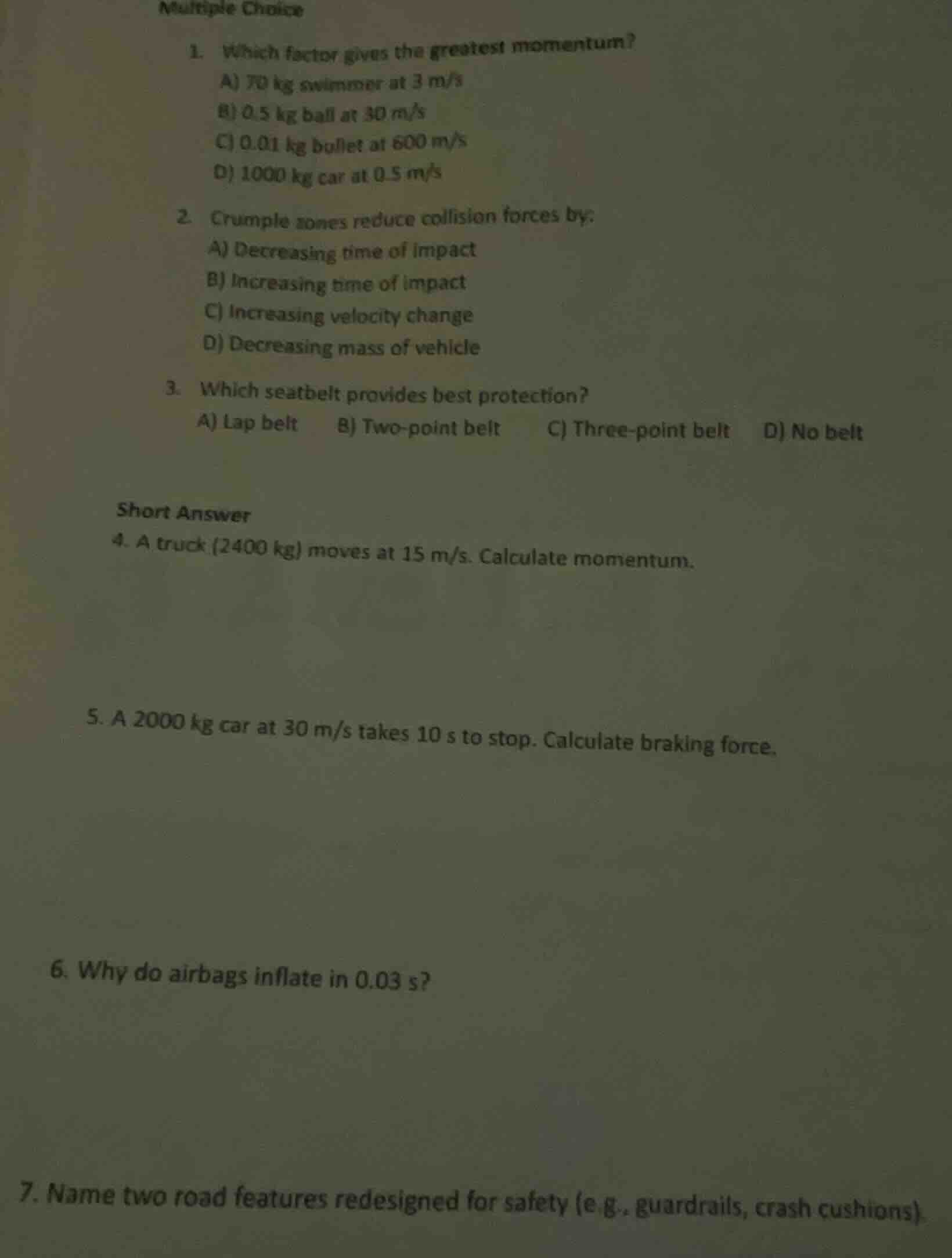
- which factor gives the greatest momentum?
a) 70 kg swimmer at 3 m/s
b) 0.5 kg ball at 30 m/s
c) 0.01 kg bullet at 600 m/s
d) 1000 kg car at 0.5 m/s
- crumple zones reduce collision forces by:
a) decreasing time of impact
b) increasing time of impact
c) increasing velocity change
d) decreasing mass of vehicle
- which seatbelt provides best protection?
a) lap belt
b) two-point belt
c) three-point belt
d) no belt
short answer
- a truck (2400 kg) moves at 15 m/s. calculate momentum.
- a 2000 kg car at 30 m/s takes 10 s to stop. calculate braking force.
- why do airbags inflate in 0.03 s?
- name two road features redesigned for safety (e.g., guardrails, crash cushions).
<pre_analysis>
{
"quality": "clear",
"question_count": 7,
"skills_matched": [
"step_cot",
"table_formatter",
"explain_then_answer",
"quick"
],
"needs_drawing": false,
"concepts_used": [
"Momentum Definition",
"Collision Safety",
"Vehicle Safety Systems",
"Seatbelt Mechanics",
"Braking Distance",
"Impact Force"
],
"new_concepts": [],
"current_concepts": [
"Momentum Definition",
"Collision Safety",
"Vehicle Safety Systems",
"Seatbelt Mechanics",
"Braking Distance",
"Impact Force"
]
}
</pre_analysis>
<reasoning>
Calculate momentum values for Question 1
\[
\]
Analyze conceptual safety questions (Questions 2, 3, 6, 7)
\[
\]
Compute numerical values for Questions 4 and 5
\[
\]
</reasoning>
<answer>
| No. | Answer |
|---|---|
| 2 | (B) Increasing time of impact |
| 3 | (C) Three-point belt |
| 4 | \(36000 \text{ kg}\cdot\text{m/s}\) |
| 5 | \(6000 \text{ N}\) |
| 6 | To fully deploy before the occupant's body moves forward and collides with the interior. |
| 7 | Guardrails and crash cushions |
</answer>
<post_analysis>
{
"subject": "Natural Science",
"question_type": "Multi-part",
"knowledge_point": [
"Natural Science",
"Physics",
"Momentum and Impulse"
]
}
</post_analysis>
Snap & solve any problem in the app
Get step-by-step solutions on Sovi AI
Photo-based solutions with guided steps
Explore more problems and detailed explanations
<pre_analysis>
{
"quality": "clear",
"question_count": 7,
"skills_matched": [
"step_cot",
"table_formatter",
"explain_then_answer",
"quick"
],
"needs_drawing": false,
"concepts_used": [
"Momentum Definition",
"Collision Safety",
"Vehicle Safety Systems",
"Seatbelt Mechanics",
"Braking Distance",
"Impact Force"
],
"new_concepts": [],
"current_concepts": [
"Momentum Definition",
"Collision Safety",
"Vehicle Safety Systems",
"Seatbelt Mechanics",
"Braking Distance",
"Impact Force"
]
}
</pre_analysis>
<reasoning>
Calculate momentum values for Question 1
\[
\]
Analyze conceptual safety questions (Questions 2, 3, 6, 7)
\[
\]
Compute numerical values for Questions 4 and 5
\[
\]
</reasoning>
<answer>
| No. | Answer |
|---|---|
| 2 | (B) Increasing time of impact |
| 3 | (C) Three-point belt |
| 4 | \(36000 \text{ kg}\cdot\text{m/s}\) |
| 5 | \(6000 \text{ N}\) |
| 6 | To fully deploy before the occupant's body moves forward and collides with the interior. |
| 7 | Guardrails and crash cushions |
</answer>
<post_analysis>
{
"subject": "Natural Science",
"question_type": "Multi-part",
"knowledge_point": [
"Natural Science",
"Physics",
"Momentum and Impulse"
]
}
</post_analysis>