QUESTION IMAGE
Question
multiple choice 2 points
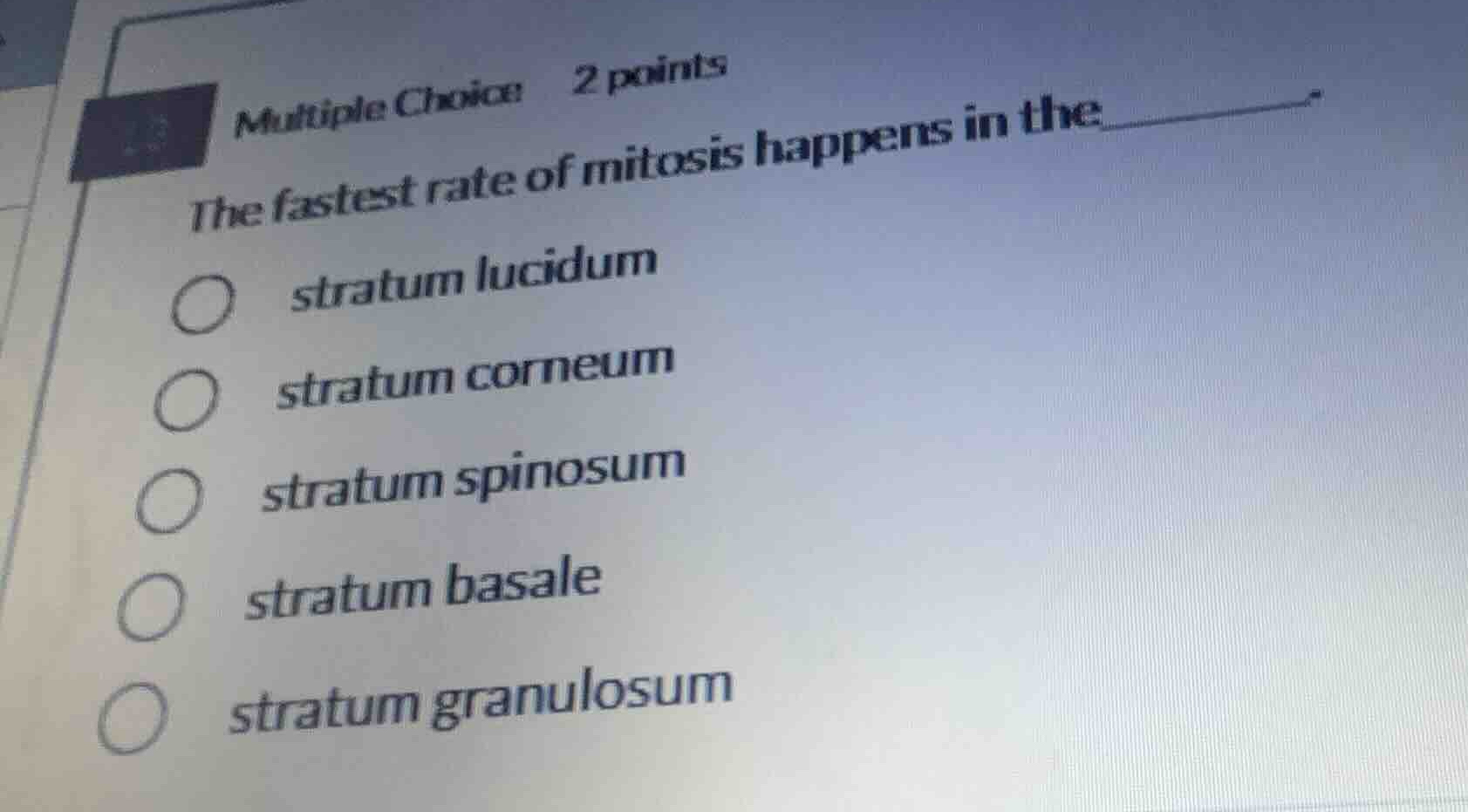
the fastest rate of mitosis happens in the
stratum lucidum
stratum corneum
stratum spinosum
stratum basale
stratum granulosum
Identify the core physiological process
The question asks for the layer of the epidermis where the fastest rate of mitosis occurs. Mitosis is the process of cell division that generates new cells to replace shed outer layers.
Analyze the epidermal layers
The epidermis is composed of five distinct layers (from superficial to deep):
- Stratum corneum: Dead, keratinized, flattened cells lacking nuclei. No cell division occurs here.
- Stratum lucidum: Clear, dead cells found only in thick skin. No cell division occurs here.
- Stratum granulosum: Cells starting to lose their nuclei and organelles, accumulating keratohyalin granules. No active cell division occurs here.
- Stratum spinosum: Several layers of keratinocytes. While some limited mitosis can occur in the deeper part of this layer, it is not the primary or fastest site.
- Stratum basale: The deepest, single layer of cuboidal or columnar stem cells. This layer is highly metabolically active and is the primary site of cell division (mitosis) in the epidermis.
Relate to student's mastered concepts
Using the Skin Histology knowledge point, we know that the epidermis is a dynamic, self-renewing epithelial tissue. The stem cells responsible for this continuous renewal reside in the deepest layer, directly adjacent to the dermis where they receive nutrients via diffusion.
Determine the correct option
Since the stem cells in the stratum basale undergo rapid and continuous cell division to replenish the outer layers of the skin, the fastest rate of mitosis happens in the stratum basale.

Snap & solve any problem in the app
Get step-by-step solutions on Sovi AI
Photo-based solutions with guided steps
Explore more problems and detailed explanations
- stratum lucidum
- stratum corneum
- stratum spinosum
- stratum basale (Correct answer)
- stratum granulosum