QUESTION IMAGE
Question
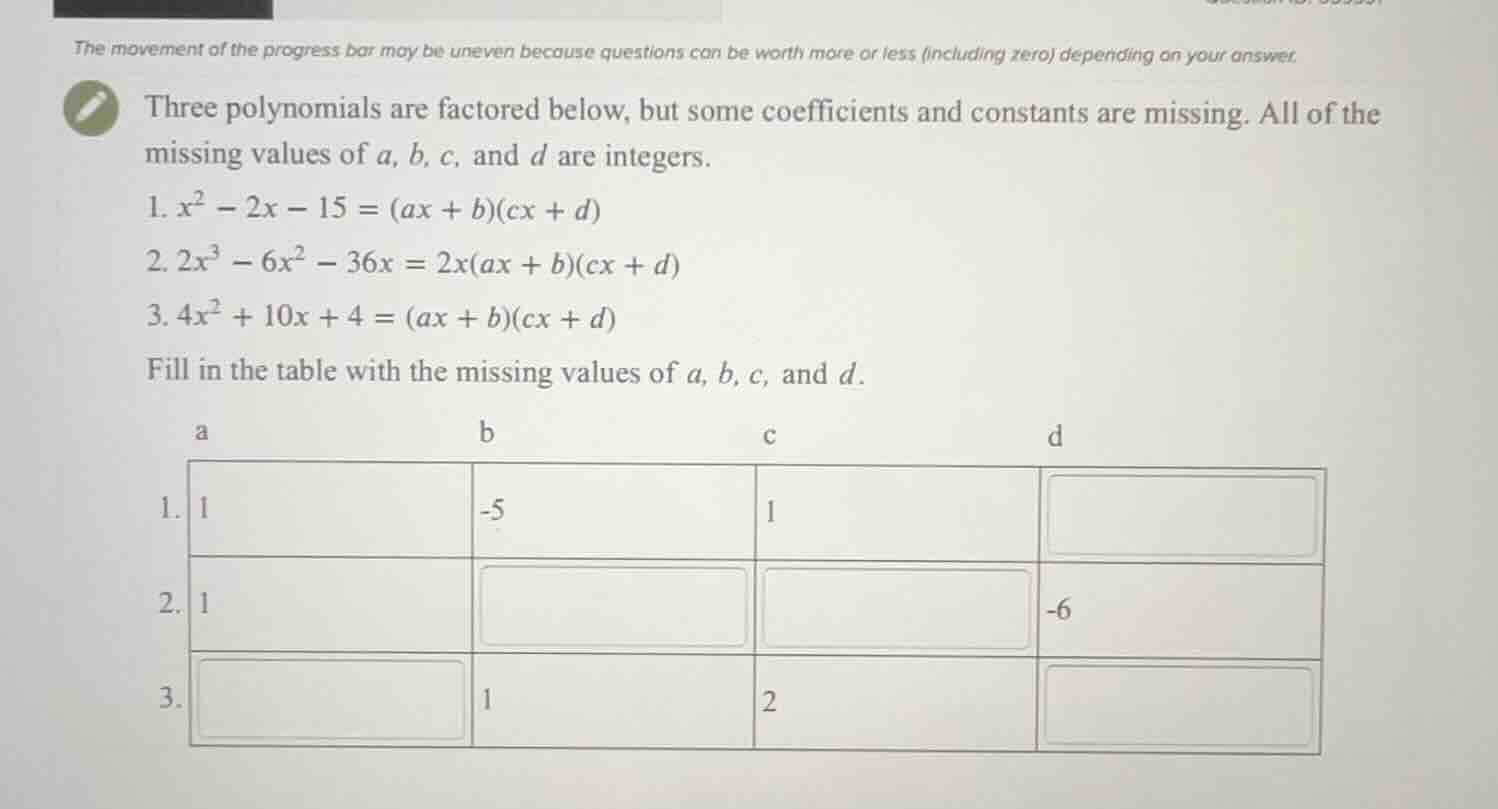
the movement of the progress bar may be uneven because questions can be worth more or less (including zero) depending on your answer. three polynomials are factored below, but some coefficients and constants are missing. all of the missing values of a, b, c, and d are integers. 1. $x^2 - 2x - 15 = (ax + b)(cx + d)$ 2. $2x^3 - 6x^2 - 36x = 2x(ax + b)(cx + d)$ 3. $4x^2 + 10x + 4 = (ax + b)(cx + d)$ fill in the table with the missing values of a, b, c, and d. | | a | b | c | d | |---|---|---|---|---| | 1. | 1 | -5 | 1 | | | 2. | 1 | | | -6 | | 3. | | 1 | 2 | |
Problem 1:
Step1: Expand the right side
$(ax + b)(cx + d)=acx^2+(ad + bc)x+bd$. For $x^2 - 2x - 15$, we know $a = 1$, $c = 1$, $b=-5$. So $ac = 1\times1 = 1$ (matches $x^2$ coefficient). Then $bd=1\times(-5)= - 5$? Wait, no, $bd$ should be $-15$ (constant term). Wait, $a = 1$, $c = 1$, $b=-5$, so $(x - 5)(x + d)=x^2+(d - 5)x-5d$. This should equal $x^2 - 2x - 15$. So equate coefficients:
Step2: Equate linear term and constant term
For linear term: $d - 5=-2\Rightarrow d = 3$. For constant term: $-5d=-15\Rightarrow d = 3$. So $d = 3$.
Problem 2:
Step1: Divide both sides by $2x$
We have $2x^3 - 6x^2 - 36x=2x(ax + b)(cx + d)$. Divide both sides by $2x$: $x^2 - 3x - 18=(ax + b)(cx + d)$. Given $a = 1$, $d=-6$, so $(x + b)(x - 6)=x^2+(b - 6)x-6b$. This should equal $x^2 - 3x - 18$.
Step2: Equate linear term and constant term
For linear term: $b - 6=-3\Rightarrow b = 3$. For constant term: $-6b=-18\Rightarrow b = 3$. Also, since $ac = 1$ (coefficient of $x^2$) and $a = 1$, then $c = 1$.
Problem 3:
Step1: Expand the right side
$(ax + b)(cx + d)=acx^2+(ad + bc)x+bd$. For $4x^2 + 10x + 4$, $b = 1$, $c = 2$. So $(ax + 1)(2x + d)=2ax^2+(ad + 2)x + d$.
Step2: Equate coefficients
For $x^2$ coefficient: $2a = 4\Rightarrow a = 2$. For constant term: $d\times1 = 4\Rightarrow d = 4$? Wait, no, $bd = 4$ (constant term) and $b = 1$, so $d = 4$? Wait, check linear term: $ad+bc=2d + 2\times1=2d + 2$. This should equal $10$. So $2d+2 = 10\Rightarrow 2d = 8\Rightarrow d = 4$. Let's verify: $(2x + 1)(2x + 4)=4x^2+8x + 2x + 4=4x^2 + 10x + 4$. Correct. So $a = 2$, $d = 4$.

Snap & solve any problem in the app
Get step-by-step solutions on Sovi AI
Photo-based solutions with guided steps
Explore more problems and detailed explanations
s:
- $d = 3$
- $b = 3$, $c = 1$
- $a = 2$, $d = 4$
Filling the table:
| a | b | c | d | |
|---|---|---|---|---|
| 2 | 1 | $\boldsymbol{3}$ | $\boldsymbol{1}$ | -6 |
| 3 | $\boldsymbol{2}$ | 1 | 2 | $\boldsymbol{4}$ |