QUESTION IMAGE
Question
the movement of the progress bar may be uneven because questions can be worth more or less (inclu
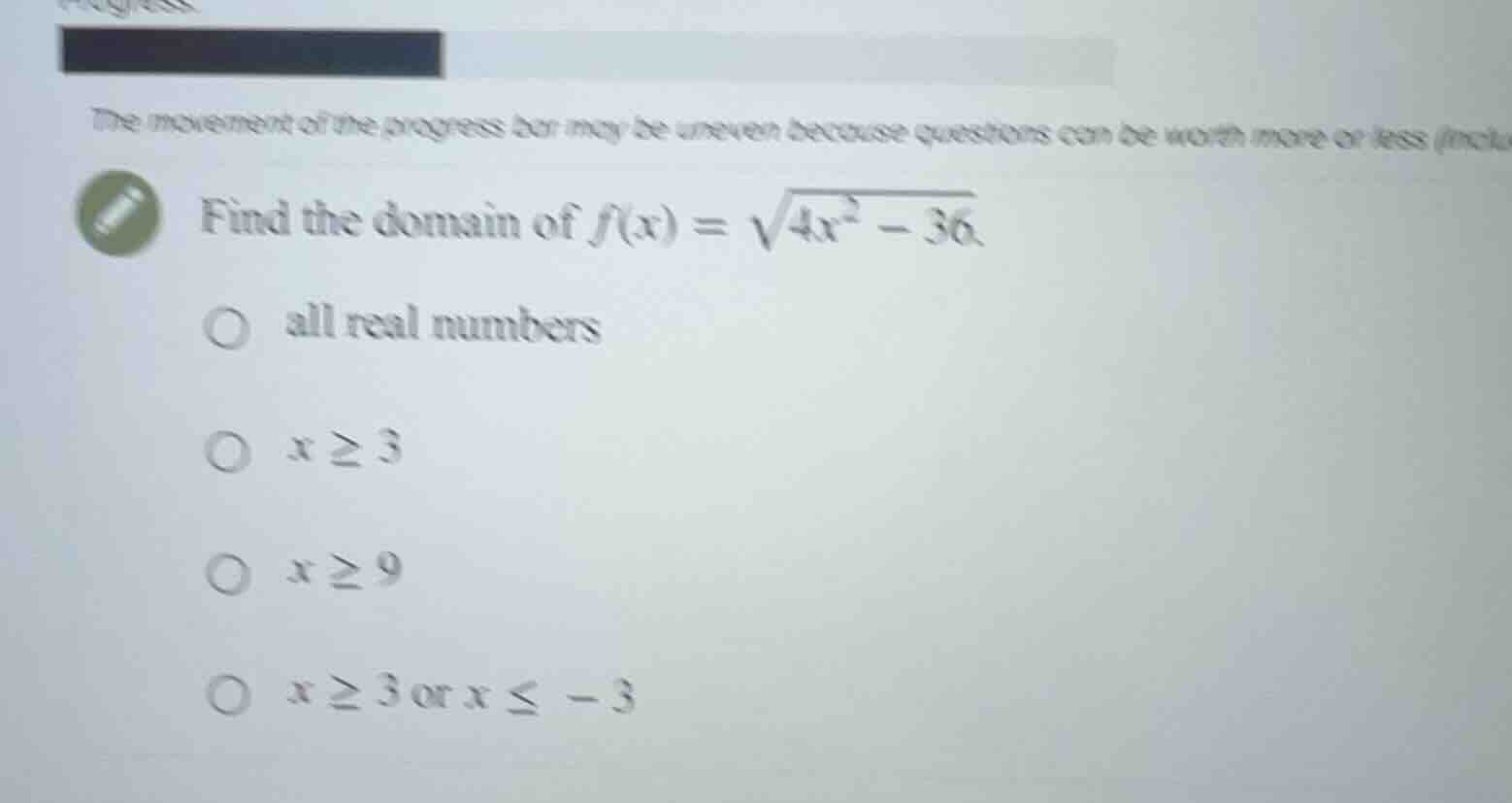
find the domain of $f(x) = \sqrt{4x^2 - 36}$.
\bigcirc all real numbers
\bigcirc $x \geq 3$
\bigcirc $x \geq 9$
\bigcirc $x \geq 3$ or $x \leq -3$
Step1: Set the expression inside the square root to be non - negative
For the function \(f(x)=\sqrt{4x^{2}-36}\), we need \(4x^{2}-36\geq0\).
Step2: Solve the inequality \(4x^{2}-36\geq0\)
First, factor out 4 from the left - hand side: \(4(x^{2} - 9)\geq0\).
Since \(x^{2}-9=(x - 3)(x + 3)\) (by the difference of squares formula \(a^{2}-b^{2}=(a - b)(a + b)\) where \(a = x\) and \(b = 3\)), the inequality becomes \(4(x - 3)(x + 3)\geq0\).
We can divide both sides of the inequality by 4 (since 4>0, the direction of the inequality remains the same) to get \((x - 3)(x + 3)\geq0\).
To solve the inequality \((x - 3)(x + 3)\geq0\), we consider the critical points \(x=3\) and \(x=-3\) (where the expression \((x - 3)(x + 3)\) equals zero).
We test the intervals:
- For \(x<-3\), let's take \(x=-4\). Then \((-4 - 3)(-4+3)=(-7)\times(-1) = 7>0\), so the inequality holds for \(x<-3\).
- For \(-3
- For \(x>3\), let's take \(x = 4\). Then \((4 - 3)(4 + 3)=(1)\times(7)=7>0\), so the inequality holds for \(x>3\).
Also, when \(x = 3\) or \(x=-3\), \((x - 3)(x + 3)=0\), which satisfies the inequality \((x - 3)(x + 3)\geq0\).
So the solution to the inequality \(4x^{2}-36\geq0\) is \(x\geq3\) or \(x\leq - 3\).

Snap & solve any problem in the app
Get step-by-step solutions on Sovi AI
Photo-based solutions with guided steps
Explore more problems and detailed explanations
\(x\geq3\) or \(x\leq - 3\) (the option: \(x\geq3\) or \(x\leq - 3\))