QUESTION IMAGE
Question
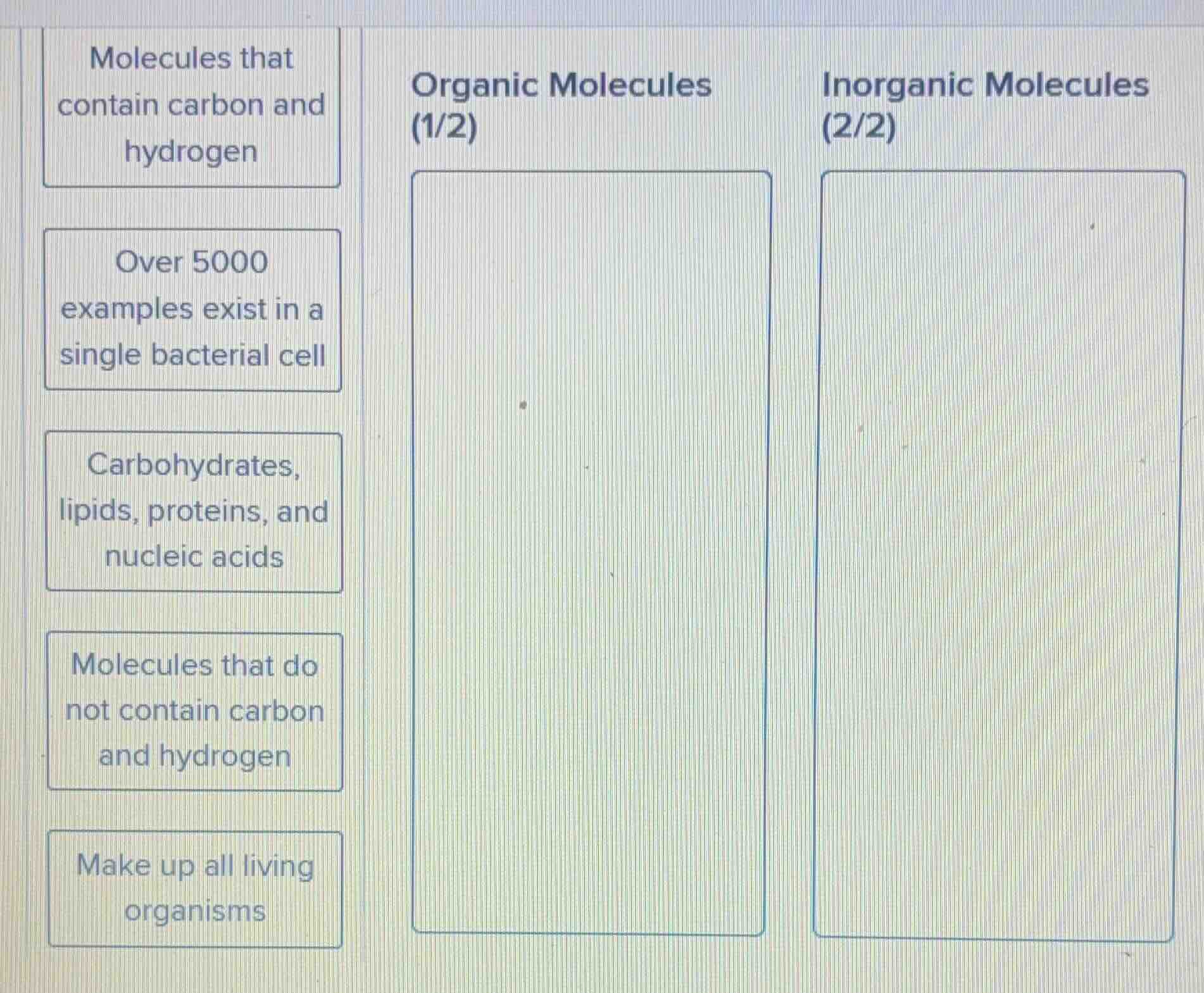
molecules that contain carbon and hydrogen
over 5000 examples exist in a single bacterial cell
carbohydrates, lipids, proteins, and nucleic acids
molecules that do not contain carbon and hydrogen
make up all living organisms
organic molecules (1/2)
inorganic molecules (2/2)
Define organic and inorganic molecules
Organic molecules are defined by containing both carbon and hydrogen atoms covalently bonded together. Inorganic molecules generally lack this carbon-hydrogen combination.
Classify chemical definitions
- "Molecules that contain carbon and hydrogen" directly defines organic molecules.
- "Molecules that do not contain carbon and hydrogen" directly defines inorganic molecules.
Classify biological examples and abundance
- "Carbohydrates, lipids, proteins, and nucleic acids" are the four major classes of biological macromolecules, which are organic.
- "Over 5000 examples exist in a single bacterial cell" refers to the vast diversity of organic compounds (proteins, metabolites, nucleic acids) that drive cellular life.
- "Make up all living organisms" is a shared characteristic, but in the context of basic biochemistry classification, both organic and inorganic molecules (like water and mineral salts) are essential components that make up living organisms. Let's look at the target counts: "Organic Molecules (1/2)" and "Inorganic Molecules (2/2)". This indicates we need to place 2 items into the Organic category and 2 items into the Inorganic category (or the interface has pre-filled counts, showing 1 out of 2 placed for Organic, and 2 out of 2 placed for Inorganic). Let's evaluate the standard biological classification:
- Organic:
- Molecules that contain carbon and hydrogen
- Carbohydrates, lipids, proteins, and nucleic acids
- Over 5000 examples exist in a single bacterial cell
- Inorganic:
- Molecules that do not contain carbon and hydrogen
- Make up all living organisms (Water and minerals make up the bulk of living mass, but both organic and inorganic molecules together make up living organisms. Often, water—an inorganic molecule—makes up the majority of cellular mass). Let's match the standard curriculum definitions:
- Organic Molecules:
- Molecules that contain carbon and hydrogen
- Carbohydrates, lipids, proteins, and nucleic acids
- Over 5000 examples exist in a single bacterial cell
- Inorganic Molecules:
- Molecules that do not contain carbon and hydrogen
- Make up all living organisms (Water, which is inorganic, makes up about 70% of living organisms, and inorganic ions are essential).

Snap & solve any problem in the app
Get step-by-step solutions on Sovi AI
Photo-based solutions with guided steps
Explore more problems and detailed explanations
The correct classification of the descriptions into their respective categories is as follows:
- Organic Molecules:
- Molecules that contain carbon and hydrogen
- Carbohydrates, lipids, proteins, and nucleic acids
- Over 5000 examples exist in a single bacterial cell
- Inorganic Molecules:
- Molecules that do not contain carbon and hydrogen
- Make up all living organisms