QUESTION IMAGE
Question
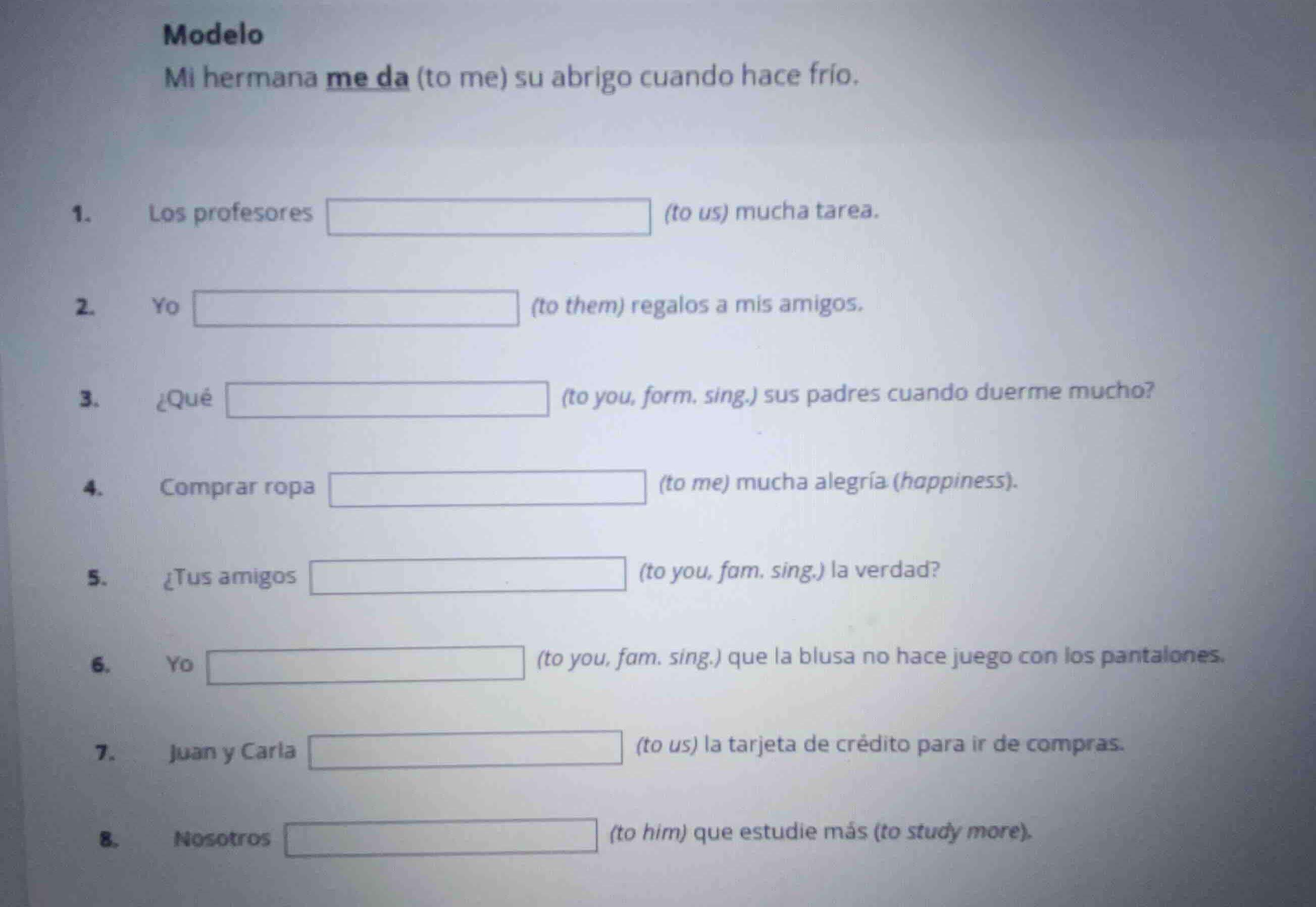
modelo
mi hermana me da (to me) su abrigo cuando hace frío.
- los profesores ______ (to us) mucha tarea.
- yo ______ (to them) regalos a mis amigos.
- ¿qué ______ (to you, form. sing.) sus padres cuando duerme mucho?
- comprar ropa ______ (to me) mucha alegría (happiness).
- ¿tus amigos ______ (to you, fam. sing.) la verdad?
- yo ______ (to you, fam. sing.) que la blusa no hace juego con los pantalones.
- juan y carla ______ (to us) la tarjeta de crédito para ir de compras.
- nosotros ______ (to him) que estudie más (to study more).
Identify the verb pattern
The exercise requires using the verbs dar (to give) or decir (to say/tell) with Indirect Object Pronouns in the Spanish Present Tense.
Analyze Questions 1 to 4
- Los profesores _____ (to us) mucha tarea.
- Subject: Los profesores (they) -> verb dar conjugated as dan.
- Indirect Object: to us -> Indirect Object Pronouns nos.
- Combined: nos dan.
- Yo _____ (to them) regalos a mis amigos.
- Subject: Yo (I) -> verb dar conjugated as doy.
- Indirect Object: to them -> Indirect Object Pronouns les.
- Combined: les doy.
- ¿Qué _____ (to you, form. sing.) sus padres cuando duerme mucho?
- Subject: sus padres (they) -> verb decir conjugated as dicen.
- Indirect Object: to you, formal singular -> Indirect Object Pronouns le.
- Combined: le dicen.
- Comprar ropa _____ (to me) mucha alegría (happiness).
- Subject: Comprar ropa (it/singular) -> verb dar conjugated as da.
- Indirect Object: to me -> Indirect Object Pronouns me.
- Combined: me da.
Analyze Questions 5 to 8
- ¿Tus amigos _____ (to you, fam. sing.) la verdad?
- Subject: Tus amigos (they) -> verb decir conjugated as dicen.
- Indirect Object: to you, familiar singular -> Indirect Object Pronouns te.
- Combined: te dicen.
- Yo _____ (to you, fam. sing.) que la blusa no hace juego con los pantalones.
- Subject: Yo (I) -> verb decir conjugated as digo.
- Indirect Object: to you, familiar singular -> Indirect Object Pronouns te.
- Combined: te digo.
- Juan y Carla _____ (to us) la tarjeta de crédito para ir de compras.
- Subject: Juan y Carla (they) -> verb dar conjugated as dan.
- Indirect Object: to us -> Indirect Object Pronouns nos.
- Combined: nos dan.
- Nosotros _____ (to him) que estudie más (to study more).
- Subject: Nosotros (we) -> verb decir conjugated as decimos.
- Indirect Object: to him -> Indirect Object Pronouns le.
- Combined: le decimos.

Snap & solve any problem in the app
Get step-by-step solutions on Sovi AI
Photo-based solutions with guided steps
Explore more problems and detailed explanations
Question 1
Los profesores <blank>nos dan</blank> (to us) mucha tarea.
Question 2
Yo <blank>les doy</blank> (to them) regalos a mis amigos.
Question 3
¿Qué <blank>le dicen</blank> (to you, form. sing.) sus padres cuando duerme mucho?
Question 4
Comprar ropa <blank>me da</blank> (to me) mucha alegría (happiness).
Question 5
¿Tus amigos <blank>te dicen</blank> (to you, fam. sing.) la verdad?
Question 6
Yo <blank>te digo</blank> (to you, fam. sing.) que la blusa no hace juego con los pantalones.
Question 7
Juan y Carla <blank>nos dan</blank> (to us) la tarjeta de crédito para ir de compras.
Question 8
Nosotros <blank>le decimos</blank> (to him) que estudie más (to study more).