QUESTION IMAGE
Question
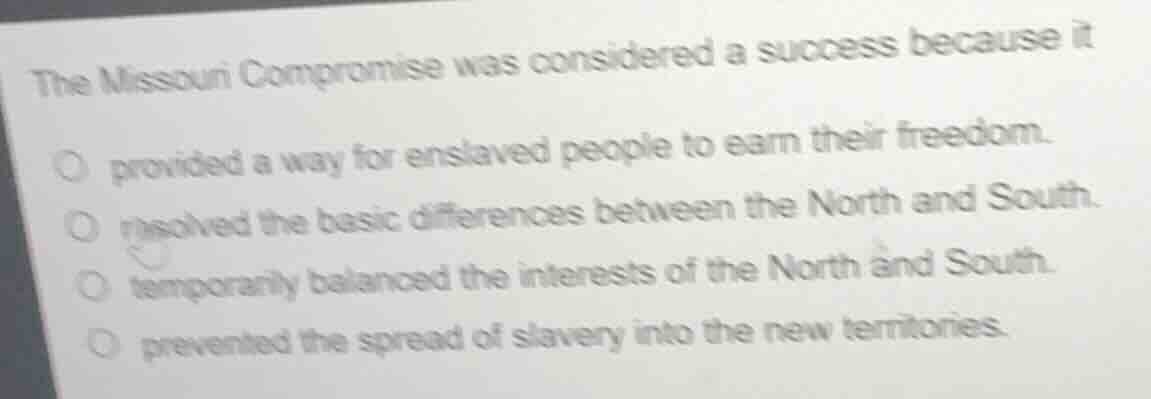
the missouri compromise was considered a success because it
- provided a way for enslaved people to earn their freedom.
- resolved the basic differences between the north and south.
- temporarily balanced the interests of the north and south.
- prevented the spread of slavery into the new territories.
<pre_analysis>
{
"quality": "clear",
"question_count": 1,
"skills_matched": [
"direct_cot",
"multiple_choice_formatter",
"explain_then_answer",
"quick"
],
"needs_drawing": false,
"concepts_used": [
"Missouri Compromise"
],
"new_concepts": [],
"current_concepts": [
"Missouri Compromise",
"Sectionalism"
]
}
</pre_analysis>
<reasoning>
Analyze the historical context of the Missouri Compromise
The Missouri Compromise of 1820 was passed to address the growing sectional tensions over the expansion of slavery. Missouri's request for admission as a slave state threatened to upset the delicate balance of power between free and slave states in the U.S. Senate.
Evaluate the options based on historical outcomes
- Option 1: "provided a way for enslaved people to earn their freedom." This is incorrect; the compromise did not provide a path to freedom for enslaved individuals.
- Option 2: "resolved the basic differences between the North and South." This is incorrect; the compromise did not resolve the fundamental ideological and economic differences regarding slavery, which eventually led to the Civil War.
- Option 3: "temporarily balanced the interests of the North and South." This is correct; by admitting Missouri as a slave state and Maine as a free state, it maintained the equal balance in the Senate and established the \(36^\circ 30'\) parallel line to regulate slavery in the remaining Louisiana Purchase territory, delaying open conflict for several decades.
- Option 4: "prevented the spread of slavery into the new territories." This is incorrect; it allowed slavery in Missouri and territories south of the \(36^\circ 30'\) line.
</reasoning>
<answer>
<mcq-option>provided a way for enslaved people to earn their freedom.</mcq-option>
<mcq-option>resolved the basic differences between the North and South.</mcq-option>
<mcq-correct>temporarily balanced the interests of the North and South.</mcq-correct>
<mcq-option>prevented the spread of slavery into the new territories.</mcq-option>
</answer>
<post_analysis>
{
"subject": "Social Science",
"question_type": "Multiple Choice",
"knowledge_point": [
"Social Science",
"U.S. History",
"Missouri Compromise"
]
}
</post_analysis>
Snap & solve any problem in the app
Get step-by-step solutions on Sovi AI
Photo-based solutions with guided steps
Explore more problems and detailed explanations
<pre_analysis>
{
"quality": "clear",
"question_count": 1,
"skills_matched": [
"direct_cot",
"multiple_choice_formatter",
"explain_then_answer",
"quick"
],
"needs_drawing": false,
"concepts_used": [
"Missouri Compromise"
],
"new_concepts": [],
"current_concepts": [
"Missouri Compromise",
"Sectionalism"
]
}
</pre_analysis>
<reasoning>
Analyze the historical context of the Missouri Compromise
The Missouri Compromise of 1820 was passed to address the growing sectional tensions over the expansion of slavery. Missouri's request for admission as a slave state threatened to upset the delicate balance of power between free and slave states in the U.S. Senate.
Evaluate the options based on historical outcomes
- Option 1: "provided a way for enslaved people to earn their freedom." This is incorrect; the compromise did not provide a path to freedom for enslaved individuals.
- Option 2: "resolved the basic differences between the North and South." This is incorrect; the compromise did not resolve the fundamental ideological and economic differences regarding slavery, which eventually led to the Civil War.
- Option 3: "temporarily balanced the interests of the North and South." This is correct; by admitting Missouri as a slave state and Maine as a free state, it maintained the equal balance in the Senate and established the \(36^\circ 30'\) parallel line to regulate slavery in the remaining Louisiana Purchase territory, delaying open conflict for several decades.
- Option 4: "prevented the spread of slavery into the new territories." This is incorrect; it allowed slavery in Missouri and territories south of the \(36^\circ 30'\) line.
</reasoning>
<answer>
<mcq-option>provided a way for enslaved people to earn their freedom.</mcq-option>
<mcq-option>resolved the basic differences between the North and South.</mcq-option>
<mcq-correct>temporarily balanced the interests of the North and South.</mcq-correct>
<mcq-option>prevented the spread of slavery into the new territories.</mcq-option>
</answer>
<post_analysis>
{
"subject": "Social Science",
"question_type": "Multiple Choice",
"knowledge_point": [
"Social Science",
"U.S. History",
"Missouri Compromise"
]
}
</post_analysis>