QUESTION IMAGE
Question
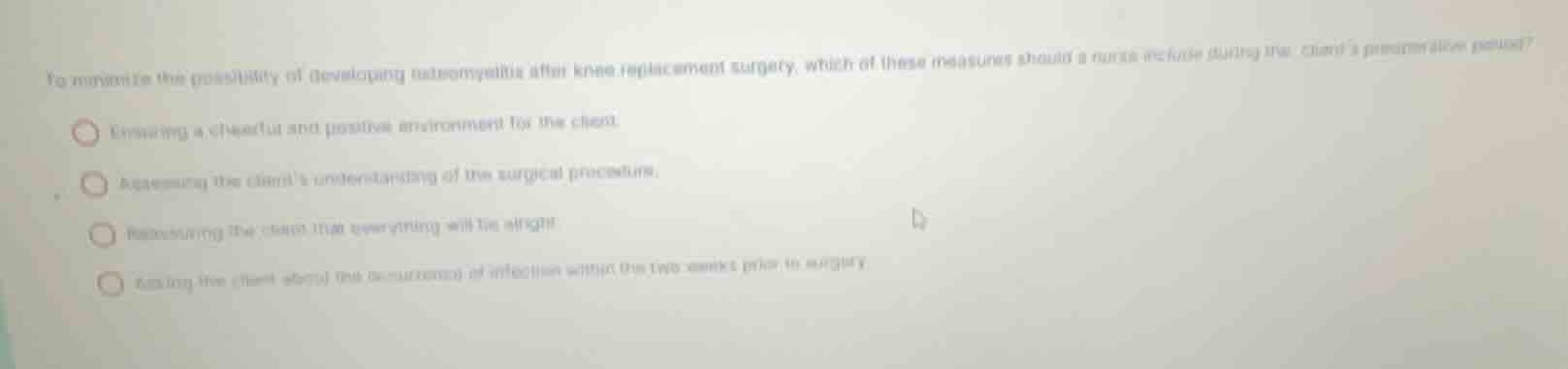
to minimize the possibility of developing osteomyelitis after knee replacement surgery, which of these measures should a nurse include during the clients preoperative period?
ensuring a cheerful and positive environment for the client.
assessing the clients understanding of the surgical procedure.
reassuring the client that everything will be alright.
asking the client about the occurrence of infection within the two weeks prior to surgery.
🆕 New Concept Discovered: Preoperative Infection Screening
Identifying and eliminating active infections before joint replacement surgery.
Step 1: Understand the clinical goal
The question asks for a preoperative nursing measure to minimize the risk of developing osteomyelitis (a severe bone infection) after a knee replacement surgery. Joint replacements involve implanting foreign material (prostheses) into the body. If bacteria are circulating in the bloodstream from a pre-existing infection, they can easily colonize the new joint prosthesis, leading to osteomyelitis.
Step 2: Analyze the options
- Option 1: "Ensuring a cheerful and positive environment for the client."
While promoting a positive environment is good for general patient well-being and anxiety reduction, it does not directly prevent a bacterial bone infection like osteomyelitis.
- Option 2: "Assessing the client's understanding of the surgical procedure."
This is a standard preoperative nursing responsibility to ensure informed consent and patient education, but it does not directly reduce the physiological risk of postoperative osteomyelitis.
- Option 3: "Reassuring the client that everything will be alright."
Providing emotional support and reassurance helps manage anxiety, but it has no physical effect on preventing bacterial contamination of the surgical site.
- Option 4: "Asking the client about the occurrence of infection within the two weeks prior to surgery."
Any active or recent infection (such as a urinary tract infection, skin infection, or dental infection) in the weeks leading up to surgery increases the risk of hematogenous (bloodborne) seeding of the new joint implant. Identifying a recent infection allows the surgical team to delay the procedure and treat the infection first, directly minimizing the risk of postoperative osteomyelitis.
Step 3: Select the correct measure
Screening for recent infections is the most direct and effective preventive measure among the choices provided to avoid introducing bacteria into the surgical site.

Snap & solve any problem in the app
Get step-by-step solutions on Sovi AI
Photo-based solutions with guided steps
Explore more problems and detailed explanations
Asking the client about the occurrence of infection within the two weeks prior to surgery