QUESTION IMAGE
Question
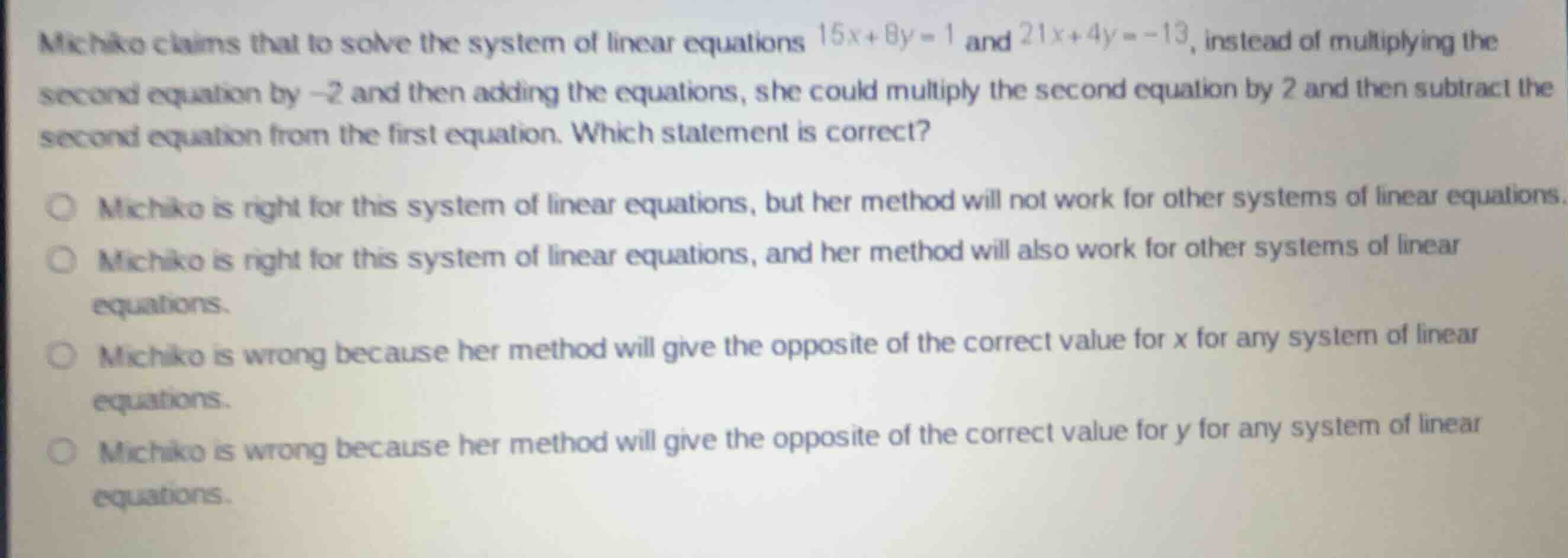
michiko claims that to solve the system of linear equations \\(15x + 8y = 1\\) and \\(21x + 4y = -13\\), instead of multiplying the second equation by \\(-2\\) and then adding the equations, she could multiply the second equation by \\(2\\) and then subtract the second equation from the first equation. which statement is correct?
michiko is right for this system of linear equations, but her method will not work for other systems of linear equations.
michiko is right for this system of linear equations, and her method will also work for other systems of linear equations.
michiko is wrong because her method will give the opposite of the correct value for \\(x\\) for any system of linear equations.
michiko is wrong because her method will give the opposite of the correct value for \\(y\\) for any system of linear equations.
Analyze the standard elimination method
Using the System of Equations and Linear Combination Method knowledge points
Multiplying Equation 2 by \(-2\) yields:
Adding this to Equation 1 eliminates \(y\):
Analyze Michiko's proposed method
Using the Linear Combination Method knowledge point
Multiplying Equation 2 by \(2\) yields:
Subtracting this new equation from Equation 1:
Compare the results of both methods
Using the System of Equations knowledge point
Both methods yield the exact same simplified equation for \(x\), meaning they produce the same correct solution.
Generalize to other systems of equations
Using the Linear Combination Method knowledge point
For any system where we want to eliminate a term \(By\) using a term \(Cy\) where \(B = kC\):
Adding \( -k \times \text{Equation 2} \) to \(\text{Equation 1}\) is algebraically identical to subtracting \( k \times \text{Equation 2} \) from \(\text{Equation 1}\):
Thus, this equivalence holds universally for all systems of linear equations.

Snap & solve any problem in the app
Get step-by-step solutions on Sovi AI
Photo-based solutions with guided steps
Explore more problems and detailed explanations
- (A) Michiko is right for this system of linear equations, but her method will not work for other systems of linear equations.
- (B) Michiko is right for this system of linear equations, and her method will also work for other systems of linear equations. (Correct answer)
- (C) Michiko is wrong because her method will give the opposite of the correct value for x for any system of linear equations.
- (D) Michiko is wrong because her method will give the opposite of the correct value for y for any system of linear equations.