QUESTION IMAGE
Question
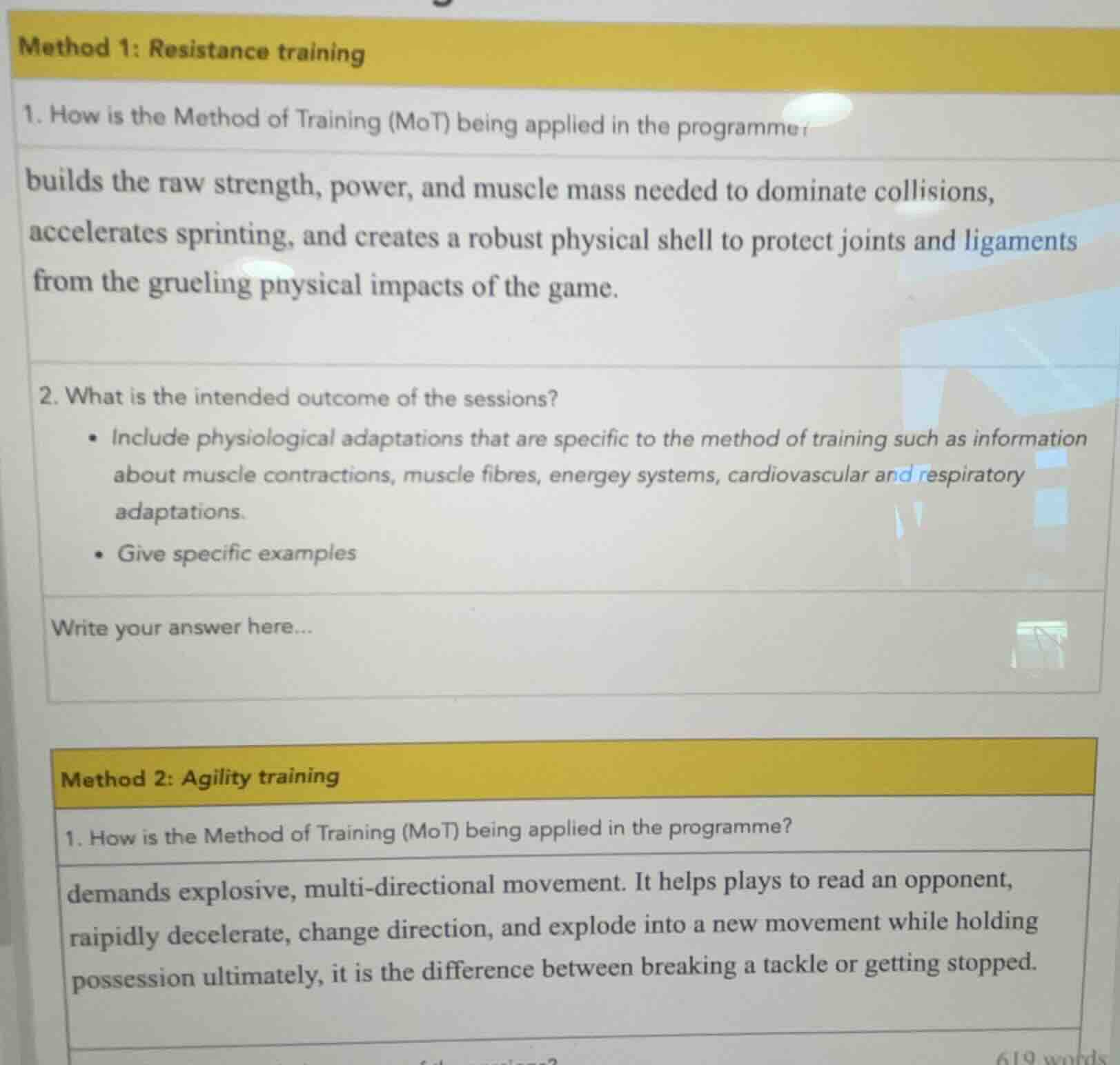
method 1: resistance training
- how is the method of training (mot) being applied in the programme?
builds the raw strength, power, and muscle mass needed to dominate collisions, accelerates sprinting, and creates a robust physical shell to protect joints and ligaments from the grueling physical impacts of the game.
- what is the intended outcome of the sessions?
- include physiological adaptations that are specific to the method of training such as information about muscle contractions, muscle fibres, energy systems, cardiovascular and respiratory adaptations.
- give specific examples
write your answer here...
method 2: agility training
- how is the method of training (mot) being applied in the programme?
demands explosive, multi-directional movement. it helps players to read an opponent, rapidly decelerate, change direction, and explode into a new movement while holding possession ultimately, it is the difference between breaking a tackle or getting stopped.
Analyze resistance training outcomes
The first section asks for the intended outcomes of resistance training. We must identify specific physiological adaptations. These include muscular hypertrophy, increased recruitment of fast-twitch (Type IIa/IIb) muscle fibers, enhanced anaerobic energy systems (ATP-PC and glycolytic pathways), and structural adaptations in connective tissues.
Identify specific muscular adaptations
Resistance training leads to increased myofibrillar protein synthesis. This results in muscle hypertrophy, which increases cross-sectional area and force-generation capacity. It also enhances the recruitment, firing rate, and synchronization of motor units, particularly targeting fast-twitch fibers.
Identify energy and cardiovascular adaptations
Anaerobic enzyme activity increases, improving the efficiency of the ATP-PC and glycolytic pathways. Cardiovascular adaptations include minor left ventricular wall thickening to handle transient pressure increases during heavy lifting, though aerobic capacity changes are minimal compared to endurance training.
Analyze agility training outcomes
The second section focuses on agility training. Agility training demands rapid deceleration, change of direction, and acceleration. The physiological adaptations are highly neuromuscular, focusing on coordination, motor unit recruitment, and reaction time.
Identify neuromuscular and energy adaptations
Agility training enhances neural pathways, improving proprioception, dynamic balance, and the stretch-shortening cycle (SSC) of muscles. It primarily utilizes the ATP-PC energy system for short, explosive bursts of speed and power, requiring rapid phosphocreatine resynthesis during recovery.

Snap & solve any problem in the app
Get step-by-step solutions on Sovi AI
Photo-based solutions with guided steps
Explore more problems and detailed explanations
Question 1: Method 1: Resistance training - Intended outcomes and physiological adaptations
- Muscle Contractions & Fibres:
- Adaptation: Muscular hypertrophy (increase in muscle fiber cross-sectional area) and increased recruitment, synchronization, and firing rate of motor units.
- Specific Example: Hypertrophy of Type IIa and Type IIb (fast-twitch) muscle fibers, which increases maximal force production and explosive power.
- Energy Systems:
- Adaptation: Increased storage of intramuscular ATP, phosphocreatine (PC), and glycogen, alongside elevated activity of anaerobic enzymes (e.g., creatine kinase).
- Specific Example: Enhanced capacity of the ATP-PC system, allowing the athlete to sustain maximal-effort muscle contractions during short, explosive movements like tackling or sprinting.
- Cardiovascular & Respiratory Adaptations:
- Adaptation: Increased thickness of the left ventricular wall (concentric hypertrophy) to withstand high blood pressure during heavy resistance efforts, with minimal changes to aerobic capacity.
- Specific Example: Improved vascular structural integrity and joint/ligament strengthening to protect against high-impact collisions.
Question 2: Method 2: Agility training - Intended outcomes and physiological adaptations
- Neuromuscular Adaptations:
- Adaptation: Enhanced neural pathway efficiency, improved proprioception, faster motor unit recruitment, and optimization of the stretch-shortening cycle (SSC).
- Specific Example: Faster pre-activation of muscles during deceleration, allowing the athlete to rapidly absorb force and transition immediately into an explosive change of direction.
- Muscle Contractions & Fibres:
- Adaptation: Improved rate of force development (RFD) and selective recruitment of fast-twitch muscle fibers for rapid, multi-directional movements.
- Specific Example: Rapid eccentric contractions during deceleration followed immediately by powerful concentric contractions to accelerate away from an opponent.
- Energy Systems:
- Adaptation: Increased efficiency of the ATP-PC system for short-duration, high-intensity bursts of movement, and improved rate of phosphocreatine resynthesis during brief recovery periods.
- Specific Example: Ability to repeatedly perform high-speed directional changes throughout a match without a significant drop in explosive power.