Sovi.AI - AI Math Tutor

Scan to solve math questions

QUESTION IMAGE

men are more likely than women to get alzheimers disease. true false if…

Question

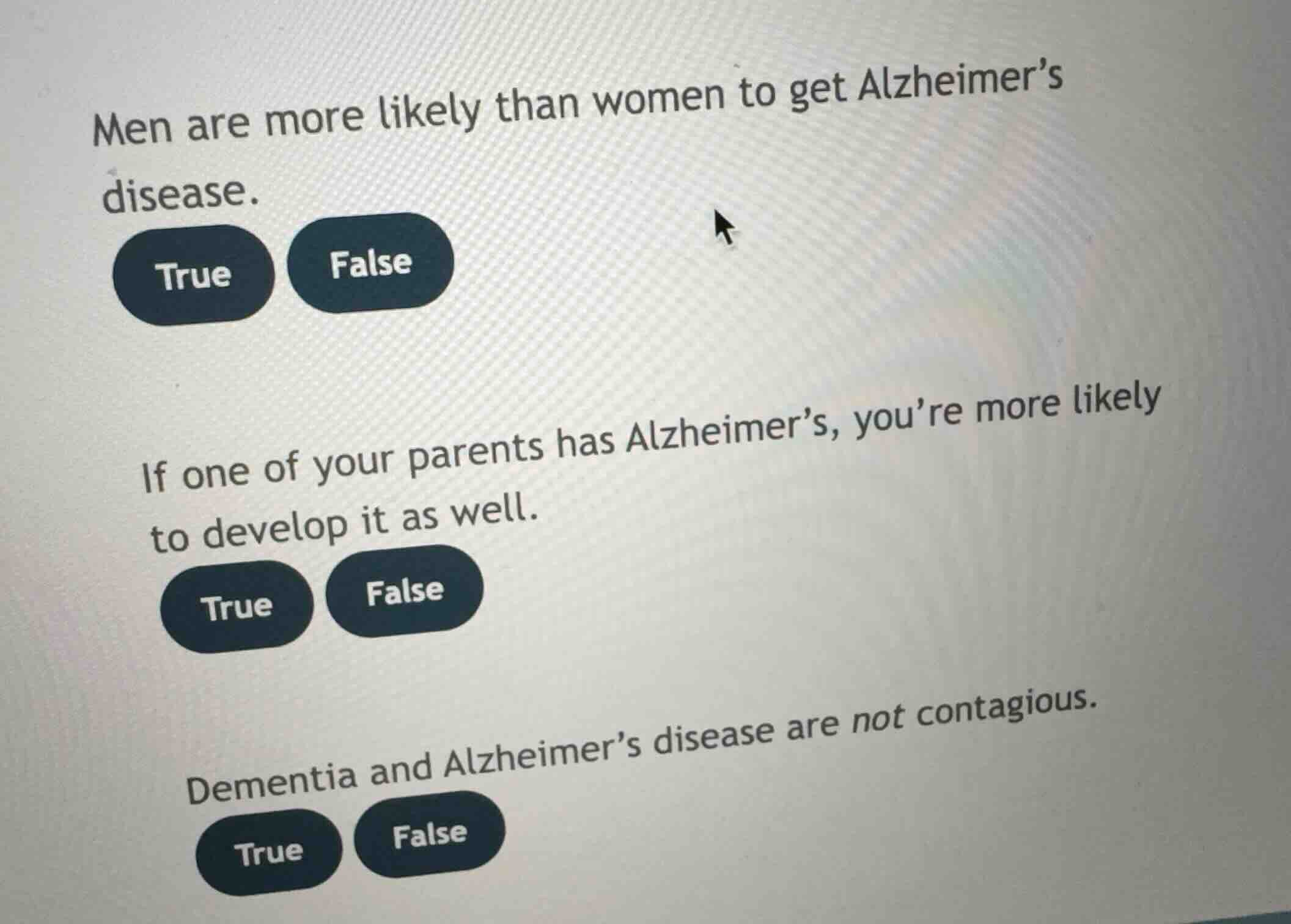
men are more likely than women to get alzheimers disease.
true false

if one of your parents has alzheimers, youre more likely to develop it as well.
true false

dementia and alzheimers disease are not contagious.
true false

Explanation:

Response

<pre_analysis>
{
"quality": "clear",
"question_count": 3,
"skills_matched": [
"direct_cot",
"multiple_choice_formatter",
"explain_then_answer",
"tutor"
],
"needs_drawing": false,
"concepts_used": [],
"new_concepts": [
"Alzheimer's Disease Epidemiology",
"Alzheimer's Risk Factors",
"Dementia Transmission"
],
"current_concepts": [
"Alzheimer's Disease Epidemiology",
"Alzheimer's Risk Factors",
"Dementia Transmission"
]
}
</pre_analysis>

<reasoning>

Analyze gender prevalence in Alzheimer's disease

According to epidemiological data, women are more likely than men to develop Alzheimer's disease. Almost two-thirds of Americans living with Alzheimer's are women. This is partly because women live longer than men on average, and age is the greatest risk factor for Alzheimer's. Therefore, the statement "Men are more likely than women to get Alzheimer's disease" is false.

Analyze genetic risk factors of Alzheimer's disease

Family history is a well-established risk factor for Alzheimer's disease. Having a first-degree relative (such as a parent or sibling) with Alzheimer's significantly increases an individual's likelihood of developing the disease. Therefore, the statement "If one of your parents has Alzheimer's, you're more likely to develop it as well" is true.

Analyze transmissibility of dementia and Alzheimer's disease

Dementia and Alzheimer's disease are progressive neurodegenerative disorders caused by complex genetic, environmental, and lifestyle factors. They are not infectious diseases and cannot be spread from person to person through contact. Therefore, the statement "Dementia and Alzheimer's disease are not contagious" is true.
</reasoning>

<answer>

Question 1

<mcq-option>True</mcq-option>
<mcq-correct>False</mcq-correct>

Question 2

<mcq-correct>True</mcq-correct>
<mcq-option>False</mcq-option>

Question 3

<mcq-correct>True</mcq-correct>
<mcq-option>False</mcq-option>
</answer>

<post_analysis>
{
"subject": "Natural Science",
"question_type": "Multiple Choice",
"knowledge_point": [
"Natural Science",
"Medicine",
"Neurology and Neurodegenerative Diseases"
]
}
</post_analysis>

Answer:

<pre_analysis>
{
"quality": "clear",
"question_count": 3,
"skills_matched": [
"direct_cot",
"multiple_choice_formatter",
"explain_then_answer",
"tutor"
],
"needs_drawing": false,
"concepts_used": [],
"new_concepts": [
"Alzheimer's Disease Epidemiology",
"Alzheimer's Risk Factors",
"Dementia Transmission"
],
"current_concepts": [
"Alzheimer's Disease Epidemiology",
"Alzheimer's Risk Factors",
"Dementia Transmission"
]
}
</pre_analysis>

<reasoning>

Analyze gender prevalence in Alzheimer's disease

According to epidemiological data, women are more likely than men to develop Alzheimer's disease. Almost two-thirds of Americans living with Alzheimer's are women. This is partly because women live longer than men on average, and age is the greatest risk factor for Alzheimer's. Therefore, the statement "Men are more likely than women to get Alzheimer's disease" is false.

Analyze genetic risk factors of Alzheimer's disease

Family history is a well-established risk factor for Alzheimer's disease. Having a first-degree relative (such as a parent or sibling) with Alzheimer's significantly increases an individual's likelihood of developing the disease. Therefore, the statement "If one of your parents has Alzheimer's, you're more likely to develop it as well" is true.

Analyze transmissibility of dementia and Alzheimer's disease

Dementia and Alzheimer's disease are progressive neurodegenerative disorders caused by complex genetic, environmental, and lifestyle factors. They are not infectious diseases and cannot be spread from person to person through contact. Therefore, the statement "Dementia and Alzheimer's disease are not contagious" is true.
</reasoning>

<answer>

Question 1

<mcq-option>True</mcq-option>
<mcq-correct>False</mcq-correct>

Question 2

<mcq-correct>True</mcq-correct>
<mcq-option>False</mcq-option>

Question 3

<mcq-correct>True</mcq-correct>
<mcq-option>False</mcq-option>
</answer>

<post_analysis>
{
"subject": "Natural Science",
"question_type": "Multiple Choice",
"knowledge_point": [
"Natural Science",
"Medicine",
"Neurology and Neurodegenerative Diseases"
]
}
</post_analysis>