QUESTION IMAGE
Question
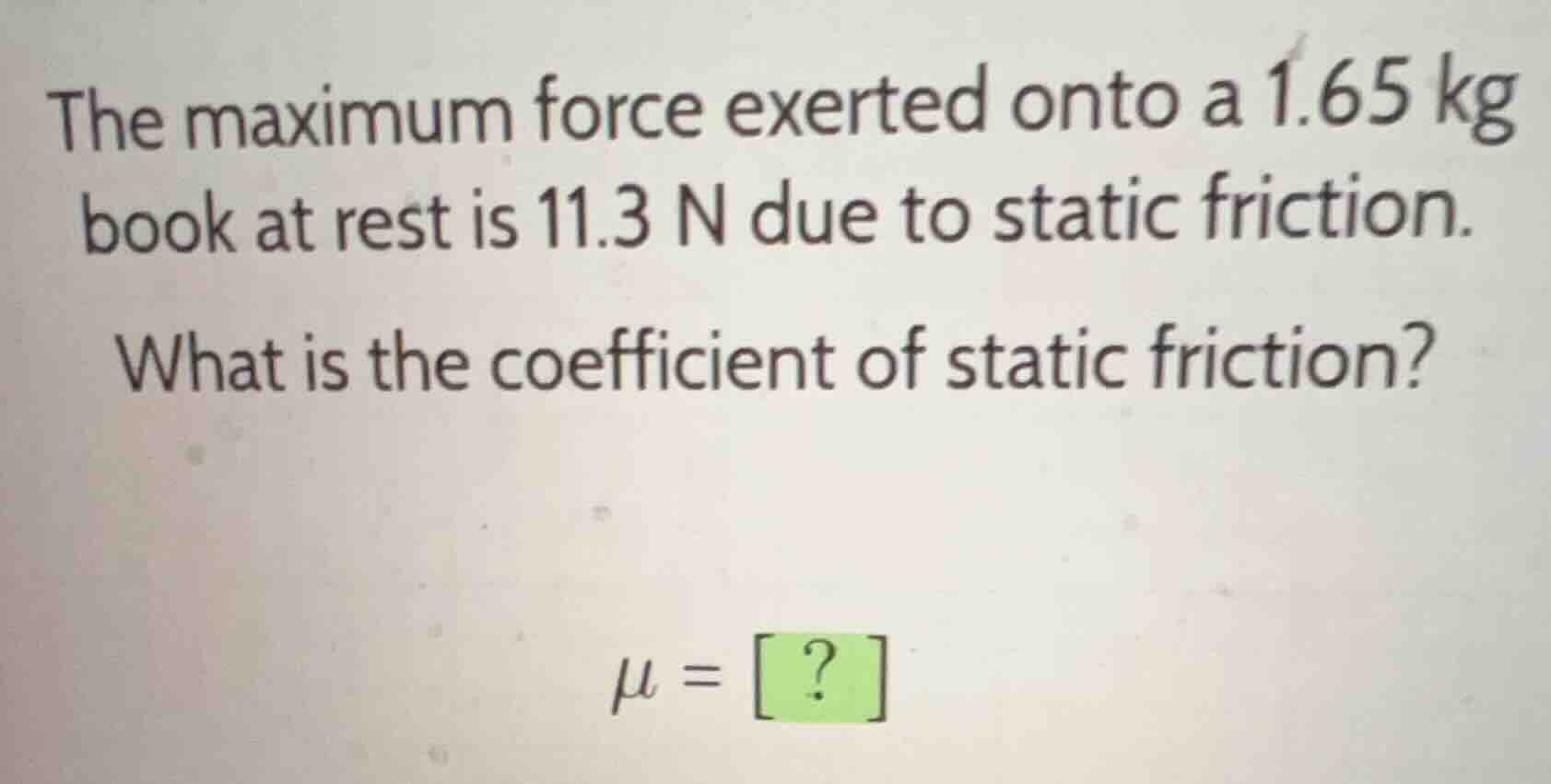
the maximum force exerted onto a 1.65 kg book at rest is 11.3 n due to static friction.
what is the coefficient of static friction?
\mu = ?
🆕 New Concept Discovered: Coefficient of Static Friction
How surfaces grip each other before sliding starts
Step 1: Identify the normal force
The normal force \( F_N \) acting on a flat surface is equal to the weight of the book:
Given:
- Mass \( m = 1.65 \text{ kg} \)
- Acceleration due to gravity \( g \approx 9.8 \text{ m/s}^2 \) (or \( 9.81 \text{ m/s}^2 \))
Step 2: Use the static friction formula
The maximum static friction force \( F_{s,\text{max}} \) is related to the normal force by:
Given:
- Maximum static friction force \( F_{s,\text{max}} = 11.3 \text{ N} \)
Rearrange the formula to solve for the coefficient of static friction \( \mu_s \):
Step 3: Calculate the coefficient
Using \( g = 9.8 \text{ m/s}^2 \), the value is approximately \( 0.70 \).
(If using \( g = 9.81 \text{ m/s}^2 \), \( F_N = 16.1865 \text{ N} \), then \( \mu_s = \frac{11.3}{16.1865} \approx 0.698 \).)
Rounding to three significant figures gives \( 0.700 \) (or \( 0.698 \)).

Snap & solve any problem in the app
Get step-by-step solutions on Sovi AI
Photo-based solutions with guided steps
Explore more problems and detailed explanations
0.70