QUESTION IMAGE
Question
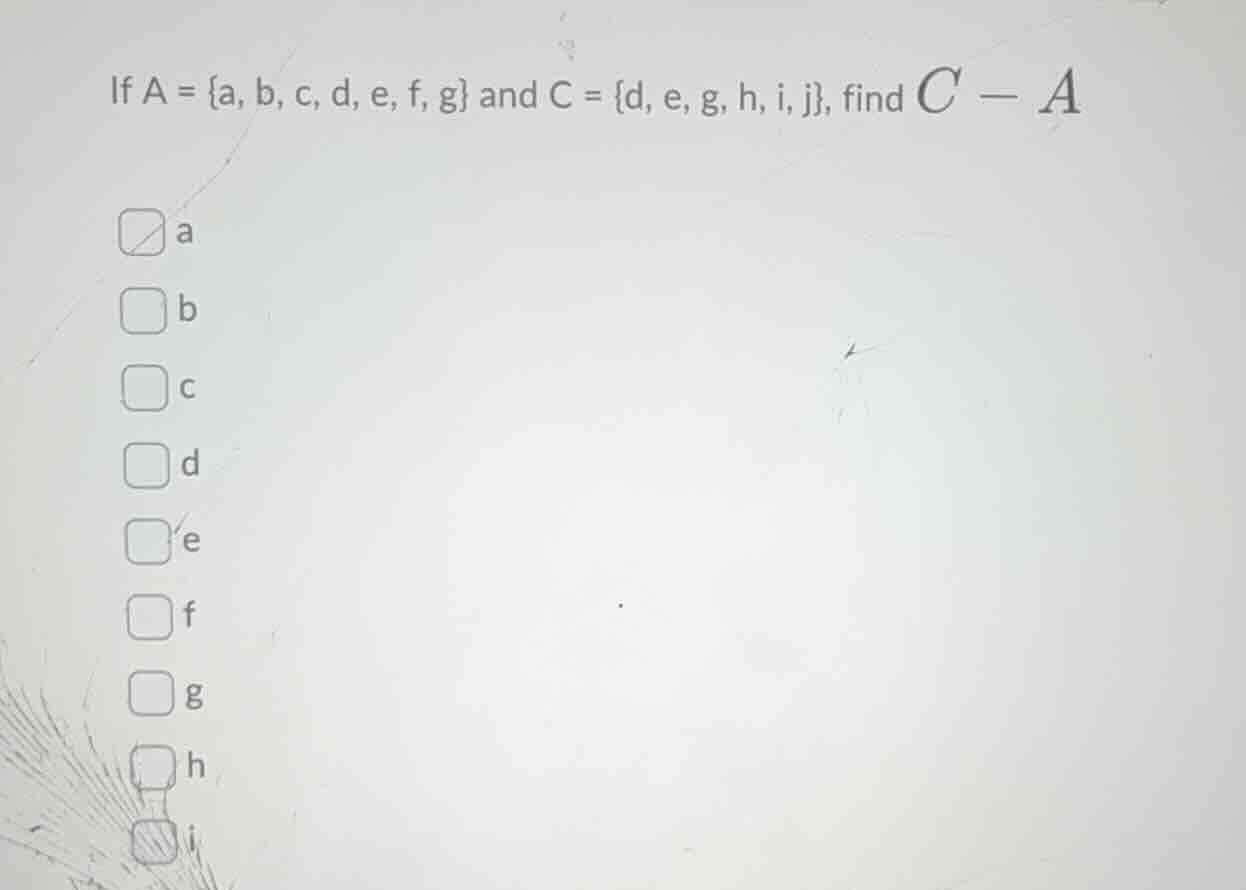
if \\(a = \\{a, b, c, d, e, f, g\\}\\) and \\(c = \\{d, e, g, h, i, j\\}\\), find \\(c - a\\)
a
b
c
d
e
f
g
h
i
🆕 New Concept Discovered: Set Difference
Elements in one set but not the other
Step 1: Identify the elements of each set
We are given two sets:
$$ A = \{a, b, c, d, e, f, g\} $$
$$ C = \{d, e, g, h, i, j\} $$
Step 2: Apply the definition of set difference
The set difference \( C - A \) (also written as \( C \setminus A \)) represents the set of all elements that belong to set \( C \) but do not belong to set \( A \).
To find this, we start with the elements of \( C \) and remove any elements that are also found in \( A \):
- \( d \) is in \( A \) (remove)
- \( e \) is in \( A \) (remove)
- \( g \) is in \( A \) (remove)
- \( h \) is not in \( A \) (keep)
- \( i \) is not in \( A \) (keep)
- \( j \) is not in \( A \) (keep)
Step 3: Write the resulting set
Subtracting the common elements \( \{d, e, g\} \) from \( C \):
$$ C - A = \{h, i, j\} $$

Snap & solve any problem in the app
Get step-by-step solutions on Sovi AI
Photo-based solutions with guided steps
Explore more problems and detailed explanations
$$ \{h, i, j\} $$